How to Build a Stablecoin Payout API Platform
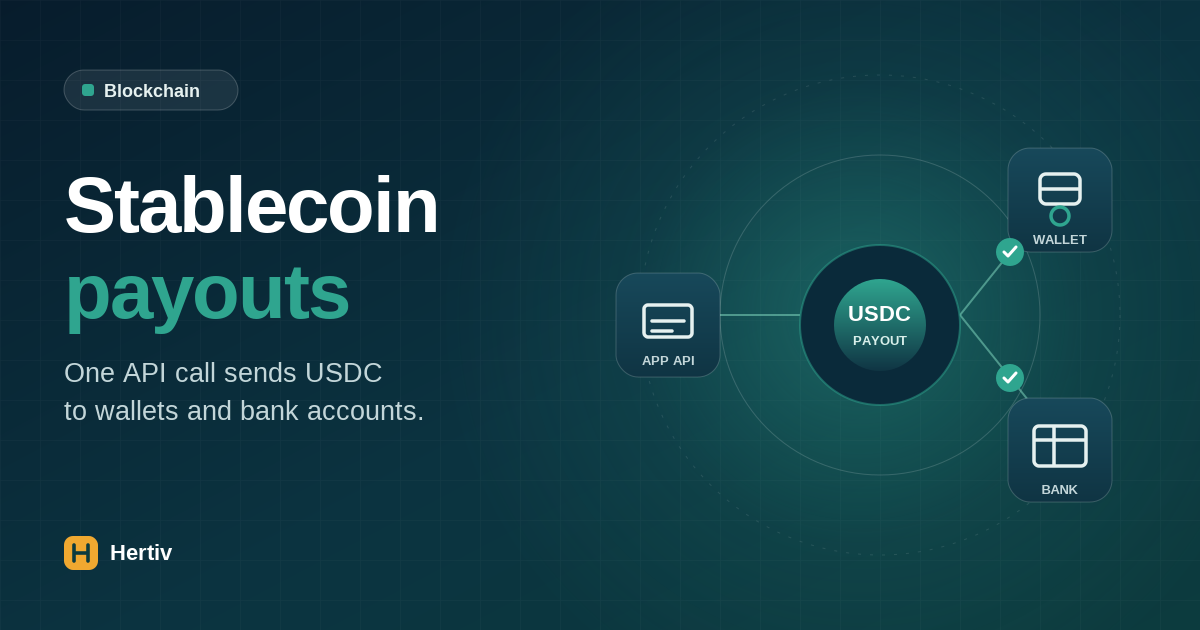
A stablecoin payout API platform lets apps send USDC or USDT to wallets and bank accounts through one integration. Here is how the pieces fit.
On this page
Short answer
A stablecoin payout API platform is a service that lets other apps send stablecoin payouts to recipients through API calls, handling wallets, conversion, compliance checks and settlement behind one interface. You build it by combining a stablecoin treasury, an on-ramp and off-ramp network, a recipient address book, and screening and reporting, then exposing all of it as documented endpoints.
What is a stablecoin payout API platform?
A stablecoin payout API platform is a service that lets other applications send stablecoin payments to third parties through API calls, instead of building the blockchain, banking and compliance plumbing themselves. A marketplace, payroll app or creator platform calls one endpoint, and the platform moves value to the recipient's wallet or bank account.
The platform sits between the sender's funds and the recipient. It holds or sources stablecoins such as USDC or USDT, converts them when the recipient wants local currency, checks the recipient against sanctions lists, and records every step for audit. The customer sees a simple API; the platform carries the complexity.
It differs from a remittance app, which serves consumers sending money home. A payout API serves businesses that pay many people at once: marketplaces paying sellers, payroll tools paying contractors, and apps paying creators. Volume and automation matter more than a consumer interface.
How does a payout move from API call to recipient?
A payout starts when the customer's app calls the API with a recipient, an amount and a currency. The platform checks the recipient is registered and screened, locks the funds, then routes the payment through the cheapest path that meets the delivery promise.
| Step | What happens | Typical timing |
|---|---|---|
| Recipient check | Address book lookup, sanctions and identity screening | Seconds |
| Funding | Stablecoins reserved from the customer's balance | Seconds |
| Onchain transfer | USDC or USDT sent to the recipient wallet or a partner | Minutes |
| Off-ramp | Partner converts to local currency and pays the bank rail | Minutes to hours |
| Confirmation | Webhook or status call tells the customer it landed | With settlement |
Two paths exist. A wallet payout sends stablecoins onchain to an address the recipient controls. A bank payout hands the stablecoins to a local partner who converts them and pays the recipient's bank account on a local rail such as SEPA, Pix or SPEI. Most platforms support both and let the customer choose per payout.
Which stablecoins and chains should you support?
Start with the two stablecoins recipients actually hold: USDC and USDT. USDC is the default for regulated business payouts because its issuer publishes reserves and supports many chains. USDT has the widest reach in markets where recipients prefer it. Supporting both covers most demand without doubling the work.
| Chain | Why include it | Watch out for |
|---|---|---|
| Ethereum | Widest wallet and exchange support | Higher fees on small payouts |
| Solana | Fast, low-cost transfers | Different address format and tooling |
| Base | Low fees, growing app ecosystem | Newer liquidity in some corridors |
| Polygon | Low fees, broad wallet support | Bridge and finality behaviour |
| Stellar | Built for payments and anchors | Smaller developer ecosystem |
Do not launch on every chain at once. Pick two or three chains that match your first customers' recipients, and add more when a corridor justifies it. Each chain adds monitoring, key management and reconciliation work, so breadth has a real cost.
What does the build involve, step by step?
Building a payout API platform means building five layers in order: accounts and API, the payout engine, treasury and liquidity, compliance, and operations tooling. Each layer depends on the one before it, so the sequence matters.
- Accounts and API keys. Customer onboarding, API keys with scoped permissions, and sandbox keys so customers can test without moving real funds.
- Recipient address book. Register recipients with a wallet address, chain and identity details, plus a hold period for new recipients before the first payout.
- Payout engine. Idempotent payout creation, status tracking, retries and webhooks, so a customer can safely retry a failed call.
- Treasury and liquidity. Funded balances per stablecoin, conversion quotes, and off-ramp partners per corridor, with limits that stop payouts when a balance runs low.
- Compliance. Sanctions screening, identity checks, transaction monitoring and record keeping, built into the payout flow rather than added after.
- Operations console. A dashboard for support staff to see payout state, investigate failures and pause a corridor when a partner has an outage.
- Testing and launch. End-to-end tests on testnets and small live amounts, then a limited launch with one corridor and one customer before expanding.
Many teams buy the off-ramp and compliance layers from specialist providers and build only the API, address book and payout engine themselves. That is a sensible split: the parts that touch bank rails and licences are the hardest to build from scratch. For the blockchain side, blockchain development covers wallet and contract integration patterns.
Example: a marketplace paying 200 creators
Example (hypothetical): a marketplace pays 200 creators every Friday, half in the US and half in Latin America. It integrates a payout API, registers each creator once with a wallet address or bank details, and funds a USDC balance each week.
The arithmetic: the marketplace pays out $60,000 a week in total. It holds a $5,000 buffer in USDC, so it funds $65,000 each week. At a 0.5% payout fee the weekly cost is $300, plus network fees of about $0.10 per onchain transfer, or $20 for 200 payouts.
Bank payouts go through local partners, so a creator in Brazil receives reais on Pix the same day, while a creator in the US receives USDC in a wallet within minutes. The marketplace's own code makes one API call per payout and listens for webhooks, instead of managing wallets, chains and bank partners itself.
The gain is operational. Before the API, the marketplace team spent a day a week on manual payouts and reconciliation. After it, the same work is a scheduled job with a dashboard, and failed payouts are visible in one place with a reason code.
What compliance and licensing must you plan for?
Compliance is the largest part of a payout platform, and it shapes the architecture. You need to know who your recipients are, screen them against sanctions lists, watch for unusual patterns, and keep records that an auditor or regulator can follow.
- Recipient identity. Collect enough identity detail to satisfy the rules in each corridor, and store it securely with clear retention limits.
- Sanctions and watchlists. Screen recipients and wallet addresses before every payout, not only at registration, because lists change.
- Travel Rule. In many regions, transfers above a threshold must carry sender and recipient information, so the API must collect and pass it on.
- Licences or partners. Most teams operate through licensed partners or obtain money transmitter licences, because moving other people's money is a regulated activity.
- Record keeping. Keep a complete, tamper-evident log of every payout, screening result and status change for the period your jurisdictions require.
Talk to a lawyer before writing the compliance layer, not after. The rules differ by corridor, and a design choice such as which entity books the payout can change which rules apply. That review is cheaper than rebuilding the payout engine later.
What are the common mistakes?
The most common mistakes in payout platforms are skipping idempotency, trusting a single corridor, and treating compliance as a checkbox.
- No idempotency keys. Without them, a retried API call can pay the same recipient twice. Every payout creation must accept and honour an idempotency key.
- One corridor, one partner. When that partner has an outage, all payouts stop. Keep a fallback route for your largest corridors.
- Ignoring failed payouts. Failures need reason codes, retries with limits, and a clear path for support to fix or refund them.
- Weak key management. Hot wallets that sign payouts need strict limits, rotation and monitoring; a compromised key can drain the treasury.
- No reconciliation. Onchain transfers, partner settlements and customer balances must reconcile daily, or small gaps become large ones.
- Compliance after launch. Screening and record keeping are far harder to bolt on than to build into the payout flow from the start.
Key takeaways
- A payout API platform moves stablecoins to wallets and bank accounts through one integration
- Support USDC and USDT on two or three chains first, then expand by corridor
- Idempotent payout creation, webhooks and a recipient address book are the core of the engine
- Compliance, screening and record keeping belong in the payout flow from the start
- Buy off-ramp and compliance layers from specialists; build the API and payout engine yourself
- Keep a fallback route and daily reconciliation for every corridor you operate
Frequently asked questions
What is the difference between a payout API and a remittance app?
A remittance app serves consumers sending money to family. A payout API serves businesses that pay many recipients at once, such as marketplaces paying sellers or payroll tools paying contractors, and it is built for volume, automation and integration into other software.
Which stablecoin should a payout platform start with?
Start with USDC and USDT. USDC is the usual default for regulated business payouts, while USDT has the widest reach in markets where recipients already hold it. Together they cover most recipient demand without the cost of supporting many stablecoins.
Do recipients need a crypto wallet to be paid?
Only for wallet payouts. Bank payouts send local currency to a bank account through an off-ramp partner, so the recipient never touches crypto. Most platforms offer both and let the customer choose per payout.
How long does a stablecoin payout take?
A wallet payout usually settles in minutes once the transaction confirms onchain. A bank payout depends on the local rail: instant rails such as Pix or SEPA Instant settle in minutes, while other rails can take hours. The platform should report status at each step.
What licences does a payout platform need?
It depends on the corridors. Moving other people's money is regulated in most regions, so teams usually operate through licensed partners or obtain money transmitter licences. Get legal advice before launch, because the booking entity and corridors change the requirements.
What happens when a payout fails?
The platform should return a reason code, retry only when safe, and surface the failure in the operations console. Failed payouts are either fixed and retried or refunded to the customer's balance, with a full log of every attempt for support and audit.


