How to Build a Solana DEX, Step by Step
A Solana DEX swaps tokens on-chain from user wallets, with fast settlement and low fees. Here is the stack, the build steps and the liquidity plan.
On this page
Short answer
A Solana DEX is a decentralised exchange built as on-chain programs on Solana that lets users swap tokens from their own wallets without a central company holding funds. Most new builds start as an automated market maker written in Rust with the Anchor framework, then add aggregator routing so traders can find their pools.
What is a Solana DEX?
A Solana DEX is a decentralised exchange that runs as on-chain programs on Solana, letting users swap tokens from their own wallets without a central company holding funds or matching orders. Trades settle on-chain, and the exchange never takes custody of user assets.
Solana confirms blocks in about 400 milliseconds and charges a fraction of a cent per transaction, so swaps feel instant and cheap compared with exchanges on slower chains. That speed shapes the whole design: the DEX can price every trade on-chain instead of batching orders off-chain.
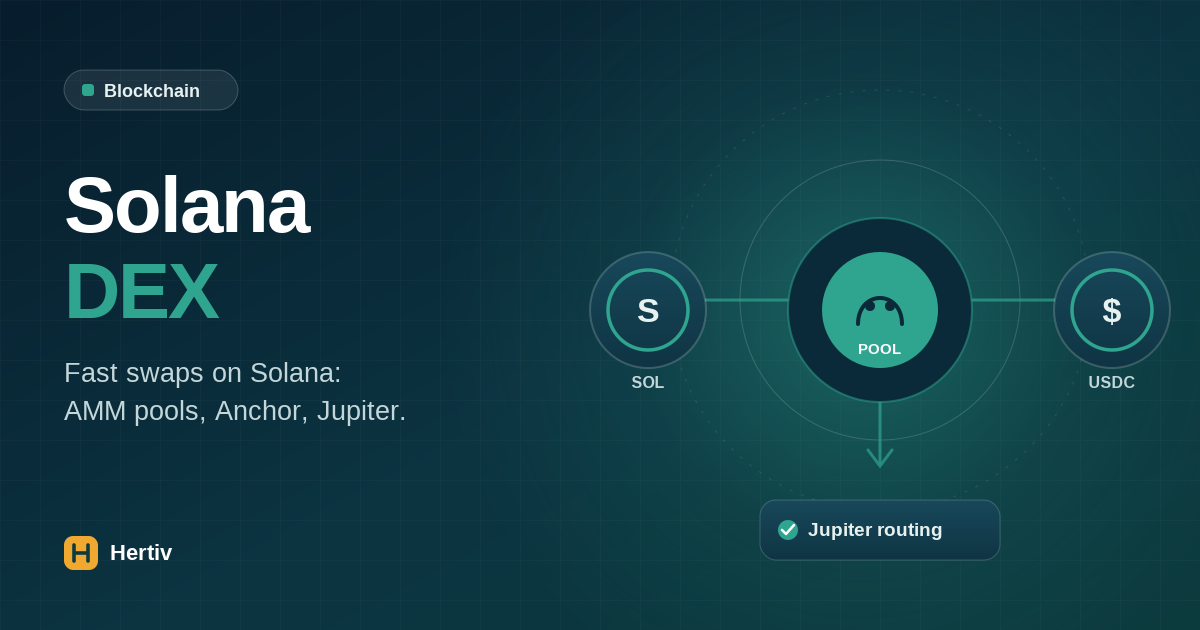
Most Solana DEXs are automated market makers. Users trade against a pool of two tokens, and the ratio of the tokens in the pool sets the price. A smaller group uses an on-chain order book, where makers post limit orders and takers fill them. This guide covers the AMM route first, because it is the fastest way to launch, then shows where an order book fits.
Which trading model fits your DEX?
The model you pick decides your timeline, your liquidity needs and who your first users are. An AMM suits a new team; an order book suits a team targeting active traders. For the wider exchange picture, crypto exchange development covers custody, compliance and listing decisions.
| Model | How price is set | Best for | Main drawback |
|---|---|---|---|
| AMM | Ratio of tokens in a pool | Simple swaps, thin starting liquidity | Slippage on large trades |
| Order book | Posted limit orders | Active traders, limit orders | Needs deep liquidity to work |
| Concentrated AMM | Pool ratio within a price range | Capital-efficient pools | Harder for liquidity providers |
| Aggregator routing | Best price across DEXs | Finding volume, not holding it | You earn no pool fees |
Most new builds start with a plain AMM and add order book depth later, once they have volume. An aggregator-only product is a different business: it routes trades across existing DEXs such as Raydium and Orca, and it needs no pools of its own. For a first launch, pick the model that matches the liquidity you can actually attract in the first month.
What does the Solana DEX stack look like?
The stack has six parts: on-chain programs, tokens, pools, price data, off-chain services and the frontend. Each part has a standard tool on Solana, so you rarely need to build from scratch.
| Part | Standard choice | What it does |
|---|---|---|
| Programs | Rust with Anchor | Swap, pool and fee logic on-chain |
| Tokens | SPL token program | Minting, transfers, pool tokens |
| Pools | Constant product AMM | Holds token pairs, prices swaps |
| Price data | Jupiter quote API | Best route and expected price |
| Off-chain | RPC node, indexer | Reads chain state, serves history |
| Frontend | Wallet adapter, web app | Connects wallets, signs swaps |
Anchor is the framework most Solana teams use because it handles account checks and serialisation that are easy to get wrong in raw Rust. A dedicated RPC endpoint is not optional at launch: public endpoints throttle under trading volume, and a slow quote is a failed swap. For teams that want the generic version of this build first, how to build a DEX covers the chain-agnostic decisions.
How do you build a Solana DEX, step by step?
Building a Solana DEX follows eight steps, from choosing the model to launching with seeded liquidity. Rushing the audit step is the most common way a launch goes wrong.
- Pick the model and the pairs. Choose AMM or order book, then pick two or three pairs with real demand, such as SOL and a stablecoin.
- Set up the toolchain. Install the Solana CLI, the Anchor framework and a local validator, then create a test wallet funded on devnet.
- Write the programs. Build the swap, pool creation and fee programs in Rust with Anchor, keeping each instruction small and checkable.
- Build the pool logic. Implement the constant product formula, LP token minting and burning, and fee collection in the program.
- Wire up price data. Use the Jupiter quote API so the frontend shows the best route and the expected output before a user signs.
- Build the frontend. Add wallet connection, swap quotes, slippage settings and pool management, with clear errors when a swap fails.
- Test and audit. Run the Anchor test suite on devnet, then pay for an independent audit and fix every finding before mainnet.
- Seed and launch. Deposit initial liquidity, open the pools, list them with Jupiter routing and watch the first trades closely.
Most of the work sits in steps three and seven. The swap math is small, but the account handling around it is where bugs hide, and an audit is the only reliable way to catch them. If the build is part of a wider exchange plan, DEX development covers the product and compliance side.
How do you get liquidity and volume?
Liquidity is the product. A DEX with thin pools gives bad prices, and bad prices drive traders away, so the launch plan matters as much as the code. Solana's fast settlement helps, but only if pools are deep; see Solana development for the platform basics.
Start by seeding your own pools with enough of each token that a normal trade moves the price by less than one percent. Then make the pools visible to aggregators: Jupiter routes a large share of Solana retail volume, and a pool it cannot see may as well not exist. Format your program instructions cleanly so routers can index them.
After launch, three levers bring volume: fee sharing with liquidity providers, incentives for the first pools, and listings of tokens traders already want. Market makers can help with depth, but only after the pools work and the audit is done. Never promise returns to liquidity providers; the fee share is the incentive, and the risk is theirs to judge.
Example (hypothetical): a small AMM pool
Example (hypothetical): a new DEX opens a SOL and USDC pool holding 100 SOL and 10,000 USDC, so the price is $100 per SOL and the constant product is 100 times 10,000, or 1,000,000.
A trader swaps 1,000 USDC for SOL. The pool now holds 11,000 USDC, so it must hold 1,000,000 divided by 11,000, or 90.91 SOL. The trader receives 100 minus 90.91, or 9.09 SOL, at an effective price of about $110 per SOL.
The gap between $100 and $110 is slippage, and it grows as the trade grows relative to the pool. That is why pool size is the first thing to fix when traders complain about prices: doubling the pool halves the slippage on the same trade.
What are the common mistakes?
The most common Solana DEX mistakes are skipping the audit, launching with thin pools, and trusting a single price source.
- Skipping the audit. An unaudited swap program is a standing invitation to lose pooled funds.
- Thin launch pools. Small pools mean heavy slippage, and traders leave after one bad swap.
- No aggregator visibility. If Jupiter cannot route to your pools, retail volume never arrives.
- Public RPC at launch. Throttled quotes turn into failed swaps on the first busy day.
- Ignoring the order book option. Some pairs, such as stablecoin pairs, suit an order book better than an AMM.
Key takeaways
- A Solana DEX is an on-chain AMM or order book that swaps tokens without taking custody
- Start with an AMM in Rust and Anchor; add order book depth only once you have volume
- Jupiter routing is how most retail traders find your pools, so make them visible to it
- A dedicated RPC endpoint is required at launch, since public endpoints throttle
- Pool size decides slippage, so seed pools deep enough for normal trades
- Audit before mainnet; swap math is small, but account handling is where bugs hide
Frequently asked questions
What is a Solana DEX?
A Solana DEX is a decentralised exchange that runs as programs on Solana and lets users swap tokens from their own wallets. Trades settle on-chain in about 400 milliseconds, and the exchange never holds user funds. Most Solana DEXs are automated market makers that price trades from token pools.
Is an AMM or an order book better on Solana?
An AMM is better for a first launch because it works with thin liquidity and is simpler to build. An order book suits active traders who want limit orders and visible depth, but it needs deep liquidity to function. Most new teams start with an AMM and add order book features later.
Do I need Jupiter to launch a Solana DEX?
No, but Jupiter routes a large share of Solana retail trading volume, so a pool it cannot see gets little traffic. Making your pools visible to aggregators is one of the highest-value steps at launch, alongside seeding deep liquidity and passing an audit.
What language is a Solana DEX written in?
On-chain programs are written in Rust, usually with the Anchor framework, which handles account checks and serialisation. The frontend is typically a web app using the Solana wallet adapter and a library such as Solana Web3.js to build and send transactions.
How much liquidity does a new Solana DEX need?
Enough that a normal trade moves the price by less than one percent. For a SOL and USDC pool, that usually means tens of thousands of dollars per side at launch. Thin pools cause heavy slippage, which drives traders away after their first swap.
Does a Solana DEX need a licence?
It depends on where you operate and what you list. Some teams geoblock restricted regions, avoid listing securities, and take legal advice before launch. The rules differ by jurisdiction, so treat compliance as a launch requirement rather than an afterthought.


