How to Build a Security Token Exchange Platform
A security token exchange lets regulated investors trade tokenised shares, funds and bonds. Here is what the platform needs, which rules apply and how to build it.
On this page
Short answer
A security token exchange is a regulated trading venue where tokenised securities, such as shares, bonds and fund units, are bought and sold on a blockchain. Building one means combining a matching engine, wallets, custody, settlement and compliance checks for investor eligibility, with a licence from the regulator in each market where the exchange operates.
What is a security token exchange?
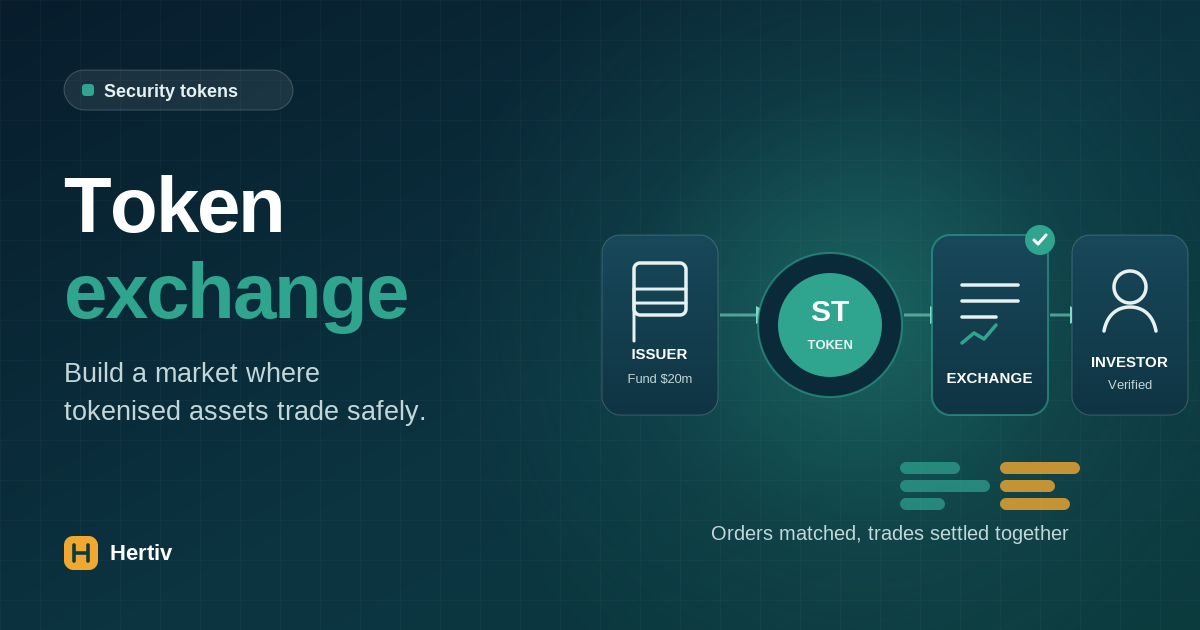
A security token exchange is a trading venue where security tokens change hands. A security token is a digital token on a blockchain that represents a regulated security, such as a share, a bond or a unit in a fund. The exchange matches buyers and sellers, checks that both sides are allowed to trade, and settles the trade by moving the token and the payment.
It differs from a crypto exchange in one key way: the asset is a security, so securities law applies. That means the venue must check who can buy, keep records for the regulator, and restrict trading to eligible investors where the rules require it. A crypto exchange that lists unregulated tokens does not carry those duties.
It also differs from a tokenisation platform. A tokenisation platform issues the token; an exchange lists it and gives holders a way to sell. Some companies do both, but the two jobs have different licences, different technology and different risks, so most teams build one first. For the issuing side, how to launch a security token covers the steps before a token ever reaches an exchange.
Which parts does the platform need?
A security token exchange needs six parts working together: a matching engine, wallets, custody, settlement, compliance checks and a market data feed. If any one of them is weak, the exchange cannot trade safely, and the regulator will not approve it.
| Part | What it does | Why it matters |
|---|---|---|
| Matching engine | Pairs buy and sell orders | Fair, fast and auditable fills |
| Wallets | Holds tokens for each account | Correct ownership after every trade |
| Custody | Safeguards assets and keys | Investor funds are protected |
| Settlement | Moves token and payment together | No trade settles one-sided |
| Compliance checks | Identity, eligibility, limits | Only allowed investors trade |
| Market data | Prices, depth, history | Traders can see a fair market |
The token standard matters too. Security tokens commonly use standards that carry transfer rules in the token itself, such as ERC-1400 or ERC-3643, so a token cannot move to an ineligible holder even if the exchange makes an error. Building on a standard with built-in transfer controls saves a whole layer of custom checks, and it is what auditors expect to see.
How do trading and settlement work?
Trading on a security token exchange follows a fixed sequence, and each step has a compliance check built in. The sequence is slower than a crypto exchange, because the checks are the point: the exchange must prove, trade by trade, that both sides were eligible and the price was fair.
- Onboarding. The investor completes identity checks and proves eligibility, such as accredited status where required, before any order is accepted.
- Deposit. Tokens and payment funds move into the exchange's wallets and custody, and the balances are shown in the account.
- Order. The investor places a buy or sell order, and the matching engine pairs it with the best available order on the other side.
- Eligibility check. Before the trade completes, the system checks the token's transfer rules against both accounts, including lock-ups and holding limits.
- Execution. The match is recorded with price, size and time, and both sides see the fill at once.
- Settlement. The token moves to the buyer and the payment moves to the seller, ideally at the same time, so neither side is exposed.
- Reporting. The trade is logged for the regulator, the transfer agent and the issuer, with a full audit trail.
Settlement is where blockchain helps most. On a traditional exchange, settlement takes a day or more and needs a chain of intermediaries. On a token exchange, the token and the payment can move together in one step, which cuts settlement risk and the capital the exchange must hold. That is the main technical advantage, and it is the reason issuers accept the extra compliance work.
What licences and rules apply?
Licences decide where an exchange can operate, and they vary by market, so the legal plan comes before the build. In the United States, a venue that matches orders in securities generally needs to register as an exchange or operate as an alternative trading system with a registered broker-dealer.
In the European Union, a multilateral trading facility licence covers the same ground. Other markets have their own regimes, and some have none at all, which usually means the exchange cannot serve investors there.
| Market | Usual route | What to expect |
|---|---|---|
| United States | ATS with broker-dealer | Long approval, strict reporting |
| European Union | MTF licence | MiFID rules, passporting possible |
| Singapore | Recognised market operator | Clear framework, sandbox option |
| United Kingdom | FCA authorisation | Case by case, sandbox available |
Two rules apply almost everywhere. First, only eligible investors may trade certain tokens, so the exchange must check identity and status before every trade. Second, the exchange must keep records and report trades to the regulator.
Teams that treat licensing as a late step usually find the build is finished but the venue cannot open, so hire the legal adviser first and let the licence shape the design. Crypto exchange development covers the engineering side, but the legal route is what decides the timeline.
How do you build it in stages?
Build a security token exchange in stages, with the licence and the compliance checks first, because those decide what the technology must do. A team that builds the trading engine first and adds compliance later usually rebuilds the engine.
- Choose the market and licence. Pick one market, talk to the regulator or a legal adviser, and map the licence route before writing code.
- Define the token rules. Choose the token standard and write the transfer rules: who can hold, lock-up periods and holding limits.
- Build compliance first. Identity checks, eligibility checks and the audit trail come before the matching engine.
- Add trading and custody. Build the matching engine, wallets and custody, with settlement that moves token and payment together.
- Test with one token. List a single token, trade it with a small group of known investors, and fix what breaks.
- Open to the market. Add more tokens and investors only after the regulator is satisfied and the audit trail is complete.
Budget for the licence work as a real cost, not an afterthought: legal fees, compliance staff and the capital the regulator requires can match the engineering budget. Teams that plan for that from the start open on time; teams that discover it late stall for months.
Example (hypothetical): listing a tokenised fund
Example (hypothetical): a fund manager tokenises a $20,000,000 property fund into 200,000 tokens at $100 each, and lists them on a new exchange. In the first month, 4,000 tokens change hands in 80 trades, and the exchange charges a 0.5% fee on each side.
The arithmetic: 4,000 tokens at $100 each is $400,000 of trading volume. A 0.5% fee on each side is $2,000 from buyers and $2,000 from sellers, or $4,000 in the month. Over a year at the same pace, that is $48,000 in fees from one token. The exchange also earns listing and custody fees, but trading fees alone do not cover the licence and running costs until several tokens trade at this pace.
That is the honest economics of a new venue: one token does not pay for an exchange. The business works when several issuers list, because the licence, the engine and the compliance checks are fixed costs, while each new token adds volume at a small marginal cost. Plan the launch around a pipeline of issuers, not a single listing.
What are the common mistakes?
The most common mistakes are treating licensing as a late step, building the engine before the compliance checks, and launching with one token and no pipeline.
- Licence last. If the venue cannot open legally, the engineering work is worthless. Start with the legal route.
- Compliance as an add-on. Eligibility checks and the audit trail belong in the core design, not in a later patch.
- Ignoring transfer rules. Tokens that can move to ineligible holders create liability for the exchange and the issuer.
- One token, no pipeline. A single listing does not cover the fixed costs; line up several issuers before launch.
- Weak custody. Investor funds need proper custody and key management, not a hot wallet and good intentions.
A security token exchange is a regulated business with a trading engine attached, not the other way round. Teams that respect that order, and that check the token market first, open on time. For a view of the tokens already trading, security token platforms for startups compares the venues and tools issuers use today.
Smart contract audit covers the review step every token contract needs before listing.
Key takeaways
- A security token exchange is a regulated venue for tokenised shares, bonds and funds
- It needs a matching engine, wallets, custody, settlement, compliance and market data
- Transfer rules in the token itself stop ineligible holders from receiving tokens
- The licence route comes before the build and decides the timeline
- Settlement can move token and payment together, cutting settlement risk
- One token does not pay for an exchange; plan a pipeline of issuers
Frequently asked questions
What is a security token exchange?
A security token exchange is a regulated trading venue where tokenised securities such as shares, bonds and fund units are bought and sold. It matches orders, checks that both sides are eligible to trade, and settles by moving the token and the payment, with records kept for the regulator.
How is it different from a crypto exchange?
A crypto exchange lists unregulated tokens, while a security token exchange lists securities, so securities law applies. The exchange must check investor eligibility, keep records for the regulator and restrict trading where the rules require it, which a crypto exchange does not have to do.
Which licence does a security token exchange need?
It depends on the market. In the United States the usual route is an alternative trading system run with a registered broker-dealer, and in the European Union it is a multilateral trading facility licence. Talk to a legal adviser before building, because the licence shapes the design.
What token standards do security token exchanges use?
Security tokens commonly use standards that carry transfer rules in the token itself, such as ERC-1400 or ERC-3643. Those rules can block a transfer to an ineligible holder, which is what auditors and regulators expect to see in place.
How does settlement work on a security token exchange?
Settlement moves the token to the buyer and the payment to the seller, ideally at the same time, so neither side is exposed. On a blockchain this can happen in one step, which cuts the settlement risk and the capital the exchange must hold compared with traditional venues.
How much does it cost to build a security token exchange?
Costs vary widely by market, licence and scope, so check vendor sites for current figures. Engineering is only part of the budget: legal fees, compliance staff and the capital the regulator requires can match the engineering cost, and should be planned from the start.


