How to Build a P2P Crypto Exchange Like Bybit
A P2P crypto exchange like Bybit connects buyers and sellers and holds crypto in escrow while fiat settles off-platform. Here is the build plan.
On this page
Short answer
A P2P crypto exchange is a marketplace where buyers and sellers trade cryptocurrency directly with each other, agreeing on price and payment method, while the platform holds the seller's crypto in escrow until the trade completes. This guide explains how to build one in the style of Bybit P2P.
What is a P2P crypto exchange?
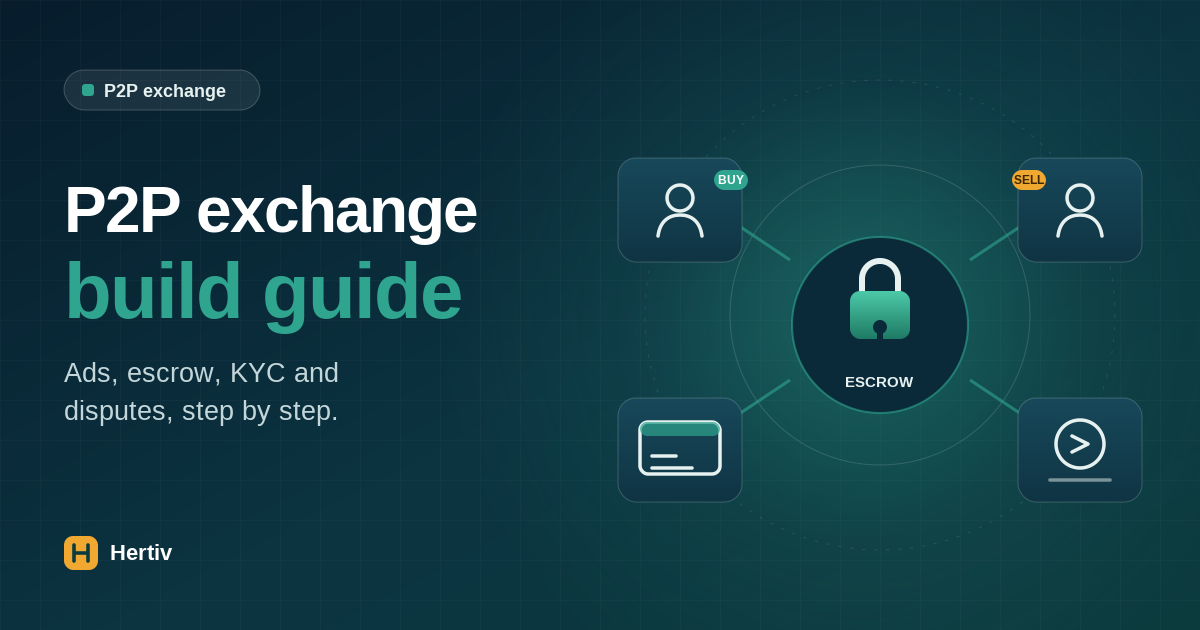
A P2P crypto exchange is a marketplace where buyers and sellers trade cryptocurrency directly with each other, agreeing on price and payment method, while the platform holds the seller's crypto in escrow until the trade completes.
In the Bybit style, the platform does not set prices and does not hold fiat money. It provides the advertisement board, the escrow wallet, the reputation system and the dispute process. Fiat moves off-platform between the users' own bank accounts or payment apps, while crypto settles on the platform.
That differs from an order-book exchange, where a matching engine pairs buyers and sellers instantly at a market price. On a P2P marketplace, each seller sets their own price and payment terms, which is why local payment methods and small trade sizes work well there.
How does a Bybit-style P2P trade work?
A Bybit-style P2P trade follows the same seven steps every time, and escrow is the safety layer that makes the whole flow work.
| Step | Who acts | What happens |
|---|---|---|
| 1. Seller posts an ad | Seller | Sets price, payment methods and trade limits |
| 2. Buyer picks an offer | Buyer | Chooses by price, method and reputation |
| 3. Escrow locks crypto | Platform | Seller's coins are frozen in escrow |
| 4. Buyer pays fiat | Buyer | Bank transfer or payment app, off-platform |
| 5. Buyer confirms payment | Buyer | Marks the trade as paid in the app |
| 6. Seller releases crypto | Seller | Escrow releases coins to the buyer's wallet |
| 7. Dispute if needed | Either side | Platform reviews evidence, escrow stays locked |
Bybit's own guide describes the same flow: the seller's coins lock in escrow when the order starts, the buyer pays by bank transfer, Zelle or a similar method, and the coins release only after the seller confirms receipt. If either side opens a dispute, the escrowed coins stay locked until the platform rules.
Which parts must you build first?
A P2P exchange has five parts that must work before launch, and each one needs its own design decisions.
- Advertisement board and matching. Sellers post ads with price, payment methods, limits and availability. Buyers filter by currency, method and reputation, then open a trade at the advertised terms.
- Escrow wallets. The platform locks the seller's coins when a trade opens and releases them only on seller confirmation or a dispute ruling. The seller must not be able to move locked funds.
- Identity verification. Bybit requires identity verification before P2P trading. Your build needs the same gate, with document checks and per-user limits tied to verification level.
- Payment method handling. Support the payment methods your target region actually uses: bank transfer, mobile money, e-wallets and local apps. Each method needs its own confirmation and fraud rules.
- Dispute centre and reputation. Completion rate, response time and verified badges let buyers pick reliable sellers, and a dispute flow with evidence upload protects both sides.
Admin tooling, notifications and risk rules sit behind all five parts. Without an admin view of open trades, locked balances and dispute queues, the team cannot run the marketplace day to day.
How do escrow and disputes work?
Escrow works by freezing the seller's coins the moment a trade opens, so the buyer knows the funds exist before paying. The escrow lifecycle has four states:
- Locked. The seller's coins move into escrow when the buyer opens the trade.
- Paid. The buyer sends fiat off-platform and marks the trade as paid.
- Released. The seller confirms fiat receipt and the platform releases the coins to the buyer.
- Disputed. Either side opens a dispute, the coins stay locked, and support reviews payment evidence from both parties.
Disputes need clear rules: a time limit for the buyer to pay, a time limit for the seller to confirm, and an evidence standard such as a bank receipt or payment screenshot with the transaction reference visible. The platform's ruling should be final for that trade, with an appeal path only for clear errors.
Reputation does most of the prevention work. Sellers with high completion rates and fast responses get more trades, while new or unreliable sellers face lower limits until they build a record.
What does it cost to run, not just build?
Build cost gets most of the attention, but running a P2P marketplace has its own budget lines, and underfunding them is what kills small exchanges.
| Running cost | What drives it |
|---|---|
| Support team | Dispute volume and response-time targets |
| Compliance and KYC | Number of regions and verification checks |
| Market making | How many ads are live at launch |
| Hosting and security | Trade volume and audit requirements |
| Fraud and risk tooling | Fake-payment attempts and chargebacks |
Budget for operations from month one. A P2P marketplace with no dispute team and no fraud checks loses sellers faster than any feature gap, because one bad trade costs a seller real money and the story spreads.
Example (hypothetical): a first-month P2P marketplace
Example (hypothetical): a new P2P marketplace opens with USDT trading against one local currency. In its first month it completes 200 trades at an average of $400 each, so total volume is $80,000.
The platform charges makers a 1% fee, which brings in $800 for the month. Twelve trades, or 6%, end in dispute, and each dispute takes about 45 minutes of support time, so the team spends 9 hours on disputes. At a hypothetical support rate of $25 an hour, disputes cost $225.
Escrow peaks at about $12,000 locked at any one time, based on 30 open trades at $400 each. The lesson is plain: revenue is thin at small volume, so the launch plan must cover support and fraud costs until volume grows, or the marketplace runs at a loss while looking busy.
What are the common mistakes?
The most common mistakes in building a P2P exchange are skipping identity checks, releasing escrow on weak evidence, and launching with no dispute team.
- Skipping KYC. Without identity verification, fraud accounts multiply and honest sellers leave after the first bad trade.
- Releasing on a screenshot alone. A payment screenshot can be faked; release rules should require the seller to confirm receipt.
- No payment time limit. Without a deadline, buyers can hold escrowed coins hostage while they decide.
- Too few payment methods. A marketplace that only supports bank transfer misses the mobile-money users in its target region.
- Hidden fees. Fees revealed at checkout destroy trust; show the full cost before the trade opens.
- No dispute team. Launching without support staff means disputes sit unresolved and escrow stays locked for days.
Key takeaways
- A P2P exchange connects buyers and sellers directly; the platform provides escrow, not prices
- Escrow locks the seller's coins when a trade opens and releases them only on confirmed payment
- Five parts must work before launch: ads, escrow, identity checks, payment methods and disputes
- Reputation and clear dispute rules do most of the fraud prevention
- Running costs matter as much as build costs: support, compliance and fraud checks start on day one
- Revenue is thin at small volume, so plan for support costs until trading grows
Frequently asked questions
How is a P2P exchange different from a normal crypto exchange?
A normal exchange matches orders on a central order book at a market price. A P2P exchange lets sellers set their own price and payment terms, and buyers pick the offer they want. The platform holds crypto in escrow instead of matching trades.
Do buyers pay fees on Bybit P2P?
Bybit P2P charges no platform fee to buyers or sellers on P2P trades, according to Bybit's own guides. Your own marketplace can set its own fee model, but show the full cost before a trade opens.
Why is escrow needed in P2P trading?
Escrow proves the seller actually has the coins before the buyer pays. The coins lock when the trade opens and release only after the seller confirms fiat receipt, so neither side can take the money and walk away.
What payment methods do P2P exchanges support?
It depends on the region: bank transfer is common almost everywhere, while mobile money, e-wallets and local payment apps matter in specific markets. Bybit P2P supports over 600 payment methods across more than 65 fiat currencies.
How long does a P2P trade take?
Most trades complete within minutes once the buyer pays, but the platform sets time limits for payment and confirmation. If either side misses the limit, the other side can open a dispute and the escrowed coins stay locked.
What happens if a buyer never pays?
The trade expires, the escrowed coins return to the seller, and the buyer may lose reputation or face limits. Clear time limits and a dispute flow keep expired trades from tying up funds.


