How to Build a Healthcare Data Lake Roadmap
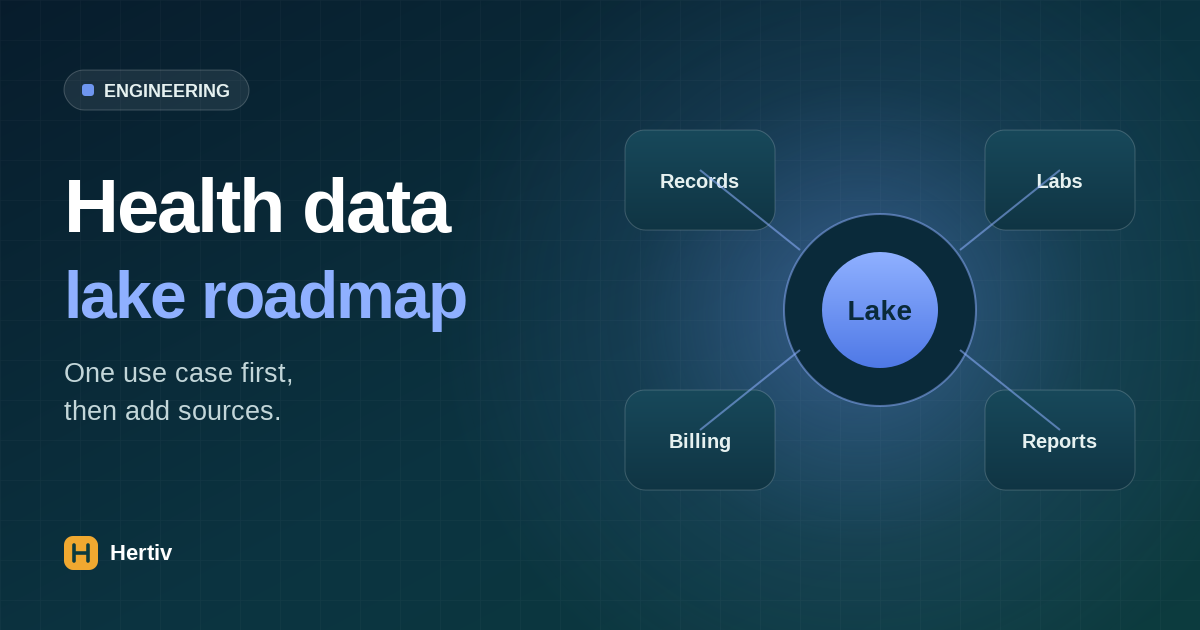
A healthcare data lake roadmap sets out how a hospital brings clinical and billing data into one store. Start with one use case, then add sources in order.
On this page
Short answer
A healthcare data lake roadmap is a staged plan for bringing clinical, billing and device data into one storage layer that teams can query. It starts with one use case, such as readmission reporting, and adds data sources in priority order while privacy, consent and access rules are built in from the start. A good roadmap names the owner of each source, the quality checks and the order of delivery.
What is a healthcare data lake roadmap?
A healthcare data lake roadmap is a plan that says, in order, which data a hospital or clinic will bring together, how it will be stored, who can use it, and what it will be used for. A data lake is a storage layer that holds raw data in its original form, from many systems at once, so teams can query it without rebuilding each source system.
The roadmap is the sequence, not the technology. It lists the data sources, the use case each one serves, the privacy rules that apply, and the team that owns each step. Without it, a data lake becomes a dumping ground: data arrives, nobody knows what it means, and nobody trusts it enough to use it.
The plan usually covers one to two years and is split into phases. Each phase delivers one working use case, such as a readmission report or a bed-capacity dashboard, and the next phase adds the sources the following use case needs. That way the lake earns its keep from the first phase instead of waiting for a big launch.
Why is healthcare data hard to bring together?
Healthcare data is hard to bring together because it lives in many systems that were never designed to share. A hospital may run a separate system for electronic records, laboratory results, imaging, pharmacy, billing and scheduling, each with its own formats, codes and definitions of the same patient.
The same patient can appear under different identifiers in different systems, and the same test can be recorded with different codes in different departments. Matching records takes careful work, and a wrong match can put the wrong result on the wrong patient, which is a safety problem as well as a data problem.
Privacy adds a further layer. Health data is sensitive, and rules such as HIPAA in the United States set strict limits on who can see it and for what purpose. A data lake that copies records without consent rules, access controls and audit logs is a legal risk, not an asset. The roadmap must answer the privacy questions before the first source is connected.
What are the phases of the roadmap?
Most roadmaps follow five phases, each with a clear output. The first phase is discovery: list the systems, the data they hold, and the questions teams want to answer. The second is governance: agree on who owns each source, who can see what, and how consent is recorded.
| Phase | What happens | Output |
|---|---|---|
| Discover | List systems and questions | Source inventory |
| Govern | Set owners, access and consent rules | Governance policy |
| Ingest | Copy sources into the lake | Raw data in the lake |
| Curate | Clean, match and label the data | Trusted data sets |
| Use | Build reports and models | Working dashboards |
The order matters. Ingesting data before governance is agreed means the lake holds records nobody is allowed to use. Curating before the first use case is chosen means the team cleans data nobody needs. Each phase should finish with something a real team can use. For the wider data picture, see what data engineering is.
How do privacy and governance fit in?
Privacy and governance are not a phase at the end of the roadmap; they are the frame around the whole plan. Before a source is connected, the team must know the legal basis for using it, whether patient consent covers the planned use, and who is allowed to see the result.
Three controls do most of the work. Access control limits each user to the data their role needs, so a billing analyst cannot see full clinical notes. De-identification removes names and direct identifiers from data used for reporting and research, while keeping a separate, guarded key for cases where identity is needed. Audit logging records every query, so the team can prove who looked at what.
Consent is the hardest part. A patient may agree to their data being used for their own care but not for research, or for research in one hospital but not shared with others. The roadmap must record consent per patient and per purpose, and the lake must enforce it when data is queried. A use case that needs data the consent does not cover must wait or be redesigned.
Example (hypothetical): a 200-bed hospital
Example (hypothetical): a 200-bed hospital wants a readmission report that shows which discharged patients return within 30 days. It picks that as the first use case and lists the sources it needs: electronic records, laboratory results, pharmacy, billing, and the scheduling system. That is 5 sources.
The team plans 2 weeks to connect each source, so 5 sources x 2 weeks = 10 weeks of ingestion work. Curation takes another 4 weeks: matching patient records across the five systems and labelling the fields the report needs. Governance takes 3 weeks in parallel, so the first working report arrives in 10 + 4 = 14 weeks, or about 3 and a half months.
The report shows that 24 of 200 discharged patients returned within 30 days in the first month, a rate of 24 / 200 = 12 percent. The care team reviews the 24 cases and finds that 9 of them missed a follow-up appointment. That finding becomes the second use case: a list of patients due a follow-up, built from the same five sources.
The second phase adds two more sources, imaging and device data from the wards, taking 2 x 2 = 4 weeks, and the team uses them for a bed-capacity dashboard. Each phase reuses the governance and curation work from the first, so later phases are faster than the first one.
How do you build it, step by step?
Teams build a healthcare data lake roadmap by starting with one use case and one team that wants it, then adding sources in priority order. The steps below keep the work small enough to finish and useful enough to defend.
- Pick one use case with a named owner. Choose a question a real team asks every week, such as readmissions or bed capacity, and name the clinician or manager who owns it.
- List the sources that use case needs. Write down each system, its owner, and the fields the use case needs, and nothing else for now.
- Agree the governance rules. Decide who can see the data, how consent is recorded, and how access is logged, before any data moves.
- Connect the sources one at a time. Copy each source into the lake in its raw form, with a record of where it came from and when it was copied.
- Curate for the use case. Match patients across sources, label the fields, and check the results against the source systems.
- Ship the use case and review it. Put the report in front of its owner, fix what is wrong, and only then start the next source.
Reviewing after each phase is what keeps the roadmap honest. If the first use case does not work, the team learns it in weeks, not after a year of building. For how to scope the first phase, see what a data lakehouse is.
What are the common mistakes?
The most common mistake is copying every source into the lake before choosing a use case. The lake fills with data nobody asked for, the team spends months cleaning it, and the first report is still a year away. Start with one question and the sources it needs.
Another mistake is treating governance as paperwork. A policy that nobody enforces is worse than no policy, because it gives a false sense of safety. Access controls, consent checks and audit logs must be built into the lake, not written in a document that sits on a shelf.
Teams also match patients carelessly. Two patients with similar names, or one patient with two record numbers, can produce wrong results that look right. Patient matching needs a defined rule, a human check for uncertain matches, and a log of every decision.
Finally, do not let the lake become the only copy of anything. Source systems remain the record of truth for clinical care, and the lake is a copy for analysis. If a source system changes a record, the lake must pick up the change, or the reports will drift away from reality. The data platform behind the lake is covered in data engineering services.
Key takeaways
- A roadmap is a sequence: one use case, then the sources it needs, in order.
- Governance comes before ingestion: owners, access, consent and audit logs first.
- Each phase ends with a working report, not with more raw data.
- Patient matching needs a defined rule and a human check for uncertain matches.
- The source systems stay the record of truth; the lake is a copy for analysis.
Frequently asked questions
What is a healthcare data lake?
A healthcare data lake is a storage layer that holds raw data from many hospital systems, such as electronic records, laboratory results, pharmacy, billing and scheduling, in its original form. Teams query the lake for reporting and analysis instead of rebuilding each source system. A roadmap sets the order in which sources are added.
How is a data lake different from a data warehouse?
A data lake stores raw data in its original form and is built for flexible analysis, while a data warehouse stores cleaned, structured data for known reports. Many hospitals use both: the lake holds the raw copies, and the warehouse holds the curated tables that dashboards read. The roadmap should say which is used for what.
How long does a healthcare data lake roadmap take?
The first use case often takes three to four months, including governance and curation, and later phases are faster because they reuse that work. A full roadmap covering the main sources of a hospital usually runs for one to two years. The exact time depends on the number of systems and the state of their data.
Who owns a healthcare data lake?
Ownership is shared. Each source system has a named owner, usually a clinical or operational lead, who is responsible for the quality of that data. A data team owns the lake platform, the pipelines and the access controls. The roadmap should name both owners for every source it adds.
What privacy rules apply to health data lakes?
It depends on the country. In the United States, HIPAA sets strict limits on who can see health data and for what purpose, and similar rules apply in other regions. The roadmap must record the legal basis and patient consent for each use, and the lake must enforce access limits and audit logging.
Can a small clinic build a data lake?
Yes, at a smaller scale. A clinic with two or three systems can follow the same roadmap: one use case, a short source list, and simple governance rules. The lake itself can be a managed cloud service rather than a system the clinic builds and runs itself.


