How to Build a Crypto Exchange Like Remitano
A Remitano-style exchange is a peer-to-peer marketplace where users trade crypto directly, with escrow holding coins until payment is confirmed. How to build one.
On this page
Short answer
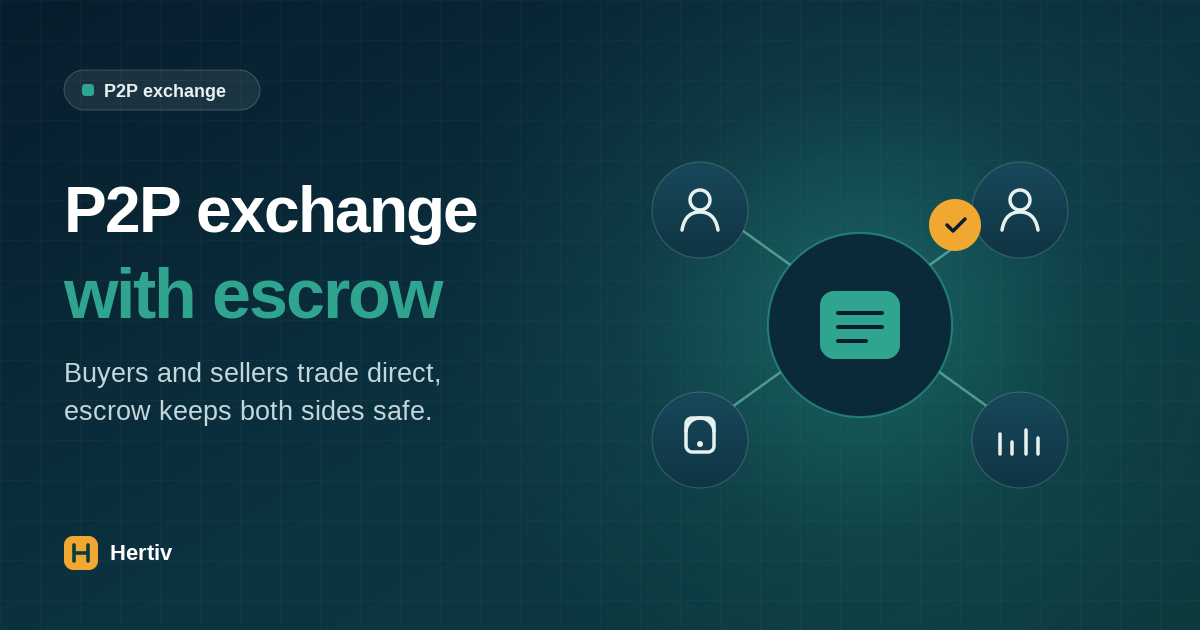
A crypto exchange like Remitano is a peer-to-peer marketplace where buyers and sellers trade crypto directly with each other, and an escrow service holds the seller's coins until the buyer confirms payment. Unlike a centralised order-book exchange, there is no company matching orders from its own pool; the platform connects people, holds funds in escrow, and takes a small fee on each completed trade.
What is a Remitano-style exchange?
A Remitano-style exchange is a peer-to-peer crypto marketplace built around escrow. Sellers list an offer with a price, a payment method and a limit, buyers pick an offer and pay the seller directly, and the platform releases the crypto from escrow only after the seller confirms the payment arrived.
Remitano itself is one of the early examples of this model. It grew in markets where bank transfers and local payment methods matter more than card payments, and where users want to trade with people in their own country and currency. The model works because the escrow step removes the main risk of trading with a stranger: paying and getting nothing back.
The platform does not set prices. Each seller sets their own rate, so the same coin can trade at slightly different prices across offers. Traders pick offers based on price, payment method and the seller's reputation, which is built from completed trades and ratings. A Coinbase-style exchange works differently, matching orders on a central order book instead of connecting peers.
How does a Remitano-style exchange work?
A Remitano-style exchange works by running a trade through four stages: offer, agreement, escrow and release. The buyer and seller agree the terms, the crypto goes into escrow, the buyer pays outside the platform, and the crypto is released once the seller confirms receipt.
A typical trade looks like this:
- Browse offers. The buyer filters offers by coin, currency, payment method and price, then picks a seller with a good reputation.
- Open a trade. The buyer enters the amount. The seller's crypto moves into escrow automatically, so it cannot be sold to anyone else while the trade is open.
- Pay the seller. The buyer sends the money through the agreed method, such as a bank transfer or a mobile wallet, and marks the trade as paid.
- Confirm and release. The seller checks the payment and confirms it. The escrow releases the crypto to the buyer's wallet.
- Dispute if needed. If the seller does not confirm, or the buyer says the payment failed, support reviews the payment proof and decides who is right.
Escrow is the whole point of the model. Without it, peer-to-peer trading depends on trust between strangers, and that trust breaks the first time a payment goes missing. With escrow, the worst case is a delayed trade while support checks the evidence.
What are the core features you need?
The core features of a Remitano-style exchange are offer listings, escrow, payment proof, reputation, dispute handling and wallets. Leave any of these out and the marketplace either does not work or does not feel safe enough to use.
| Feature | What it does | Why it matters |
|---|---|---|
| Offer board | Buy and sell listings with price, limits and payment methods | Users need choice to find a fair price and a method they can use |
| Escrow wallet | Holds the seller's crypto during a trade | Removes the risk of paying and receiving nothing |
| Trade chat | Messages between buyer and seller during a trade | Resolves questions and creates a record for disputes |
| Payment proof | Upload of receipts or screenshots | Support needs evidence to settle disputes fairly |
| Reputation | Trade count, completion rate and ratings per user | Good sellers attract buyers; bad actors lose trust fast |
| Dispute centre | Support review of contested trades | Someone must decide when the two sides disagree |
| KYC and limits | Identity checks tied to trade limits | Required in most markets and deters fraud |
Start with this list and resist adding order-book trading, margin or derivatives in version one. A peer-to-peer marketplace has a different risk model from an order-book exchange, and mixing the two before the escrow flow is solid creates support cases your team cannot settle quickly. A crypto exchange development plan should treat escrow and disputes as the core product, not as add-ons.
How do you build a Remitano-style exchange, step by step?
You build a Remitano-style exchange by starting with wallets and escrow, then adding offers, payments and disputes, and only then opening to real users with a small set of coins and payment methods. Each step is small, and the escrow flow must be correct before any real money moves.
- Define the market. Pick one country or region, one or two coins, and the payment methods people actually use there. A narrow launch is easier to support and to keep legal.
- Build wallets and escrow. Create hot and cold wallets, and a smart contract or server-side escrow that locks the seller's coins when a trade opens and releases them only on confirmation or a support decision.
- Build the offer board. Listings with price, limits, payment methods and seller reputation, plus search and filters so buyers can find a good offer quickly.
- Add trade chat and proof. Messages tied to each trade, file upload for payment receipts, and a countdown timer so trades do not sit open forever.
- Add KYC and limits. Identity checks that scale with trade size, daily limits for new accounts, and velocity checks that flag unusual activity.
- Build the dispute flow. A support dashboard that shows the trade, the chat, the payment proof and the escrow state, so one person can settle a case in minutes.
- Test with a closed group. Run real trades with a small group of test users, pay them in, and fix the escrow and dispute cases that appear before opening publicly.
Security review belongs in the build, not after it. Escrow wallets hold user funds, so get an audit of the escrow logic and the key management before launch, and keep most funds in cold storage.
What does it cost to build and run?
The cost of building a Remitano-style exchange depends on the coins you support, the payment methods you integrate and the markets you serve. The figures below are planning ranges, not quotes, and compliance costs vary sharply by country.
| Cost area | Typical first-year range | What it covers |
|---|---|---|
| Development | $80,000-$250,000 | Platform, wallets, escrow, KYC, admin tools |
| Security audit | $15,000-$50,000 | Escrow logic, wallets and key management review |
| Legal and licences | $20,000-$100,000 | Entity setup, licences and legal advice per market |
| Support team | $30,000-$80,000 | Dispute handling and user support |
| Running costs | $2,000-$6,000 a month | Hosting, KYC checks, monitoring and backups |
The largest ongoing cost is usually support, not servers. Disputes need a human decision, and a marketplace with slow dispute handling loses sellers fast. Budget for support from day one, and treat dispute resolution time as a product metric, not a back-office chore.
Example (hypothetical): a regional peer-to-peer exchange in year one
Example (hypothetical): a team launches a Remitano-style exchange in one country with two coins and bank transfer as the main payment method. It charges a 1 percent fee on completed trades, paid by the seller, and it spends $150,000 in its first year on development, audit, legal work and support.
By month six it has 2,000 active traders, each trading about $400 a month on average. Monthly volume is 2,000 times $400, or $800,000. At a 1 percent fee that is $8,000 a month, or $96,000 a year if volume holds steady.
The arithmetic: $96,000 in fee income against $150,000 in first-year costs leaves a $54,000 gap. To break even on the same cost base, monthly volume needs to reach $1,250,000, because $1,250,000 times 1 percent is $12,500 a month, or $150,000 a year. The team can close the gap by adding traders, adding coins, or adding payment methods that bring in more volume, but the fee rate and the cost base decide the target either way.
What are the common mistakes?
The most common mistakes when building a Remitano-style exchange are weak escrow, slow dispute handling, launching in too many markets at once, and treating compliance as an afterthought.
- Escrow that can be bypassed. If a trade can settle without escrow, fraud follows. Every trade must pass through escrow, with no exceptions.
- Slow disputes. A trade stuck in dispute for days makes both sides leave. Aim for a same-day decision on most cases.
- Too many coins and countries. Each new coin and market adds wallets, payment methods and legal work. Start narrow and expand on evidence.
- No KYC scaling. Letting new accounts trade large amounts without checks invites fraud and regulatory trouble.
- Ignoring payment proof. Without a clear way to upload and check payment evidence, support cannot settle disputes fairly.
- Thin liquidity. An offer board with few sellers and wide prices gives buyers no reason to return.
Key takeaways
- A Remitano-style exchange is a peer-to-peer marketplace where escrow holds the seller's coins until payment is confirmed.
- The trade flow is offer, agreement, escrow, payment, release, with support settling disputes from payment proof and chat records.
- Core features are the offer board, escrow, trade chat, payment proof, reputation and dispute handling.
- Build wallets and escrow first, then offers, payments and disputes, and test with a closed group before opening.
- Support is the largest ongoing cost, because disputes need a human decision and slow handling drives sellers away.
- Fees and volume decide break-even: at a 1 percent fee, $1,250,000 of monthly volume covers $150,000 of yearly costs.
Frequently asked questions
Is Remitano a centralised exchange?
Remitano is a peer-to-peer marketplace, not a centralised order-book exchange. Users trade directly with each other at prices set by sellers, and the platform holds the crypto in escrow until payment is confirmed. A centralised exchange matches buy and sell orders from its own order book instead.
How does escrow protect buyers and sellers?
Escrow locks the seller's crypto when a trade opens, so the seller cannot sell the same coins to someone else or keep them after being paid. The crypto is released only when the seller confirms payment, or when support decides a dispute in the buyer's favour after checking payment proof.
What payment methods work on a peer-to-peer exchange?
Bank transfers, mobile wallets and cash deposits are the most common, because they are what people in the target market already use. The right set depends on the country: pick the methods with the most users and the clearest payment proof, and add more only after the first ones work well.
Do I need a licence to run a peer-to-peer exchange?
In most countries, yes, or at least a registered entity with anti-money-laundering controls and identity checks. The rules vary by country, and some markets require a specific licence for crypto trading or custody. Get legal advice for each market before launch.
How do peer-to-peer exchanges make money?
Most charge a small percentage fee on completed trades, usually paid by the seller, and some charge for faster listing placement or for withdrawals. Escrow and dispute handling are the service the fee pays for, so fee income depends on trade volume, not on the number of registered users.
Can a peer-to-peer exchange list any coin?
Technically yes, but each coin adds wallet work, escrow testing and support load. Start with one or two widely used coins with good wallet tooling, and add more only when the escrow flow and dispute handling are already solid.


