How to Build Apps on Base: A Practical Guide for Teams
Base is an Ethereum layer 2 built on the OP Stack, with low fees and fast confirmations. Learn the stack, the build steps, and how to launch safely.
On this page
Short answer
To build apps on Base, you write smart contracts in Solidity, deploy them to the Base network with a standard Ethereum toolchain, and connect a normal web or mobile front end through a wallet. Base is an Ethereum layer 2 built on the OP Stack, so most Ethereum tools, libraries and wallets work with little change.
What is Base?
Base is an Ethereum layer 2 network built by Coinbase on the OP Stack, the same open-source framework behind Optimism. A layer 2 runs transactions off the Ethereum main network and posts the results back to it, which keeps fees low and confirmations fast while borrowing Ethereum's security.
Base is compatible with the Ethereum Virtual Machine, so smart contracts written for Ethereum run on Base without rewriting. Developers use the same language, Solidity, the same tools, such as Hardhat and Foundry, and the same wallets, such as MetaMask and Coinbase Wallet.
Base has no native token of its own. Fees are paid in ETH, and the network is designed for consumer apps: payments, social apps, games and onchain commerce. That focus shapes what is worth building there.
What do you need before you start?
Before you start, you need a clear app idea, a wallet with test ETH, and a development setup. Install Node.js and a framework such as Hardhat or Foundry, pick a front-end stack you already know, and set up a wallet such as MetaMask with the Base Sepolia test network added.
You also need a plan for the smart contract layer. Decide what must live onchain and what can stay offchain: most apps keep only the parts that need trust or shared state onchain, such as ownership, payments or voting, and keep the rest in a normal database.
Finally, get test ETH from a Base Sepolia faucet and a block explorer account for verifying contracts. Testnet work costs nothing but time, and it is where every bug should be found. For the wider context, read Solana vs Base to see how Base compares with another popular chain.
How to build an app on Base, step by step
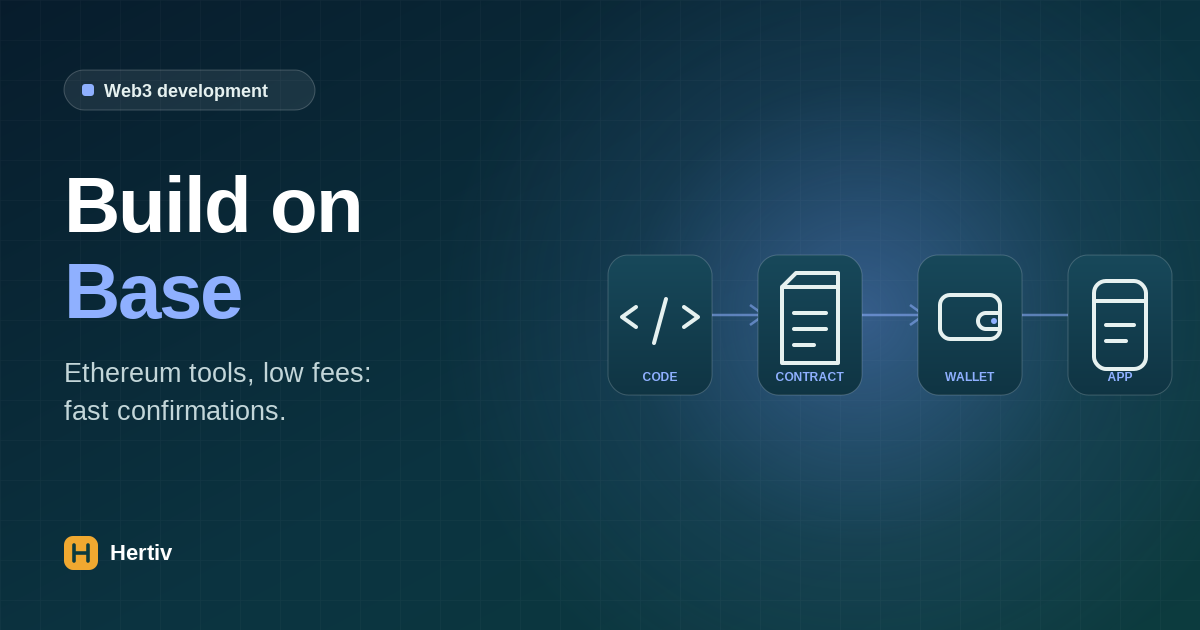
Building on Base follows the same steps as any Ethereum app, with a few network-specific details. Keep the contract small, test it hard, and launch the front end only after the contract is audited or at least reviewed by a second developer.
- Write the contract. Build the core logic in Solidity, keeping each function small and the state simple.
- Test locally. Run unit tests with Hardhat or Foundry, including failure cases and edge cases.
- Deploy to Base Sepolia. Deploy to the test network, verify the contract on the block explorer, and try every user flow.
- Build the front end. Connect the app with a wallet library such as wagmi or ethers, and handle errors clearly.
- Audit and launch. Get a review or audit for anything holding funds, then deploy to Base mainnet and monitor.
Each step has a clear exit test: the contract passes its tests, the testnet flow works end to end, and the front end handles a failed transaction without confusing the user.
Smart contracts on Base: what to know
Smart contracts on Base work like contracts on Ethereum, with two practical differences: fees and finality. Fees on Base are much lower than on Ethereum mainnet, which makes small, frequent transactions realistic for consumer apps. Confirmations arrive in seconds, and finality follows the OP Stack's challenge window.
Use the standard OpenZeppelin libraries for tokens, access control and upgrades rather than writing your own. They are reviewed by many teams and cover the patterns most apps need. Keep admin powers small and time-locked where possible, so a single compromised key cannot drain a contract.
| Part | Tool | What it does |
|---|---|---|
| Contracts | Solidity, OpenZeppelin | Onchain logic, tokens, access control |
| Testing | Hardhat, Foundry | Unit tests, local network, fuzzing |
| Front end | wagmi, ethers, viem | Wallet connection and contract calls |
| Data | Indexer, subgraph | Reads contract events for the app |
| Monitoring | Block explorer, alerts | Tracks transactions and errors |
For the contract side, what is smart contract development covers the full process.
For the front end, how to create Web3 dApps covers the patterns that work across chains.
Example (hypothetical): a loyalty points app
Example (hypothetical): a coffee shop chain wants a loyalty app on Base. Customers earn one point per dollar spent, and 100 points buy a free drink. The contract stores points per wallet, the shop's point-of-sale system mints points after each sale, and the app shows the balance.
The build takes a small team eight weeks: two weeks for the contract and tests, three weeks for the app and wallet flow, two weeks of testnet trials with two shops, and one week for review and launch. The contract is simple, with mint, redeem and transfer functions, and no admin can mint points without a signed sale record.
The arithmetic: 5,000 regular customers spend an average of 40 dollars a month, earning 200,000 points a month. At 100 points per free drink, that is 2,000 free drinks a month, which the chain budgets as a known cost of the programme. The app reads balances from the contract, so points work across all shops without a central database.
Testing and launching on Base
Testing on Base starts with unit tests and ends with real users on testnet. Write tests for every function, including the ones that should fail, and run a fuzzer over the contract to catch edge cases. Then deploy to Base Sepolia and run the full user journey with test wallets.
Before mainnet, get a second pair of eyes on the contract. A full audit is the right call for anything holding user funds; a peer review can be enough for a simple, low-value contract. Either way, write down the risks you accepted and the limits of the review.
At launch, deploy the contract, verify it on the block explorer, and set up monitoring for failed transactions and unusual activity. Keep a pause function in the contract so the team can stop minting or transfers if something goes wrong, and test that pause on testnet first.
Common mistakes when building on Base
The most common mistake is putting too much onchain. Storing images, long text or every user action onchain wastes fees and slows the app. Keep the contract to the logic that needs shared trust, and store the rest offchain with a link to the onchain record.
Another mistake is skipping testnet. Mainnet is not a test environment: a bug there costs real money and real users. Run the full journey on Base Sepolia with real wallets before you deploy.
Finally, teams forget the wallet experience. If connecting a wallet takes three clicks and a confusing prompt, most users leave. Test the onboarding flow with people who have never used crypto, and make the first action in the app work within a minute of opening it.
Key takeaways
- Base is an Ethereum layer 2 on the OP Stack, with low fees and fast confirmations.
- Ethereum tools, Solidity and wallets work on Base with little change.
- Keep only trust-critical logic onchain; store the rest offchain.
- Test on Base Sepolia end to end before touching mainnet.
- Audit anything holding funds and keep a pause function ready.
Frequently asked questions
Is Base the same as Ethereum?
No. Base is a layer 2 network that runs on top of Ethereum. It processes transactions off the main network and posts the results back to Ethereum, which keeps fees low. Contracts written for Ethereum run on Base because it uses the same virtual machine.
What do I pay fees with on Base?
Fees on Base are paid in ETH, the same as on Ethereum, but the amounts are much lower. You need a small amount of ETH in your wallet for each transaction. Testnet work uses free test ETH from a faucet.
Do I need to learn a new language to build on Base?
No. Smart contracts on Base are written in Solidity, the standard Ethereum language. If you know Solidity, Hardhat or Foundry, you can build on Base. The front end uses the same wallet libraries as other Ethereum apps.
How long does it take to build an app on Base?
A simple app with one contract and a basic front end can take four to eight weeks for a small team. Most of that time goes to testing, the wallet flow and launch checks, not to writing the contract. Anything holding user funds needs extra review time.
Is Base safe for holding user funds?
Base inherits security from Ethereum through the OP Stack, but your contract is only as safe as its code. Get an audit or a thorough peer review before launch, limit admin powers, and keep a pause function. No chain makes a buggy contract safe.
Can I move an Ethereum app to Base?
In most cases, yes. Because Base is EVM-compatible, the same contracts usually deploy with little or no change. You will need to update the network settings, test on Base Sepolia, and check that any Ethereum-specific services you use also support Base.


