How to Build an App Like Instashop: A Practical Guide
Instashop is a grocery delivery app that connects shoppers with local stores. Here is the feature set, the picker and delivery flow, and what a first version costs.
On this page
Short answer
An app like Instashop is a grocery delivery app: customers order from nearby stores, a picker collects the items in the store, and a courier delivers them to the door. Building one needs a store catalogue, live stock checks, a picker app, courier dispatch and payments. Start with one city and a small set of partner stores, then widen coverage once the fulfilment loop works.
What is an app like Instashop?
An app like Instashop is a grocery delivery app that lets customers order groceries and household items from local supermarkets and shops, then delivers them within hours. Instashop, the original app, operates in several Middle East markets and works with partner stores rather than holding its own stock.
The model has three sides: the customer app for browsing and ordering, the store side for managing stock and orders, and the picker and courier apps for fulfilment. The customer never sees the middle two, but they decide whether the order arrives complete and on time.
Your version does not need to copy Instashop. It needs the same loop: browse, order, pick, deliver. If stock data is wrong or pickers cannot find items, customers get substitutions and missing products, and they stop ordering.
What features does a grocery delivery app need?
A grocery delivery app needs a small set of features that work together. The catalogue is the front door, stock accuracy is the engine, and the picker and courier flow is the reason orders arrive complete.
| Feature | What it does | Needed for launch? |
|---|---|---|
| Store catalogue | Shows products, prices and categories per store | Yes |
| Live stock checks | Marks items out of stock before checkout | Yes |
| Substitution choices | Lets the customer pick a replacement or a refund | Yes |
| Picker app | Guides a picker through the store by aisle | Yes |
| Courier dispatch | Assigns deliveries and tracks the route | Yes |
| Payments and promos | Charges the order and applies vouchers | Yes |
| Delivery slots | Offers time windows the team can meet | Yes |
| Loyalty and lists | Saves favourites and repeat shopping lists | Later |
Start with the rows marked yes. Loyalty, lists and personalised offers can wait until orders arrive complete and on time. For a first version, a team building a mobile app should treat stock accuracy as the product, not the storefront design.
How does the order flow work?
The order flow works in five stages, and each stage has a failure mode that costs you the order. Getting the flow right matters more than adding features.
First, the customer browses a store, adds items and picks a delivery slot. The app should check stock at checkout, not after payment, so the customer does not pay for items that are not there.
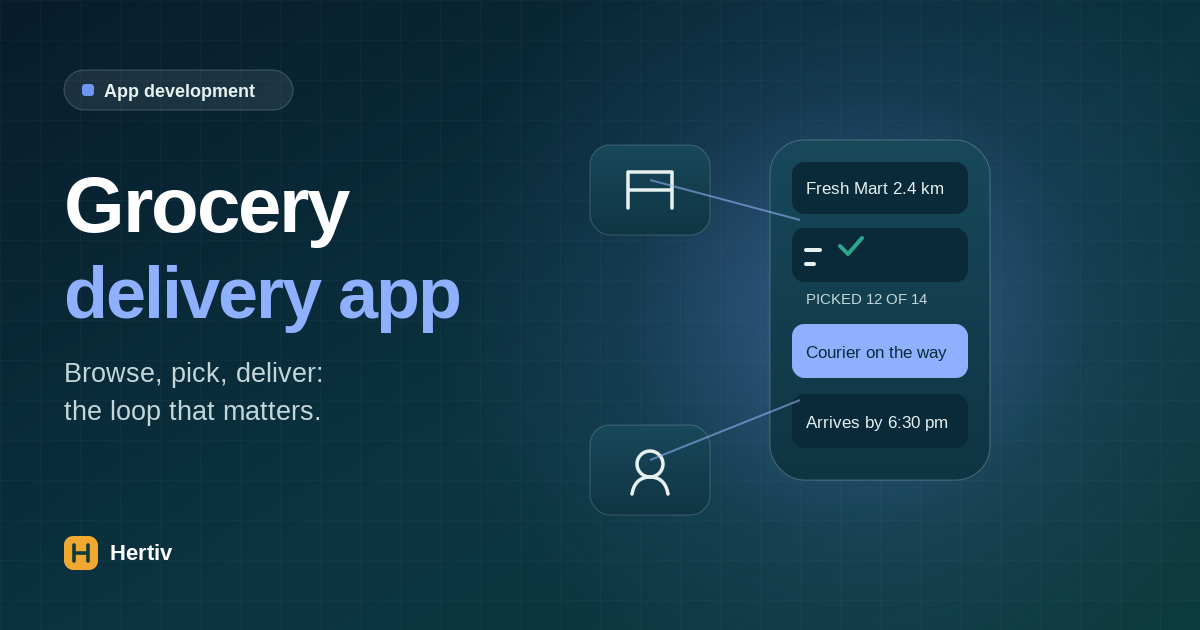
Second, the order goes to the store, where a picker gets a list sorted by aisle. Third, the picker scans each item and marks substitutions where the customer allowed them. Fourth, a courier is assigned and the order is packed and handed over. Fifth, the customer tracks the courier and rates the order.
Two details decide quality. Substitution rules must be set by the customer in advance, with a clear refund option, because a wrong replacement is the most common complaint. And the delivery slot must reflect real picker and courier capacity, or orders pile up and arrive late.
Before building, check that the idea has a real audience with a small validation step. See how to validate an app idea for a practical way to test demand before writing code.
What technology does the app need?
The app needs five technical pieces: a customer app, a store and picker app, a courier app, a backend with stock and orders, and integrations for payments and maps.
The catalogue is the hardest data problem. Each store has its own products, prices and barcodes, and prices change often. You need a product database with store-level stock, plus a way for stores to update it, either by file upload or by a small dashboard. Without that, the catalogue goes stale within weeks.
The backend runs orders, dispatch and payments. Dispatch needs live courier locations and a simple assignment rule, such as nearest available courier with capacity. Payments should use a proven provider, and you should hold the charge until the order is confirmed, so refunds for missing items are simple.
Maps and routing come from a mapping provider, and notifications keep the customer informed at each stage. None of these pieces is new technology, which is why the operations matter more than the code.
How to build an app like Instashop in 6 steps
You build an app like Instashop by proving the fulfilment loop with a few stores in one area, then widening coverage before adding extras.
- Pick one area and a few stores. Choose a dense neighbourhood and three to five partner stores, so pickers and couriers stay close together.
- Build the catalogue first. Import each store product list, clean duplicates and wrong prices, and set up a simple way for stores to update stock.
- Build the customer app and checkout. Browsing, stock checks, substitution choices and delivery slots come before loyalty features.
- Build the picker and courier apps. Aisle-sorted picking lists and simple courier assignment matter more than a polished design.
- Run real orders with a small team. Fulfil a few hundred orders yourself, fix the stock errors and the late deliveries first.
- Expand store by store. Add stores only when the current ones run at good accuracy and on-time rates.
Partner stores are the bottleneck, not the code. A store that will not keep stock data current will produce missing items no matter how good the app is. See grocery app development cost for a breakdown of the budget side.
Example (hypothetical): a first-version budget
Example (hypothetical): a small team builds a first version for one city area with five partner stores. The team has two developers, one designer and one part-time operations lead, working for 16 weeks.
The build work is 1,920 hours at $70 an hour, which is $134,400. Store onboarding adds $8,000 for catalogue cleaning and training, payments and maps add $6,000, and testing tools add $4,000. The total is $152,400. A 10% reserve of $15,240 brings the planning figure to $167,640.
Running costs after launch are smaller but real: hosting and maps at about $400 a month, a part-time catalogue editor at about $2,000 a month to keep products current, and courier payouts per order. The catalogue is the ongoing cost, not the code. If the team stops updating products, orders go wrong and customers leave.
What are the common mistakes?
The most common mistakes are stale stock data, no substitution rules, and delivery slots that the team cannot meet.
- Launching with stale stock. If a third of orders have missing items, customers stop ordering. Cover fewer stores accurately instead of many stores badly.
- Skipping substitution choices. A picker who guesses a replacement creates complaints. Let the customer choose in advance.
- Promising slots you cannot meet. A one-hour window needs pickers and couriers ready. Offer wider slots until the team is fast.
- Ignoring store onboarding. A store that will not update stock will sink the service, however good the app is.
- Adding features before fulfilment works. Loyalty points and recipe suggestions do not help if orders arrive incomplete.
Key takeaways
- A grocery delivery app is a fulfilment business with an app on top, not an app with delivery attached
- Stock accuracy decides whether customers order a second time
- Substitution rules must be set by the customer in advance, with a clear refund option
- Start with a few stores in one dense area, then expand store by store
- Budget for ongoing catalogue work: stale products kill a grocery app faster than bugs do
Frequently asked questions
Is Instashop itself a franchise I can copy?
No. Instashop is a commercial app with its own store partnerships and brand. You can build a similar grocery delivery app in your own market, but you need your own store agreements, your own catalogue work and your own design. Copying its branding or name would be a legal problem, not a shortcut.
How much does an app like Instashop cost to build?
A first version for one area and a few stores typically needs a small team for three to four months, plus ongoing catalogue work. The build cost is mostly developer time; the running cost is mostly keeping stock data current and paying couriers. See the worked example in this article for a planning figure with the arithmetic shown.
How do stores keep their stock up to date?
Most teams start with a simple dashboard or a file upload the store updates daily, then move to a point-of-sale feed where the store system supports it. The key is a named person at each store who owns the data. Without that, stock goes stale within weeks.
Do I need my own couriers?
Not at first. Many teams start with a small courier pool they manage directly, so they control quality, then add third-party couriers as volume grows. Either way, you need live courier locations and a simple assignment rule, or deliveries bunch up.
How do substitutions work?
The customer sets a rule per item at checkout: accept a named replacement, accept any similar item, or refund the item. The picker follows that rule and scans the replacement. Clear rules cut complaints far more than any other single feature.
What is the hardest part of a grocery delivery app?
Keeping the catalogue and stock accurate across stores. Prices change, products go out of stock, and barcodes vary by store. The teams that succeed treat catalogue work as a daily operation, not a one-time import.


