How to Become a Prompt Engineer: A Practical Path
Prompt engineering is a practical skill you can build in months with focused practice and a small portfolio. Here is a path that gets you hired.
On this page
Short answer
A prompt engineer designs, tests and improves the instructions given to large language models so they produce useful output for real tasks. You can build the skill in about 12 weeks with focused practice, a test set and two or three finished projects, without a degree in machine learning.
What is a prompt engineer?
A prompt engineer is someone who designs, tests and improves the instructions given to large language models so the model produces useful, accurate output for a real task. The job sits between product work and model work: understanding what the user needs, writing instructions the model can follow, and measuring whether the result is good enough.
The work is less about clever phrasing and more about method. A prompt engineer breaks a task into steps, gives the model the right context and examples, sets clear output formats, and then tests the result against real inputs. When the model fails, they change the instruction, the data or the workflow, and test again.
Prompt engineers work in product teams, support teams, content teams and AI consultancies. Some hold the title formally; many do the work under titles such as AI engineer, product engineer or solutions engineer. The skill matters more than the title, and it is a skill you can build without a degree in machine learning.
What does a prompt engineer actually do day to day?
Day to day, a prompt engineer spends most time on four things: understanding the task, writing and testing prompts, measuring results, and working with engineers to put the prompts into a product. Writing prompts is only part of the job; the rest is testing and judgement.
| Task | What it involves | Share of the week |
|---|---|---|
| Task design | Breaking a user need into steps the model can do | About a fifth |
| Prompt writing | Drafting instructions, examples and output formats | About a quarter |
| Testing | Running prompts on real inputs and checking output | About a quarter |
| Evaluation | Scoring results and tracking what improved | About a fifth |
| Shipping | Working with engineers to put prompts in the product | The rest |
The testing habit is what separates a prompt engineer from someone who chats with a model. A prompt engineer keeps a set of test cases, runs them after every change, and can say whether a new version is better or worse. What is prompt engineering explains the basic techniques this work builds on.
Which skills matter most?
The skills that matter most are clear writing, structured thinking, basic programming and evaluation. You do not need to train models, but you do need to read code, call an API and work with data, because prompts live inside software, not in a chat window.
| Skill | Why it matters |
|---|---|
| Clear writing | Instructions must be plain enough for the model to follow |
| Task analysis | Breaking a messy job into steps the model can do |
| Basic Python | Running prompts, handling data and calling APIs |
| Evaluation | Judging output quality with a test set, not by feel |
| Domain knowledge | Knowing what good output looks like in one field |
| Communication | Explaining trade-offs to product and business teams |
Domain knowledge is the part most beginners skip. A prompt engineer who knows support, law, medicine or finance can judge output quality in that field, while a generalist cannot. Pick one field you know and build your examples there. Prompt engineering vs fine-tuning helps you decide when prompting is enough and when a model needs training.
How to learn prompt engineering in 12 weeks
You learn prompt engineering in about 12 weeks by practising on real tasks, building a small test set, and shipping two or three finished examples. Reading alone is not enough; the skill comes from writing prompts, watching them fail, and fixing them.
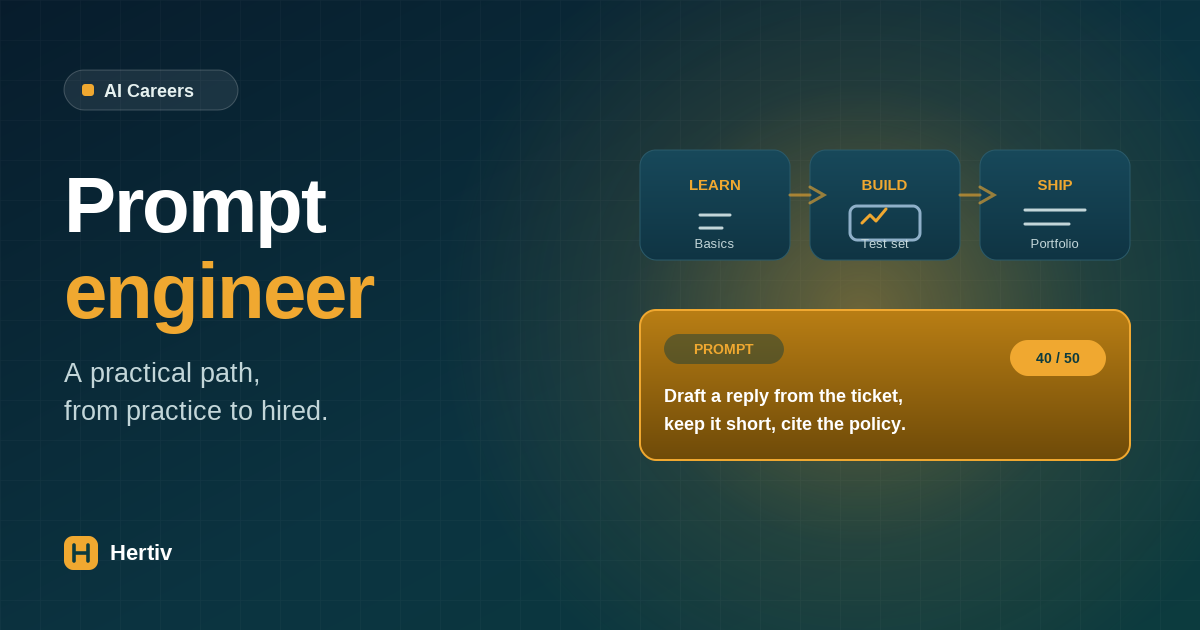
- Weeks 1-2: learn the basics. Study how models follow instructions, how context works, and how to set output formats. Practise on everyday tasks.
- Weeks 3-4: pick a field. Choose one area you know, such as support, sales or content, and collect 20 real examples of the work.
- Weeks 5-6: build a test set. Turn your examples into test cases with expected outputs, so you can score every version.
- Weeks 7-8: build two projects. Ship a small tool, such as a support reply drafter or a document summariser, with your prompts inside.
- Weeks 9-10: learn evaluation. Add scoring to your projects and track which changes actually improve results.
- Weeks 11-12: publish and apply. Write up what you built, share the test results, and apply for junior AI or product roles.
Eight hours a week is enough if the hours are spent building. Two hours of reading and six hours of building beats eight hours of reading. AI proof of concept development is a useful model for how a small prompt project becomes a real product trial.
How do you build a portfolio without a job?
You build a portfolio without a job by solving small, visible problems with prompts and showing your working. Employers want to see that you can take a messy task, design a prompt for it, test it and explain the result. Three solid examples beat ten shallow ones.
Good portfolio projects start from a real task. A support reply drafter trained on your own past emails, a contract clause summariser, or a product description writer for a shop you know are all stronger than a generic chatbot. For each project, show the task, the prompt, a few test cases, and what you measured: how often the output was usable, where it failed, and what you changed.
Write each project up in plain language. State the problem, show the test results, and be honest about the limits. A write-up that says the model handled 80 out of 100 test cases and failed on the other 20, with reasons, is far more convincing than one that claims everything worked. Machine learning development covers the wider engineering work your prompts will sit inside.
Example (hypothetical): a 12-week learning plan
Example (hypothetical): a support agent wants to become a prompt engineer and has 8 hours a week for 12 weeks. That is 12 times 8, which is 96 hours in total, and the plan splits those hours across four kinds of work.
The split is 30 hours of prompting practice on real support tickets, 24 hours learning how models behave and how to structure instructions, 18 hours building a test set and scoring results, and 24 hours building a portfolio project that drafts support replies. Adding them up, 30 plus 24 plus 18 plus 24 equals 96 hours, which matches the time available.
By week 12 the agent has a test set of 50 real tickets, a reply-drafting tool that handles the common cases, and a write-up showing that the tool produced usable drafts for 40 of the 50 test tickets, with the other 10 needing human edits. That write-up, not a certificate, is what gets the interview.
What are the common mistakes?
The most common mistakes are collecting certificates instead of building, testing by feel instead of with a test set, and copying prompts without understanding them. Each of these slows learning and shows up quickly in an interview.
- Collecting certificates. Courses help, but employers ask what you built, not what you watched.
- Testing by feel. Trying a prompt once and deciding it works is not testing; a test set with real inputs is.
- Copying prompts blindly. A prompt written for one model and one task rarely works unchanged in another setting.
- Ignoring evaluation. If you cannot score output, you cannot tell whether a change helped or hurt.
- Skipping the basics. Prompting without basic Python and API skills leaves you unable to ship anything.
- Staying generic. A prompt engineer with no field to apply the skill to is hard to hire; pick one and go deep.
Prompt engineering rewards people who test, measure and ship. Start small, keep a test set, and let the results speak for you.
Key takeaways
- Prompt engineering is method, not clever phrasing: test, measure and improve
- Clear writing, task analysis, basic Python and evaluation matter most
- A test set with real inputs is what separates real work from chatting
- Three solid portfolio projects beat ten shallow ones
- Pick one field you know and build your examples there
Frequently asked questions
Do I need a degree to become a prompt engineer?
No. Employers look for a portfolio of finished prompt work, a test set and measured results. A degree in machine learning helps for research roles, but most prompt engineering jobs value practical skill and domain knowledge more.
How long does it take to become a prompt engineer?
With about 8 hours a week of focused building, most people can reach a hireable level in around 12 weeks. The time must be spent writing prompts, testing them and shipping small projects, not only reading about them.
Do I need to learn programming?
Yes, at least basic Python. Prompts live inside software, so you need to call APIs, handle data and run tests. You do not need to train models, but you do need to read code and ship small tools.
What should my portfolio include?
Two or three finished projects, each with the task, the prompt, test cases and measured results. Show where the model failed and what you changed. Honest results are more convincing than perfect ones.
Is prompt engineering a real job or a passing trend?
It is a real skill inside product, support and AI teams, even when the job title differs. The work of designing, testing and measuring model instructions will keep mattering as long as teams ship products built on language models.
Should I learn fine-tuning as well?
Later, yes. Start with prompting, since it solves most tasks faster and cheaper. Learn fine-tuning once you can show when prompting is not enough, which is a judgement employers value.


