How Long Does It Take to Build an AI Agent?
A simple AI agent takes a few weeks; a production agent with tools, guardrails and evaluation takes two to four months. Here is what sets the timeline.
On this page
Short answer
A simple AI agent that answers questions from one knowledge base usually takes two to four weeks to build. A production agent that calls several tools, follows guardrails and passes evaluation usually takes two to four months. The difference comes from tool connections, testing and integration, not from the model itself.
How long does it take to build an AI agent?
An AI agent is software that takes a goal, plans steps, uses tools and data, and acts on its own until the task is done or it needs a human. A simple agent that answers questions from one knowledge base usually takes two to four weeks to build, while a production agent that calls several tools, follows guardrails and passes evaluation usually takes two to four months.
The gap between those two numbers comes from everything around the model: connecting tools, writing prompts that behave, testing failure cases, and wiring the agent into systems people already use. The model itself is the fastest part of the build.
| Agent type | Typical build time | What it includes |
|---|---|---|
| FAQ or support agent | 2-4 weeks | One knowledge base, no tools that change anything |
| Research assistant | 3-6 weeks | Search and documents, short summaries |
| Workflow agent, 2-3 tools | 6-10 weeks | Tool connections, human review, basic logging |
| Multi-step agent with guardrails | 10-16 weeks | Several tools, guardrails, evaluation set, monitoring |
| Multi-agent system | 3-6 months | Several agents, shared state, coordination rules |
Use the table to set expectations before you commit to a date. A team that plans for a four-week build and then adds tool use, human review and evaluation will miss the date by months, not days.
What makes a simple agent fast to build?
A simple agent is fast to build when it does one job, reads one source of truth, and has no tools that change anything. The team writes one prompt, connects one document set, and tests it against real questions from users.
Most of the work is the knowledge base. Clean help articles, product docs or policy pages give the agent good answers; messy or outdated pages give it bad ones, and no amount of prompt tuning fixes that.
- One job. The agent answers questions or drafts replies, not five different tasks.
- One data source. A help centre or a document set the team already trusts.
- Read-only. The agent reads and writes drafts, but it does not change orders, records or money.
- One channel. Chat or email, not every channel at once.
- Human handoff. Edge cases go to a person instead of getting a guessed answer.
A support team can often ship a simple agent in a month if the docs are ready. If the docs are not ready, the first two weeks go to writing them, and the timeline moves with it.
Why do production agents take two to four months?
A production agent takes longer because it must work for every user, not just the happy path. It needs tool connections that fail safely, guardrails that stop bad actions, logging so the team can see what happened, and an evaluation set that measures quality before each release.
Each tool adds a week or more. The team must agree what the tool can and cannot do, handle its errors, and test what happens when the tool is slow or down. Three tools can add a month on their own.
Evaluation is the other large cost. A set of 50 to 100 real tasks, scored by a human, shows whether a change helped or hurt. Without it, the team ships blind and finds problems from users instead of tests.
A proof of concept is the fastest way to learn the real timeline. Build a small AI proof of concept first, and measure how long each part actually takes before promising a launch date.
The build in six steps
A typical agent build follows six steps, and the order matters. Skipping the evaluation step is the most common reason a build that looked done takes another month.
- Pick one job and one user. Write down the task, who uses it, and what a good result looks like.
- Gather the data. Clean the documents or records the agent will read, and name one owner for them.
- Wire one tool at a time. Connect the first tool, test its failures, then add the next one.
- Add guardrails. Decide what the agent may never do, and block those actions before launch.
- Build the evaluation set. Collect real tasks, score the agent on them, and fix the worst failures first.
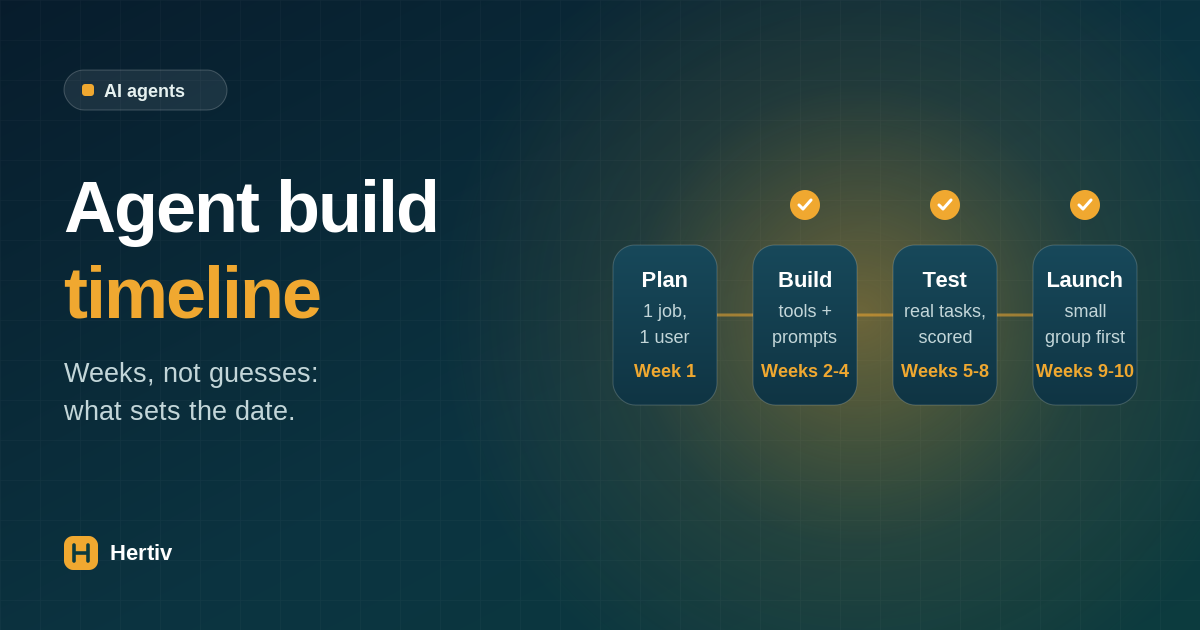
- Launch to a small group. Start with a quarter of users, watch the failures, and widen the rollout only when the scores hold.
Steps one and two decide the timeline more than the coding does. A clear job and clean data can cut a month off the build; a vague job and messy data can add one.
Example (hypothetical): a support agent in ten weeks
Example (hypothetical): a 20-person support team wants an agent that answers order and delivery questions from its help centre. The plan runs ten weeks: two weeks to clean the help centre, three weeks to build the agent and connect the order lookup tool, three weeks to test it on 200 past tickets, and two weeks to launch it to a quarter of customers.
Testing shows the agent answers 140 of the 200 tickets well enough to send, and a human reviews the other 60. That gives the team a clear launch rule: send the 140, route the 60 to a person, and review the failures each week.
The team also budgets one week after launch for fixes. Most agents need a small round of prompt and tool fixes in the first two weeks of real use, and planning for it keeps the launch calm.
What slows a build down?
Three things slow an agent build down more than any other: unclear ownership of the data, tools that were never built to be called by software, and a scope that grows each week. Each one can add a month if it is found late.
- No data owner. Nobody can say which document is current, so the agent learns from stale pages.
- Weak tool APIs. A tool that works in a demo can fail under real load or return errors the agent cannot read.
- Growing scope. A new job is added every week, so the agent is never finished enough to test.
- No evaluation set. The team argues about quality instead of measuring it.
- Late security review. The review starts the week before launch and finds a data problem.
Security and privacy review is the delay teams forget most often. If the agent touches customer data, the review should start in week one, not the week before launch.
Common mistakes
The most common mistake is promising a date before the tools are tested. A tool that works in a demo can fail under real load, and the fix is rarely a one-line change.
- Promising a date before testing tools. Test each tool under real load before the launch date is set.
- Building five jobs at once. One job shipped beats five jobs half built.
- Skipping evaluation. Without scored tasks, every change is a guess.
- No human handoff. An agent with no way to reach a person will guess when it should ask.
- Treating launch as the end. An agent needs weekly review of its failures for the first month.
Cost and time move together, so check what it costs to build an AI agent alongside the timeline before you commit to either.
Key takeaways
- A simple agent takes 2-4 weeks; a production agent takes 2-4 months.
- Tools, guardrails and evaluation set the timeline, not the model.
- Each tool adds a week or more once errors and downtime are handled.
- A scored evaluation set is what turns a demo into a launch.
- Plan one week after launch for fixes from real use.
Frequently asked questions
How long does it take to build a simple AI agent?
A simple agent that answers questions from one knowledge base usually takes two to four weeks. That assumes the documents are clean, the agent is read-only, and a human handles the edge cases. Messy docs add time before the build even starts.
Why do production AI agents take months to build?
Production agents need tool connections that fail safely, guardrails, logging and an evaluation set. Each tool adds a week or more, and testing on real tasks takes several weeks. Those parts, not the model, set the timeline.
Can an AI agent be built in a week?
A demo can be built in a week, but a demo is not a product. It usually lacks guardrails, error handling, logging and evaluation, so it is not ready for real users. A one-week build is a good proof of concept, not a launch.
What part of an agent build takes the longest?
Tool connections and evaluation usually take the longest. Tools need error handling and testing under real load, and a scored evaluation set takes weeks to build and run. Data cleaning runs close behind when the source documents are messy.
How do I shorten an AI agent timeline?
Pick one job, one data source and one channel, and keep the agent read-only for the first version. Clean the data before coding starts, and build the evaluation set while the agent is being built, not after it.
Should I launch an agent to all users at once?
No. Launch to a small group first, watch the failures for one or two weeks, and widen the rollout only when the scores hold. A staged launch catches bad answers early, while a full launch turns every failure into a support ticket.


