What Does It Cost to Build an AI Agent?
Building an AI agent costs far more than the model bill: design, data, evaluation and running costs add up. Here is what each part costs.
On this page
Short answer
There is no single price for building an AI agent, because cost depends on scope, data readiness and how much the agent is allowed to do on its own. A small support agent with retrieval over existing help content costs far less than an agent that writes to several systems with approval gates. The sections below break the build into parts you can price one by one.
What is the cost of building an AI agent?
The cost of building an AI agent is the total of design, data preparation, development, evaluation, integration and running costs, and it varies more with scope than with the model you choose. A narrow agent that answers questions from existing documents is a small project; an agent that takes actions across several systems is a product.
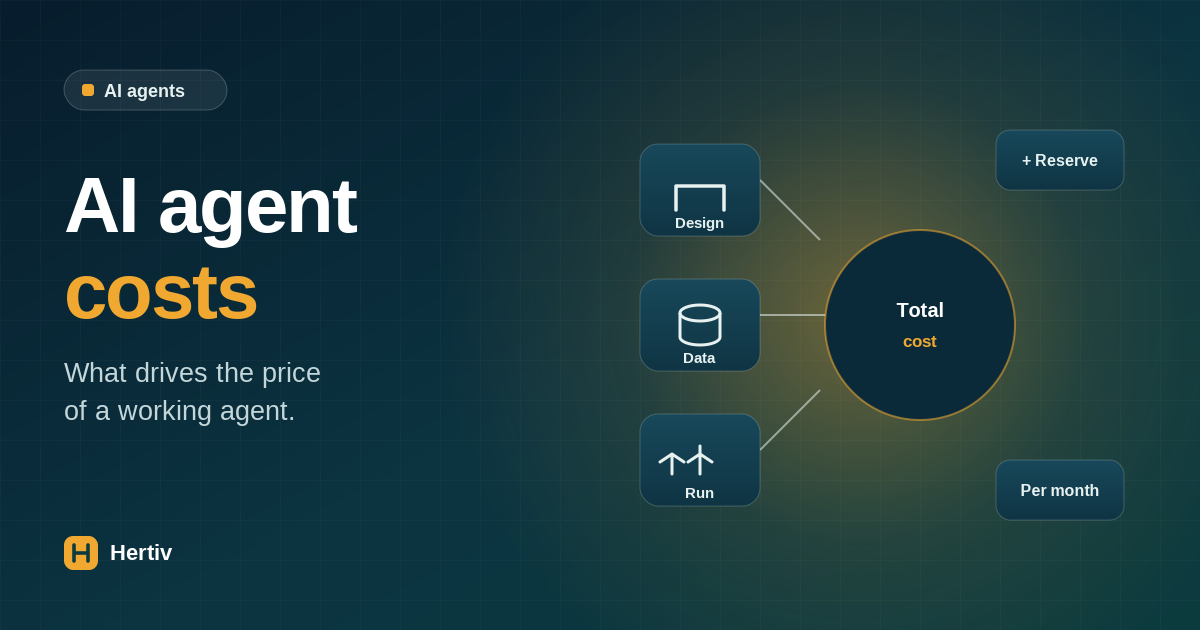
Most teams underestimate the non-model costs. The model bill is often the smallest line in the first year, while data cleaning, evaluation and integration take most of the budget. Use the table below to see where the money goes.
| Cost part | What it covers | When it is large |
|---|---|---|
| Design and scoping | Workflows, prompts, guardrails, handoff rules | Many user types or sensitive actions |
| Data preparation | Cleaning docs, building retrieval, test sets | Messy or scattered source content |
| Development | Agent logic, tools, integrations, UI | Many systems or custom tools |
| Evaluation | Test cases, human review, quality checks | High stakes or regulated answers |
| Integration | CRM, ticketing, auth, logging, monitoring | Legacy systems or strict security rules |
| Running costs | Model calls, hosting, monitoring, maintenance | High volume or large context windows |
Price each row separately for your own project. A quote that gives one number with no breakdown is a warning sign, because you cannot tell which part is driving the price.
What drives the cost up or down?
Scope drives cost more than anything else. An agent that only reads and drafts costs far less than one that writes to your CRM, issues refunds or changes bookings, because every write action needs permissions, approval gates and rollback paths.
Data readiness is the second driver. If your help centre, policies and ticket history are clean and current, retrieval works quickly. If the same policy exists in five conflicting versions, someone has to clean it before the agent can trust it, and that work is slow and manual.
Volume matters too, but later. A pilot with a few hundred conversations a month has a small model bill, while a public-facing agent with tens of thousands of chats a day needs caching, rate limits and cost monitoring from day one. Design for the volume you will have in six months, not the volume you have on launch day.
Build in-house or hire a vendor?
Building in-house costs less in fees but more in time, and it only works if you have engineers who know retrieval, evaluation and prompt design. A team that has never shipped an agent will spend the first month learning, and that learning time is part of the cost.
Hiring a vendor costs more up front but buys experience: the vendor has made the same mistakes before and brings patterns for evaluation, guardrails and handoff design. The right choice depends on whether the agent is a one-off project or the start of a programme you will run for years.
Either way, keep ownership of the evaluation set and the prompts. Those are the assets that decide quality, and you should be able to take them to another team if the relationship ends. See how much AI agent development costs for a fuller breakdown of vendor pricing.
How to estimate your agent's cost in 5 steps
Estimate in parts, not as one number. A part-by-part estimate shows where the money goes and where you can cut scope without cutting quality.
- Write down the workflows the agent will handle, and the systems it must read or write.
- List the data sources and rate their quality: clean, usable with fixes, or needs rebuilding.
- Estimate hours for design, data work, development, evaluation and integration separately.
- Price the running costs for a month at your expected volume, including model calls and hosting.
- Add a reserve of 10 to 20 percent for the fixes the evaluation will uncover.
Run the estimate past someone who has shipped an agent before. The most common error is underestimating data preparation and evaluation, which together often take as long as development. An AI readiness assessment can surface data gaps before you commit to a budget.
Example (hypothetical): a support agent for a small team
Example (hypothetical): a support team of 12 people wants an agent that drafts answers from their help centre, with a human approving every reply before it is sent. The build is scoped at 400 hours of engineering at $60 an hour, which is $24,000.
Design and prompt work add $3,000, and building the evaluation set with 200 labelled tickets adds $2,000. The build total is $24,000 plus $3,000 plus $2,000, which is $29,000. A 10 percent reserve adds $2,900, giving a launch budget of $31,900.
Running costs are $900 a month for model calls and hosting, plus $300 a month for monitoring and review time, which is $1,200 a month or $14,400 a year. Over the first year the team spends $31,900 to build and $14,400 to run, which is $46,300 in total. The agent is worth it only if it saves more staff time than that over the year.
Running costs after launch
Running costs continue for as long as the agent is live, and they grow with volume. The main lines are model calls, hosting, monitoring and maintenance, plus the human time spent reviewing the agent's work and updating its knowledge.
Model costs depend on how much text the agent reads per conversation. Long context windows and multi-step reasoning cost more than short, single-turn answers, so caching repeated content and keeping prompts tight pays off quickly. Set a monthly budget alert before launch, not after the first large bill.
Maintenance is the cost teams forget. Models change, documents go stale, and user behaviour shifts, so someone must own the agent: review failures weekly, update the evaluation set monthly, and retrain or re-prompt when quality drops. Budget at least a few hours a week for this, or the agent will quietly get worse. A proof of concept is a good way to measure real running costs before committing to a full launch.
Common mistakes when budgeting an AI agent
Most budget overruns come from treating the agent as a model problem instead of a product problem. The model is one line in the budget; the product around it is the rest.
- Budgeting only the model bill and forgetting data, evaluation and integration
- Skipping the evaluation set, then paying to fix quality problems in production
- Letting the agent write to systems without approval gates, then paying for the cleanup
- Designing for pilot volume and rebuilding when real users arrive
- Treating launch as the end of spending, with no budget for monitoring or maintenance
- Comparing vendor quotes that cover different scopes, and picking the cheaper one by mistake
Start with a narrow agent, measure the real costs for a month, and expand only when the numbers work. For help scoping the build, see AI agent development and the services around it.
Key takeaways
- Cost depends on scope, data readiness and what the agent may do.
- Data preparation and evaluation often cost as much as development.
- Estimate in parts, and add a 10 to 20 percent reserve.
- Running costs grow with volume: budget for monitoring and maintenance.
- Keep ownership of the evaluation set and the prompts.
Frequently asked questions
How much does a simple AI agent cost to build?
A narrow agent that drafts answers from existing documents, with human approval on every reply, is the cheapest kind to build, because it needs little integration and no write access. Costs rise sharply when the agent must read from or write to several systems, handle sensitive actions, or serve high volumes. Get a part-by-part quote, not a single number.
What is the biggest hidden cost in building an AI agent?
Data preparation is usually the biggest hidden cost. Cleaning help content, removing duplicates, fixing outdated policies and building a labelled evaluation set takes real human time, and it cannot be skipped without hurting quality. Integration with legacy systems is the second most common surprise.
Do AI agents cost a lot to run each month?
Running costs depend on volume and on how much text the agent reads per conversation. A small internal agent can cost a modest amount each month, while a public-facing agent with long context windows costs far more. Caching, short prompts and a monthly budget alert keep the bill under control.
Is it cheaper to build an AI agent in-house?
It is cheaper in fees but not always cheaper in total, because your team spends time learning agent patterns, evaluation and guardrails. A vendor costs more up front but brings that experience. The better choice depends on whether you plan to build more agents after the first one.
How long does it take to build an AI agent?
A narrow proof of concept takes a few weeks when the data is ready. A production agent with integrations, evaluation, approval gates and monitoring usually takes longer, because the work around the model takes more time than the model itself. Data readiness is the biggest schedule risk.
What should an AI agent quote include?
A good quote breaks out design, data preparation, development, evaluation, integration and running costs separately, with a reserve for fixes. It should also state who owns the prompts and the evaluation set, and what ongoing maintenance costs after launch.


