How IoT Works in Manufacturing: Parts, Flow and Example
IoT in manufacturing links sensors, networks and software into a loop that spots problems early. Here is how it works, with a factory example.
On this page
Short answer
The Internet of Things in manufacturing is a loop: sensors on machines measure vibration, temperature or output, a network carries the readings to a platform, the platform spots a problem, and the team acts on it. The loop, not the sensor, is what makes it IoT.
How does IoT work in manufacturing?
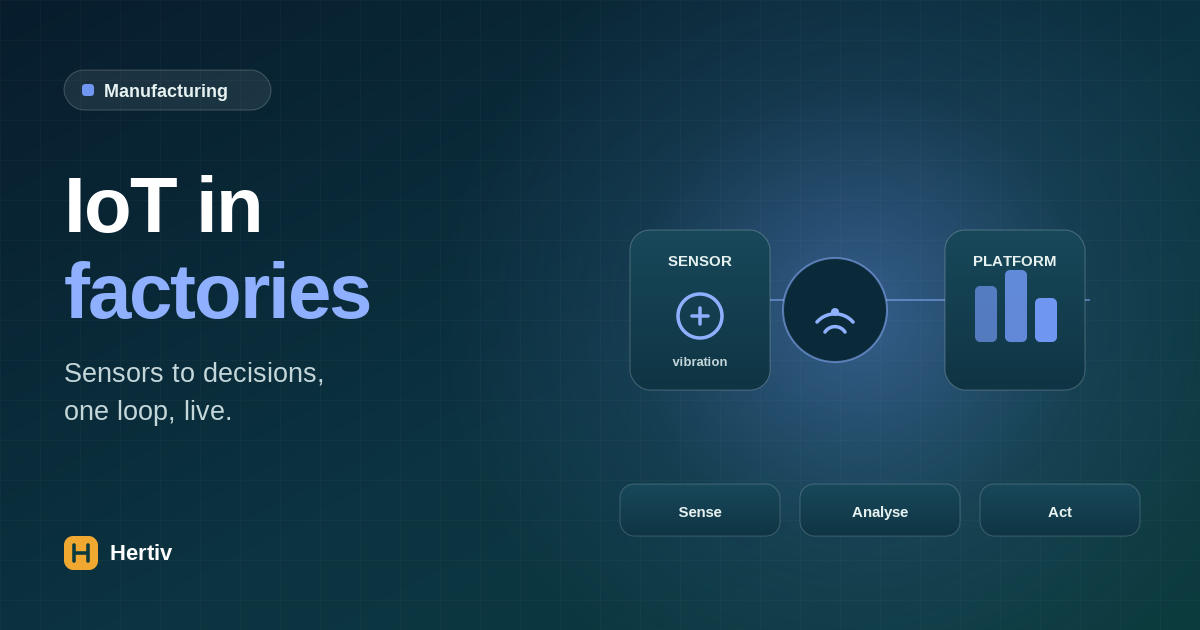
The Internet of Things (IoT) in manufacturing is a system of sensors on machines, a network that carries their readings, software that turns readings into decisions, and actions that follow. A sensor measures vibration, temperature or output; the network sends that reading to a platform; the platform spots a problem or an opportunity; and the team or the machine acts on it.
The point is not the sensor itself but the loop it creates. A machine that only reports its own state is a display; a machine whose readings change what happens next is part of an IoT system. That loop is what makes IoT different from simply logging data.
What are the parts of a manufacturing IoT system?
A manufacturing IoT system has four parts, and each one has a job. If one part is weak, the whole loop suffers: bad sensors give bad readings, a slow network delays alerts, and a platform nobody checks changes nothing.
| Part | What it does | Example in a factory |
|---|---|---|
| Sensors | Measure the physical world | Vibration, temperature, pressure, count |
| Connectivity | Carry readings to the platform | Wi-Fi, wired ethernet, cellular |
| Platform | Store, analyse and show data | Dashboards, alerts, trend charts |
| Action | Change what happens next | Maintenance order, line stop, reorder |
Most factories already have the first two parts in some form: machines with gauges and a network. The work is usually in the last two parts — turning readings into a decision someone trusts, and making sure the decision actually happens. A plain guide to IoT uses across industries is in IoT use cases across industries.
How does data flow through an IoT system?
Data flows through an IoT system in five steps, from the machine to the decision and back. Each step can be checked on its own, which makes faults easier to find.
- Sense. A sensor on a machine measures one thing, such as vibration, and records it every few seconds.
- Send. The reading travels over the factory network to a gateway or straight to the platform.
- Store. The platform stores the reading with the time and the machine it came from.
- Analyse. Rules or models compare the reading with normal behaviour and raise an alert when it drifts.
- Act. The alert reaches a person or a control system, which schedules maintenance or adjusts the line.
A break anywhere in that chain stops the loop. If alerts arrive late, the machine may already have failed; if nobody owns the alert, it is ignored. The fix is usually ownership and process, not a better sensor.
Where does IoT help most in manufacturing?
IoT helps most in manufacturing where a small change in timing saves real money: catching a machine before it fails, cutting unplanned stops, and tracking output accurately. Those are the cases where a sensor pays for itself quickly.
- Predictive maintenance. Vibration or temperature drift warns of wear before a breakdown stops the line.
- Quality checks. Readings during production catch defects early, when rework is still cheap.
- Energy use. Metering shows which machines draw power when idle, so teams can switch them off.
- Tracking output. Counts from the line give a true picture of throughput without manual tallying.
IoT helps least where the process is already stable and well understood, or where nobody will act on the alerts. A dashboard that nobody opens is a cost, not a benefit. Start with one line and one decision, and expand only when that decision improves. The tools angle is covered in how IoT tools help manufacturing companies.
Example: a packaging line that warns before it fails
Example (hypothetical): a packaging line runs 16 hours a day and stops without warning about twice a month. Each unplanned stop lasts about 3 hours and costs the team roughly 6 hours of lost output and rework, so the line loses about 12 hours a month to breakdowns.
The team fits vibration sensors to the three motors that fail most often and sets an alert when vibration rises 25% above its normal range. Over the next three months, the sensors flag 5 developing faults, and the team fixes each one during a planned 30-minute stop, so planned stops total about 2.5 hours instead of 12 hours of unplanned stops.
The saving is about 9.5 hours of line time a month, plus fewer rushed repairs. The sensors and platform cost less than one month of the old losses, so the team adds sensors to the next line only after the first one proves itself.
How do you start IoT in a factory?
You start IoT in a factory with one line, one decision and one owner. A small working loop teaches the team more than a large rollout that nobody trusts.
- Pick one decision. Choose a single choice the readings will change, such as when to service a motor.
- Pick one line. Instrument the machines on that line and leave the rest alone for now.
- Assign an owner. One person owns the alerts and the response, or they will be ignored.
- Run it for a month. Compare alerts with real faults and tune the thresholds until they are useful.
- Expand on evidence. Add lines only when the first line shows a real saving.
Budget for the platform and the process, not just the sensors: someone must watch the alerts, maintain the devices and keep the data clean. If you need help scoping the work, a custom software development partner can map the first loop with you.
What are the common mistakes?
The most common mistakes are buying sensors before naming the decision, setting alerts nobody owns, and expanding before the first line proves itself.
- Sensors without a decision. If no one can say what will change, the data will sit unread.
- Alerts without an owner. An alert that reaches no one is the same as no alert.
- Too many sensors at once. A flood of readings hides the few signals that matter.
- Ignoring the network. A weak factory network delays or drops the readings the loop depends on.
- Skipping security. Connected machines need the same access controls as any other system.
IoT is a loop, not a shopping list. Name the decision first, instrument the line that feeds it, and let the evidence decide whether to expand.
Key takeaways
- IoT in manufacturing is a loop: sense, send, store, analyse, act
- The four parts are sensors, connectivity, platform and action
- It pays off fastest in predictive maintenance, quality checks and energy use
- Start with one line, one decision and one owner
- An alert nobody owns is the same as no alert
Frequently asked questions
What is IoT in manufacturing?
IoT in manufacturing means connecting machines with sensors so their readings can be collected, analysed and acted on. A sensor measures something physical, a network carries the reading to software, and the software raises an alert or triggers an action when the reading drifts.
Do factories need new machines for IoT?
Usually not. Most IoT projects add sensors to existing machines rather than replacing them. A vibration or temperature sensor can be fitted to a motor or a press, and the readings flow over the factory network to a platform.
What is the difference between IoT and automation?
Automation makes a machine do a task without a person, while IoT makes a machine report its state so decisions can be made. The two often work together: IoT readings can trigger an automated response, such as stopping a line or scheduling maintenance.
Is IoT in manufacturing secure?
It can be, but only if the devices are treated like any other system on the network: with access controls, updates and monitoring. Connected machines that are left unpatched or openly reachable are a real risk, so security belongs in the plan from the start.
How much does factory IoT cost?
Costs vary with the number of machines, the sensors and the platform, so check the vendor site for current pricing. Most teams start with a small pilot on one line, which keeps the first cost low and shows whether the savings justify expanding.
What data does manufacturing IoT collect?
Typical readings are vibration, temperature, pressure, power use, counts and cycle times. The useful set is the one tied to a decision: if a reading cannot change what anyone does, collecting it adds cost without value.


