How IoT Tools Help Manufacturing Companies Run Better Plants
IoT tools help manufacturers see machine health, quality and energy use in real time, so teams fix issues earlier, cut downtime and make decisions from data instead of guesswork.
On this page
Short answer
IoT tools connect machines, sensors and systems so manufacturing teams get live data on equipment health, production flow and energy use. That data supports earlier maintenance, faster root-cause analysis and tighter process control.
What do IoT tools actually do in a manufacturing plant?
IoT tools in manufacturing are the combination of sensors, gateways, connectivity and software that collect data from machines and turn it into information operators and engineers can act on. They sit between the physical equipment and the business systems that plan and manage production.
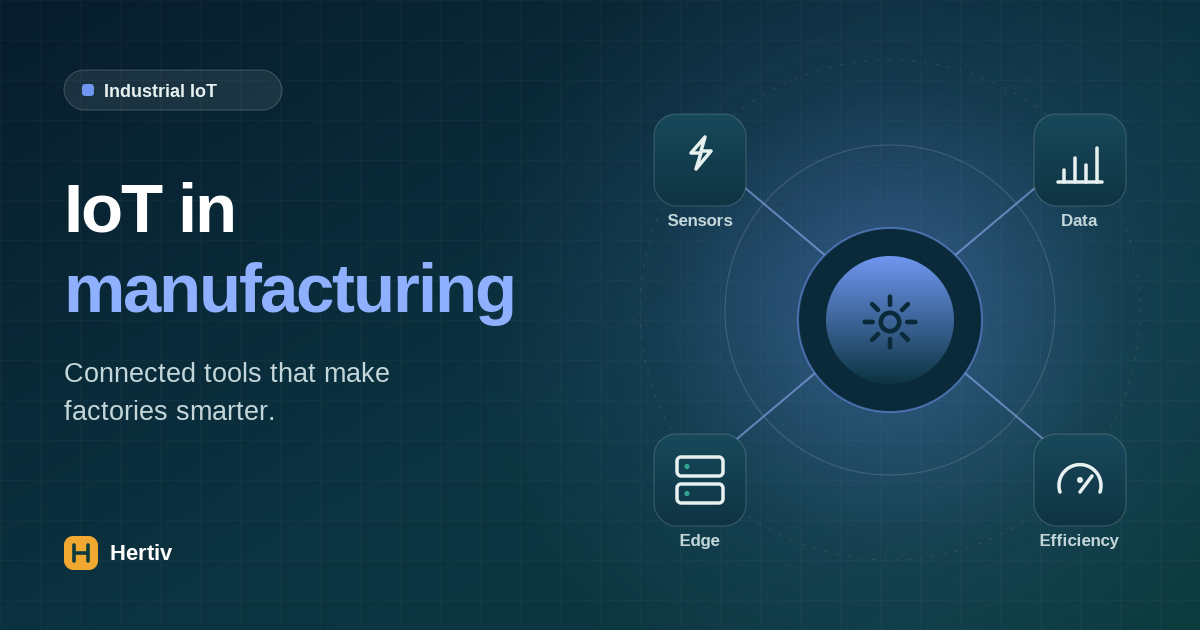
The stack has four layers:
- Sensors and edge devices measure vibration, temperature, pressure, current, flow, position or energy use.
- Connectivity and gateways move data from the shop floor to a network, using industrial protocols alongside newer options such as private wireless or low-power networks.
- Platform and storage handle time-series data, device management and integration with MES, ERP or CMMS systems.
- Applications present dashboards, alerts, anomaly detection and maintenance workflows to the people who need them.
The value is not the sensor itself. It is the decision the sensor enables: replacing a bearing before it fails, adjusting a setpoint before scrap rises, or proving which shift produced an out-of-spec batch. That is why IoT projects succeed when they start from a decision, not from a device list.
Which manufacturing problems do IoT tools solve best?
The strongest IoT use cases are the ones where a machine signal exists but nobody sees it until something breaks. The table below maps common problems to what IoT changes and what data you need.
| Problem | What IoT changes | Typical data needed | Effort |
|---|---|---|---|
| Unplanned downtime | Earlier warning of degrading equipment | Vibration, temperature, current, run hours | Medium |
| Quality variation | Links process conditions to defect rates | Process parameters, inspection results, batch IDs | Medium |
| Energy spend | Shows consumption by line, asset or shift | Meter data, production counts, shift schedule | Low to medium |
| Slow root-cause analysis | Correlates events across machines and systems | Time-synchronised machine and MES events | High |
| Manual inspections | Automates measurement and recording | Vision or sensor readings, tolerance rules | Medium to high |
| Spare parts planning | Ties consumption to actual wear | Maintenance records, part usage, asset IDs | Low |
Start with the row where the business cost is clear and the data already exists in some form. Downtime and energy are common starting points because the financial impact is easy to describe and the sensors are well understood.
How does predictive maintenance work in practice?
Predictive maintenance uses sensor data and models to estimate when equipment is likely to fail, so maintenance happens before breakdown rather than on a fixed calendar. It is the most frequently cited reason manufacturers invest in IoT, and it is also the easiest place to overpromise.
The practical pattern looks like this:
- Pick one asset class with meaningful downtime cost, such as a pump, compressor or motor.
- Install or connect sensors that capture the failure modes you care about.
- Collect a baseline of normal behaviour across operating conditions.
- Set simple thresholds or anomaly rules first; add machine learning models once you have enough labelled history.
- Route alerts into the maintenance workflow, not a separate dashboard nobody checks.
Example (hypothetical): a plant tracks 40 motors. Two unplanned failures per month cost an average of 6 hours of line time each, at a line contribution of USD 2,000 per hour. That is roughly USD 288,000 per year in lost contribution. If earlier warnings remove half of those events, the avoided cost is about USD 144,000 per year. Whether that justifies the project depends on sensor, integration and engineering costs, which vary widely by scope.
Where do IoT and AI meet on the shop floor?
IoT supplies the data that makes AI useful in manufacturing; AI turns high-volume sensor streams into alerts, forecasts and recommendations. Neither works well alone. A model without reliable data produces noise, and data without analysis sits unused.
Common combinations include anomaly detection on vibration or energy signals, computer vision for quality inspection, and forecasting that uses production and sensor data together. For manufacturers exploring this, Hertiv's AI for manufacturing work covers use-case selection through to production deployment.
A few practical points:
- Keep models close to the data where latency matters, for example on an edge device next to the line.
- Log model inputs and outputs so engineers can explain why an alert fired.
- Treat model drift as a maintenance item with an owner and a review cadence.
- Start with a small pilot that has a defined success measure before expanding.
For teams planning this step, an AI readiness assessment can clarify whether data, infrastructure and skills are in place before committing to a larger programme.
How do you connect IoT data to MES, ERP and maintenance systems?
IoT data becomes far more useful when it is joined to production context: which order was running, which operator was on shift, which batch was in the machine. That context normally lives in MES, ERP or a CMMS.
Integration usually involves:
- A clear data model that links asset IDs, work orders, batches and time stamps.
- Time synchronisation across devices, because correlating events is impossible if clocks disagree.
- An integration layer that buffers data and handles protocol translation, rather than point-to-point scripts between every system.
- Ownership rules for which system is the source of truth for each field.
Many plants already have the raw signals but lack the plumbing to combine them. Data engineering work often matters more than adding more sensors. Hertiv's data engineering services cover pipelines, storage and integration for operational data.
What are the security and network risks of plant IoT?
IoT expands the attack surface of a plant, because many devices are hard to patch, run older operating systems, or sit on networks that were never designed for outside connectivity. Operational technology outages can stop production, so security has to be part of the design.
Basic controls that reduce most risk:
- Segment OT networks from corporate IT and the internet, with controlled gateways between them.
- Inventory every connected device and who owns it.
- Change default credentials and disable unused services on devices.
- Patch where possible and isolate where patching is not possible.
- Log device and gateway activity and alert on unusual behaviour.
- Apply least-privilege access for anyone who can send commands to equipment.
Hertiv's cybersecurity services cover architecture review and controls for connected products and industrial environments.
How should a manufacturer prioritise an IoT rollout?
Prioritise by business value and data readiness, not by which vendor demo looks best. A staged rollout keeps cost and risk under control and produces evidence for the next phase.
A workable sequence:
- Define the decision. Name the decision the data will change, who makes it and how often.
- Estimate the cost of the problem. Quantify downtime, scrap, energy waste or inspection labour in money per year.
- Check data readiness. Confirm the signals exist or can be measured, and that the network can carry them.
- Build a narrow pilot. One line, one asset class, one decision, with a success metric agreed in advance.
- Review and scale. Keep what worked, retire what did not, and standardise the integration pattern before expanding.
Use a cost model early so the pilot scope matches the expected return. Hertiv's AI project cost calculator and AI ROI calculator give rough ranges to frame the discussion; real figures depend on your equipment, network and integration scope.
What mistakes should you avoid?
Most IoT disappointments come from organisational and data issues rather than sensor hardware. Avoiding a few common mistakes improves the odds considerably.
- Starting with technology instead of a decision. Buying a platform before knowing what question it answers.
- Piloting on the hardest asset. Choose something with clear signals and willing operators.
- Ignoring data quality. Missing values, drifting sensors and bad timestamps undermine every model.
- Skipping the workflow. Alerts that do not reach a person with authority to act get ignored.
- Underestimating integration. Connecting to MES and maintenance systems often takes longer than installing sensors.
- Leaving security until later. Retrofitting segmentation and access control is slower and costlier.
- No owner after handover. Someone must own each dashboard, model and device fleet once the project team moves on.
Key takeaways
- IoT turns machine-level signals into usable production data
- Predictive maintenance is usually the fastest payback area
- Start with one line or asset class, not the whole plant
- Data quality and network reliability decide whether pilots scale
- OT security must be designed in from the first sensor
Frequently asked questions
Do we need to replace existing machines to use IoT?
Usually not. Most plants retrofit sensors and gateways onto existing equipment and read data from controllers that are already there. The constraint is access to signals and network coverage, not the age of the machine.
How long does an IoT pilot take?
A narrow pilot on one asset class or line typically takes a few weeks to a few months, depending on sensor installation, network setup and integration with existing systems. Connecting to MES or maintenance software is often the longest part.
Is IoT only useful for large factories?
No. Smaller plants often see faster results because decisions are closer to the floor and approval cycles are shorter. A single high-value asset with costly downtime can justify a pilot on its own.
What skills does a manufacturing IoT project need?
It needs a mix: someone who understands the process and equipment, an engineer for sensors and networks, a developer for integration and software, and a security reviewer. Many teams fill gaps with staff augmentation or a delivery partner.
How do we measure whether IoT is working?
Pick metrics tied to the original problem, such as unplanned downtime hours, scrap rate, energy per unit produced or mean time to repair. Compare before and after over a defined period, and review whether alerts led to actions.
Can IoT data feed AI models safely?
Yes, provided access is controlled, data is clean and models are monitored. Keep sensitive operational data within approved environments, log model behaviour and review outputs before they trigger automatic actions on equipment.


