How Hybrid Smart Contracts Work: On-Chain and Off-Chain
Hybrid smart contracts pair on-chain rules with off-chain data and computation. Here is how the parts fit together and where they are used.
On this page
Short answer
A hybrid smart contract is a smart contract that combines on-chain code with off-chain data and computation. The chain holds the agreement and the funds, while oracle networks supply verified outside facts and off-chain services do work the chain cannot do cheaply.
What is a hybrid smart contract?
A hybrid smart contract is a smart contract that combines on-chain code with off-chain data and computation. The blockchain part holds the agreement and settles the outcome, while trusted off-chain services supply the facts and do the heavy work that a chain cannot do cheaply.
A plain smart contract can only use data that already lives on its own chain. That is a hard limit, because most real-world facts, such as a rainfall reading, a share price or a delivery confirmation, exist off-chain. A hybrid contract solves this by connecting the chain to outside systems through data feeds and off-chain computation.
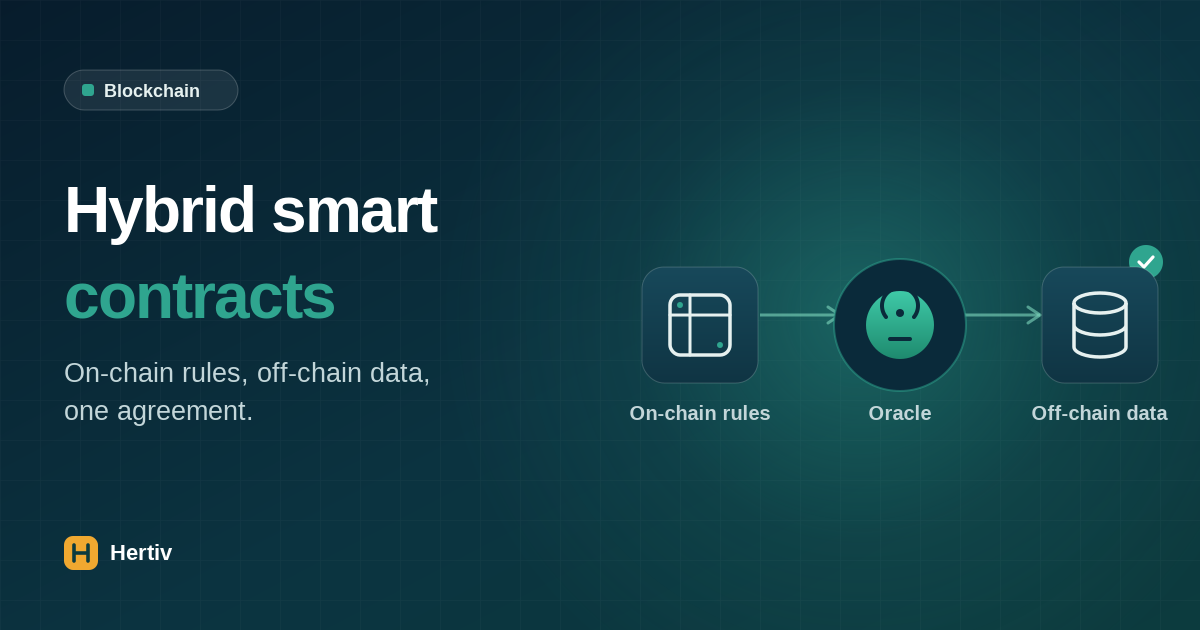
The design has three parts. The on-chain contract holds the rules and the money. An oracle network brings verified outside data onto the chain. An off-chain computation layer runs work that is too large or too private for the chain, and returns a result the contract can check. Each part does what it is good at, and the chain remains the place where the agreement is enforced.
The idea is best known from Chainlink, which popularised the term, but the pattern is general. Any contract that needs outside facts or heavy computation to settle is, in practice, a hybrid contract. For the basics of the on-chain part, see how smart contracts work.
On-chain vs off-chain: what runs where?
Deciding what runs on-chain and what runs off-chain is the central design choice in a hybrid contract. The chain is good at holding rules and money, and poor at storing large data or running heavy computation.
| Job | Where it runs | Why |
|---|---|---|
| Hold the agreement | On-chain | Rules are visible and cannot be changed quietly |
| Hold the funds | On-chain | Settlement is automatic once conditions are met |
| Fetch outside data | Off-chain oracle | Weather, prices and delivery records live off-chain |
| Heavy computation | Off-chain | Chains are slow and costly for large calculations |
| Private data | Off-chain | Personal and commercial data should not be public |
| Verify the result | On-chain | The contract checks the proof before paying out |
The rule of thumb is simple: put the promise and the money on-chain, and put the facts and the heavy work off-chain, with a verifiable link between the two. If the link is weak, the whole design is weak.
How does a hybrid smart contract work step by step?
A hybrid smart contract works by moving through a short sequence: agree the terms, gather the facts, check them, and settle. Each step is recorded so that either side can see what happened.
- Write the terms on-chain. The contract records what happens and under what conditions, for example a payout if rainfall falls below a set level by a set date.
- Lock the funds. The money for the payout is held by the contract, so the promise is backed by funds rather than by trust.
- Request the facts. When the date arrives, the contract asks an oracle network for the agreed data, such as a rainfall reading from a named source.
- Aggregate the answer. Several independent oracle nodes fetch the same reading and the network combines them, so one faulty or dishonest node cannot decide the outcome alone.
- Deliver the result on-chain. The aggregated reading is written to the chain with a proof that the contract can check.
- Settle automatically. The contract compares the reading with the threshold and either pays out or returns the funds, with no further action needed.
The critical step is aggregation. A single data source is a single point of failure, and a contract that trusts one feed is only as honest as that feed. Independent nodes and a clear rule for combining their answers are what make the design trustworthy.
What do oracles add to a smart contract?
Oracles add the outside world to a smart contract. Without them, a contract can only react to events on its own chain, which excludes almost everything a business actually cares about, from prices and weather to delivery confirmations and election results.
A good oracle service does three things. It fetches data from named sources, so users know where the number came from. It uses many independent nodes, so no single node can change the answer. And it signs its reports, so the contract can check that the data arrived unchanged.
Oracles also add off-chain computation. Some work, such as generating a random number fairly or running a pricing model, is too costly or too private for a chain. The computation runs off-chain and the result is delivered with a proof the contract can verify, which keeps the chain light while still letting it enforce the outcome.
The risk to watch is centralisation. If one company runs the only feed, the contract inherits that company's failure modes. Teams usually require several independent sources and a written rule for what happens when sources disagree. The same caution applies when choosing a smart contract audit firm: independence matters.
Where are hybrid smart contracts used?
Hybrid smart contracts are used wherever an agreement depends on a fact that lives off-chain. Insurance is the clearest case: a policy that pays when a flight is delayed or rainfall is low needs outside data, and the contract settles as soon as the data arrives.
Trade finance uses them to release payment when a shipment is confirmed delivered, with the delivery record supplied by a logistics system rather than by either trading party. That removes the argument about whether the goods arrived, because both sides agreed in advance which source counts.
Other uses include dynamic NFTs that change with real-world events, such as a token that updates when a sports result is known; prediction markets that settle on a verified outcome; and games that need a fair random number, generated off-chain and delivered with a proof the contract can check.
They are also used in finance, where a lending contract needs a live price to decide whether a loan is still covered. The pattern is the same each time: the chain holds the promise, and outside data decides when it is kept. See smart contracts in insurance for a related use case.
Example: a rainfall policy that pays itself
Example (hypothetical): a farming cooperative offers rainfall cover to 400 small farmers. Each farmer pays a premium of 50, so the pool holds 400 times 50, or 20,000. The contract states that if rainfall in the growing season falls below 200 millimetres, each affected farmer receives 100.
At the end of the season, the oracle network reports rainfall of 160 millimetres from three independent weather sources, which is below the threshold. The contract checks the reading, finds 60 farmers in the affected area, and pays 60 times 100, or 6,000, from the pool. No farmer files a claim and no adjuster visits a farm.
The remaining 14,000 stays in the pool for the next season, minus the agreed operating costs. The farmers know in advance exactly what triggers a payout and how much it is, because the terms and the data source were written into the contract before anyone paid.
The design only works if the weather sources are trustworthy and the affected area is defined precisely. A vague boundary or a single source would turn a clear rule into a dispute, which is why the cooperative agreed the sources and the area in writing first.
What are the common mistakes?
The most common mistakes with hybrid smart contracts are trusting a single data source, writing vague triggers, and forgetting that the off-chain parts need the same care as the on-chain code.
- One oracle, one failure. A contract that trusts a single feed inherits every failure of that feed. Use several independent sources and a written rule for disagreements.
- Vague trigger conditions. If the rainfall threshold, the measurement point or the date is unclear, the payout will be disputed no matter how good the code is.
- Ignoring the off-chain code. The computation layer can have bugs too, and it is not protected by the chain. Review it with the same care as the contract.
- No fallback when data is missing. Sources go down. Agree in advance what happens if the reading never arrives: delay, use a backup source, or return the funds.
- Putting private data on-chain. Keep personal and commercial data off-chain and store only the proof, as with any contract design.
- Skipping the audit. A hybrid design has more moving parts than a plain contract, so a review should cover the contract, the oracle setup and the computation layer together.
Key takeaways
- A hybrid smart contract pairs on-chain rules with off-chain data, because most real-world facts live off-chain
- Oracles fetch and aggregate outside data, so no single source can decide the outcome alone
- The chain holds the promise and the money; facts and heavy computation run off-chain with a verifiable link
- Insurance, trade finance and lending are the clearest uses, since each depends on an outside fact
- A single data source, a vague trigger or a missing fallback is what breaks most hybrid designs
Frequently asked questions
How is a hybrid smart contract different from a normal one?
A normal smart contract can only use data already on its own chain. A hybrid contract connects to outside systems through oracle networks, so it can react to prices, weather, delivery records and other real-world facts.
What is an oracle in a smart contract?
An oracle is a service that brings verified outside data onto a blockchain. Good oracle networks use many independent nodes that fetch the same fact and combine their answers, so one faulty or dishonest node cannot decide the outcome.
Why not put everything on-chain?
Chains are slow and costly for large data and heavy computation, and anything stored on a public chain is visible to everyone. Private data and large calculations belong off-chain, with only a verifiable result delivered to the contract.
Do hybrid smart contracts need Chainlink?
No. Chainlink popularised the term and is the best-known oracle network, but the pattern is general. Any design that pairs on-chain rules with verified off-chain data and computation follows the same idea.
What happens if the oracle data never arrives?
That is why a fallback matters. Agree in advance whether the contract waits, switches to a backup source, or returns the funds. Without a fallback, money can sit locked while the parties argue.
Are hybrid smart contracts safe to use today?
They are used in insurance, trade finance and lending, but they have more moving parts than a plain contract. A review should cover the on-chain code, the oracle setup and the off-chain computation together before real money is involved.


