How Blockchain Verification Works, Step by Step
Blockchain verification is the set of checks nodes run before accepting a transaction or a block. Here is what gets checked, and how to check a payment yourself.
On this page
Short answer
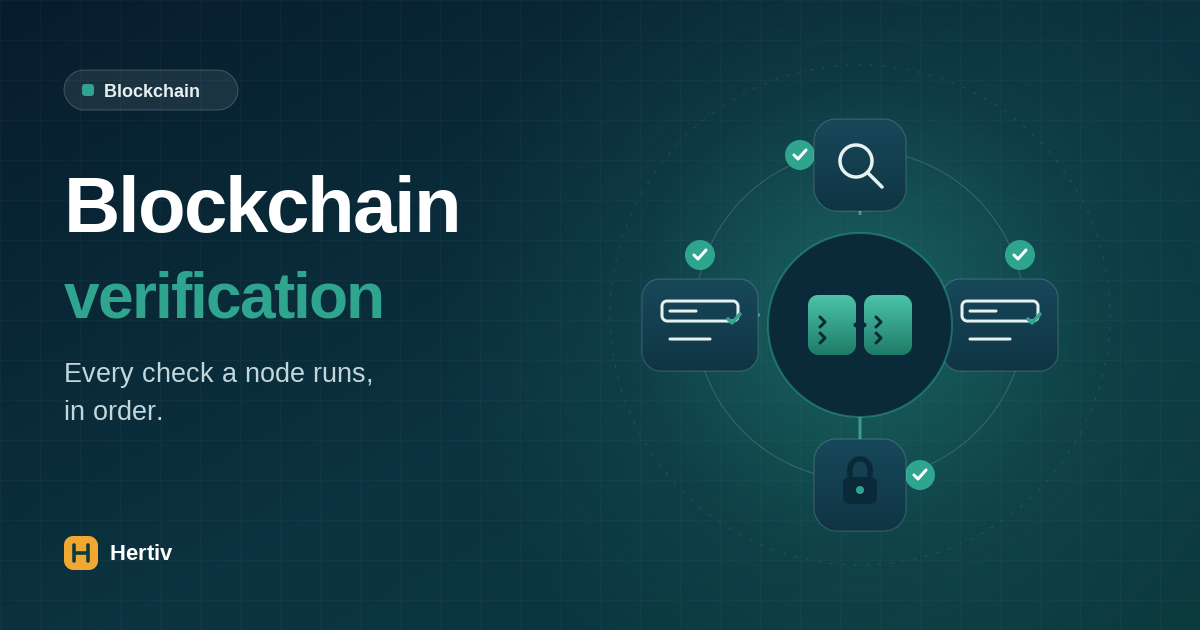
Blockchain verification is the process nodes use to check that a transaction is genuine and allowed before it is added to the ledger. Each node checks the signature, the inputs and the format, then checks that the block links correctly to the one before it. Once enough nodes agree, the transaction is confirmed, and each later block makes it harder to change.
What is blockchain verification?
Blockchain verification is the set of checks that network nodes run on a transaction and a block before they accept them as part of the shared ledger. A node is a computer that holds a copy of the ledger and follows the network rules, and it runs the same checks as every other node.
Verification is not the same as agreement. Verification asks whether a transaction follows the rules. Agreement, or consensus, asks which valid block comes next. A transaction must pass verification before it can even be considered for a block. If you are new to the idea, what blockchain is explains the shared ledger first.
A failed check means rejection, not a warning. A node that receives a transaction with a bad signature or a spent input drops it and does not pass it on. There is no central authority to appeal to, which is why the checks have to be exact and the same on every node.
What does a node check before it accepts a transaction?
A node runs several checks on every transaction, in roughly the same order each time. The first failed check stops the process, so a bad transaction is dropped quickly.
| Check | What it proves | How it fails |
|---|---|---|
| Signature is valid | The sender approved this payment | Wrong key or changed details |
| Inputs are unspent | The money has not already been spent | Double spend attempt |
| Format is correct | The transaction follows network rules | Missing fields or bad values |
| Amounts add up | Outputs do not exceed inputs plus fee | Money created from nothing |
| Sender has the funds | The balance covers the payment | Payment larger than the balance |
The signature check is the most important. A transaction is signed with the sender's private key, and any node can confirm the signature with the matching public key. If the details were changed after signing, the signature no longer matches and the transaction is rejected. The same checks apply on every chain, though the exact rules differ, which is part of blockchain security as a whole.
How is a block verified and added to the chain?
A block is verified in two parts: the transactions inside it, and the block itself. Both must pass before the block joins the chain.
- Transactions are gathered. Nodes collect valid transactions into a pool of unconfirmed work.
- A block is proposed. One node, chosen by the network's consensus rules, bundles a set of transactions into a candidate block.
- Other nodes check the block. They re-run the transaction checks, confirm the block format, and confirm that the block links to the previous block by its hash.
- The network agrees. If enough nodes accept the block, it is added to the chain and every copy of the ledger updates.
- Later blocks confirm it. Each new block built on top adds one confirmation, which makes the earlier block harder to change.
The hash link is what makes history hard to rewrite. Each block contains the hash of the block before it, so changing one block would break the link and force the attacker to redo every block after it. How the network picks the next block is a separate question, covered in what a consensus mechanism is.
How can you verify a transaction yourself?
You do not need to run a node to check a payment. A block explorer is a public search tool for a blockchain: paste in a transaction ID and it shows the status, the confirmations, the inputs and the outputs.
When you check a payment, look for three things. First, that the transaction exists at all, which means it was accepted. Second, how many confirmations it has, which tells you how settled it is. Third, that the amount and the destination address match what you agreed. If any of these is wrong, do not treat the payment as received.
How many confirmations are enough depends on the amount. Small payments are often accepted after one or two confirmations, while large payments usually wait for several. There is no single number that fits every network or every amount, so agree the number with the other party before the payment is sent.
How does verification differ on permissioned chains?
On a permissioned chain, the members are known companies or institutions, and only approved validators may check and add blocks. The transaction checks are the same — signatures, inputs, format and balances — but the agreement step uses voting among a small, named set of validators instead of open competition.
This makes verification faster, because fewer validators need to agree, and it makes the record private, because only members can read it. The trade-off is openness: an outsider cannot run a node and check the record for themselves. They have to trust the members and the audit trail the members publish.
Permissioned chains suit groups that already know each other, such as banks sharing settlement records or companies tracking goods through a supply chain. A public chain suits cases where anyone must be able to verify the record without asking permission.
Example (hypothetical): a shop checks a customer payment
Example (hypothetical): a small online shop accepts crypto payments and receives 40 of them a month. Each payment is checked by hand in a block explorer before the order ships.
Checking one payment takes 3 minutes: paste the transaction ID, confirm the amount and address, and note the confirmations. For 40 payments that is 120 minutes, or 2 hours, a month. The shop then adds a simple automated check that reads the same explorer data and flags anything that does not match. The automated check takes 30 seconds per payment, or 20 minutes a month for all 40, saving 100 minutes a month.
The shop still waits for confirmations before shipping. A payment with no confirmations is treated as pending, and an order over $500 waits for three confirmations. The rule is written down, so any staff member can follow it without guessing.
What are the common mistakes?
The most common mistakes in blockchain verification are treating an unconfirmed payment as final, and trusting a screenshot instead of the chain itself.
- Treating zero confirmations as final. A transaction in the pool can still be dropped; wait for confirmations.
- Trusting a screenshot instead of the explorer. A screenshot can be edited. Check the transaction ID yourself.
- Assuming verification proves the sender is honest. Verification proves the payment is valid, not that the goods will arrive.
- Confusing verification with consensus. Verification checks the rules; consensus picks the next block. Both matter, and they are different jobs.
- Expecting public audit on a private chain. A permissioned chain is verifiable by its members, not by the public.
Verification is a mechanical job: the same checks, run the same way, on every node. That sameness is the point. When every node agrees on what counts as valid, no single party needs to be trusted. If you are building on a chain and want the checks reviewed by specialists, a smart contract audit looks at the code that runs on top of those checks.
Key takeaways
- Verification is the set of checks nodes run; consensus is how they agree on the result.
- A transaction must pass signature, input, format and balance checks before it is accepted.
- Each block links to the previous one by hash, so changing history means redoing the chain.
- Confirmations count the blocks built on top of yours; more confirmations mean a safer payment.
- Anyone can check a transaction in a block explorer; never trust a screenshot.
Frequently asked questions
What does it mean for a transaction to be verified?
It means nodes have checked its signature, its inputs and its format against the network rules and found it valid. A verified transaction is one the network has accepted, not one a person has approved by hand.
How many confirmations make a payment safe?
There is no single number. Each confirmation is another block built on top of yours, which makes reversal harder. Small payments are often accepted after one or two, while large payments usually wait for several.
Who verifies transactions on a blockchain?
Every full node on the network runs the same checks independently. No single node or company decides; a transaction is accepted only when the nodes that follow the rules agree it is valid.
Is verification the same as consensus?
No. Verification is checking that a transaction and a block follow the rules. Consensus is the process the network uses to agree on which valid block comes next. Verification happens first; consensus decides the order.
Can a verified transaction still be a scam?
Yes. Verification proves the payment itself is genuine and correctly formed. It says nothing about the person you paid or whether they will deliver what they promised. Check the seller separately before you pay.
How do I check a transaction myself?
Paste its ID into a block explorer for that network. You will see whether it is confirmed, how many confirmations it has, and the inputs and outputs. If it does not appear, it has not been accepted yet.