What Does Healthcare Software Cost in the Middle East?
Healthcare software in the Middle East costs as much as its scope, compliance work and integrations demand. Learn what drives the budget and how to plan it.
On this page
Short answer
Healthcare software development in the Middle East has no single price, because the budget depends on scope, compliance work and integrations with local systems. A small clinic tool costs far less than a hospital platform with patient records, billing and telehealth. The reliable way to budget is to price the work in parts, design, build, testing, compliance and launch, and to keep a reserve for changes.
What does healthcare software cost in the Middle East?
Healthcare software development in the Middle East is custom software built for clinics, hospitals and health platforms in the region, and its cost is the total budget for design, build, testing, compliance and launch. There is no single price, because a booking tool for one clinic and a hospital platform with patient records, billing and telehealth are different projects with different amounts of work.
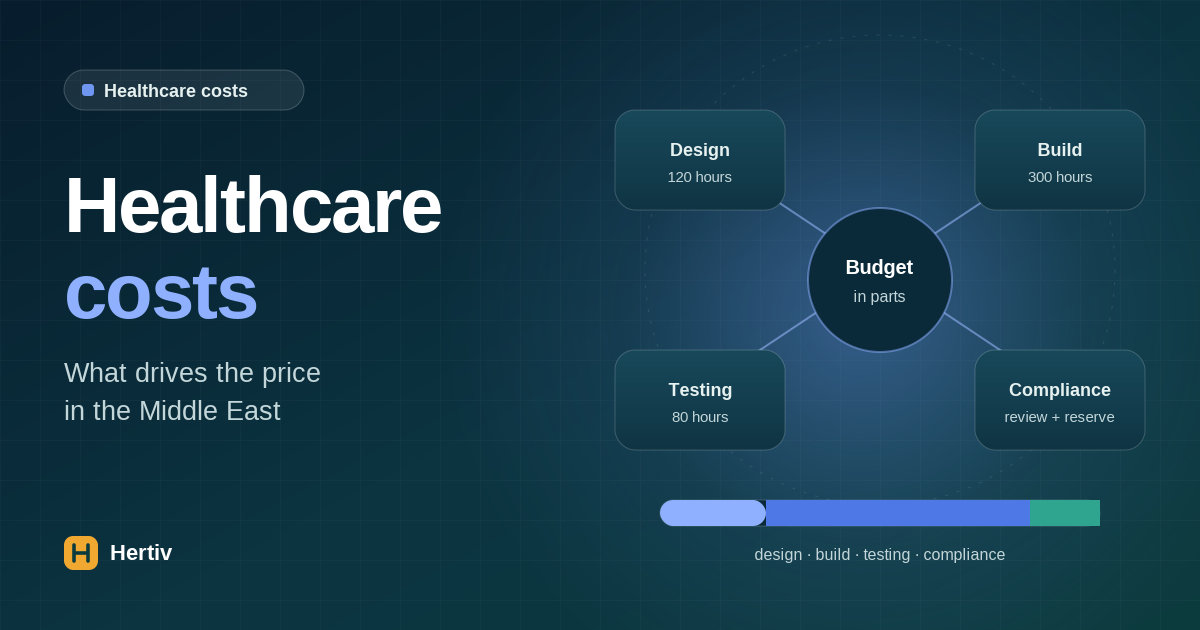
The budget is best understood as a sum of parts. Each part, design, build, testing, compliance and launch, can be priced on its own, and the total is the sum of the parts plus a reserve for change. The table below shows what each part covers and what makes it more or less expensive.
| Part | What it covers | What changes the cost |
|---|---|---|
| Design | Screens, flows and prototypes for staff and patients | Number of screens and languages needed |
| Build | The working software, records, billing and messaging | Number of features and integrations |
| Testing | Checks that the software works and stays safe | How much patient data the system touches |
| Compliance | Data rules, consent handling and audit logs | Local law and where data must be stored |
| Launch and support | Hosting, training and fixing problems after launch | Hours of support and hosting location |
Teams in the region often start by comparing their project with a similar one they have already built. A guide to software development costs in Dubai shows how the same kind of scoping works for general software, and the same logic applies to healthcare builds.
What drives the cost up or down?
Scope is the largest driver. Every extra feature, patient records, e-prescriptions, lab results, insurance claims, adds design, build and testing time, and it adds testing for the ways the features interact. A narrow tool with one clear job is cheaper than a platform that tries to cover every department at once.
Integrations are the second driver. A system that must talk to a hospital information system, a lab, a pharmacy and an insurer needs work on each connection, plus testing when any of those systems change. Standalone tools avoid that cost, but they also give staff more manual work.
The third driver is the team. Senior developers and clinical reviewers cost more per hour, but they make fewer errors in work where an error can affect care. A team that knows healthcare rules usually finishes faster than a cheaper team that has to learn them during the project.
How do Middle East rules shape the budget?
Data protection law is the main budget factor in the region. The UAE and Saudi Arabia each have a personal data protection law, and health data is treated as sensitive data under both. A build must include consent handling, access controls, audit logs and a plan for where data is stored, and each of those items needs design and testing time.
Data residency often adds cost. Some health authorities and hospital groups require patient data to stay inside the country, which can mean local hosting instead of a global cloud region. Local hosting can cost more, and it needs a team that can operate it.
Language and local practice matter too. A product used in the region usually needs Arabic and English, right-to-left layouts and date and calendar formats that match local use. These are not small additions: every screen and message needs review in both languages.
What does a healthcare build usually include?
Most healthcare builds include a small set of core features. Patient records and appointments sit at the centre, with billing, prescriptions and messaging around them. Telehealth and lab results are common additions, and reporting for managers and regulators usually follows.
- Patient records and visit history. The record every other feature reads and writes.
- Appointments and reminders. Booking, changes and messages to patients.
- Billing and insurance claims. Charges, claims and payment records.
- Prescriptions and lab results. Orders from clinicians and results back to them.
- Telehealth video visits. Remote appointments with notes and follow-up.
- Reports for managers and regulators. Counts, outcomes and audit-ready records.
A breakdown of telemedicine app costs shows how video visits and scheduling change the budget, and the same pattern holds for other features: each one adds build time, testing time and support work.
The features that cost the most are the ones that touch money or safety. Billing and insurance claims need exact arithmetic and audit trails, and anything that touches a diagnosis or a prescription needs extra review. Teams usually build those features last, after the core flows work.
How to plan the budget in five steps
A clear budget starts with a clear scope. Write down the users, the jobs they do, and the systems the software must talk to, then price each part separately so a change in one part does not hide inside a single big number.
- List the users and the jobs each one does, and cut any job that can wait until after launch.
- Price design, build, testing, compliance and launch as separate lines.
- Get a written view from a local legal adviser on data rules before you fix the scope.
- Add a reserve of about 10 percent for changes found during testing.
- Agree what "done" means for each line, so the budget has a clear end point.
Keep the reserve visible in the budget rather than hiding it inside other lines. When testing finds a problem, the reserve pays for the fix without a new approval round, which keeps the launch date intact.
Example (hypothetical): a clinic booking system
Example (hypothetical): a clinic in the region plans a booking system with patient records, appointments and reminders, in Arabic and English, hosted locally. The team prices the work in hours: 120 hours for design, 300 hours for build and 80 hours for testing, a total of 500 hours.
At 60 dollars an hour, the 500 hours cost 30,000 dollars. The team adds 3,000 dollars for a compliance review and 2,000 dollars for launch and first-year hosting, which brings the total to 35,000 dollars. A 10 percent reserve adds 3,500 dollars, so the full budget is 38,500 dollars.
The example shows why the reserve matters. If testing finds that the Arabic layout breaks on small screens, the fix comes from the reserve, and the launch date stays. Without the reserve, the same fix needs a new budget decision.
What are the common mistakes?
The most common mistake is fixing a price before the scope is clear. A team that agrees a total first and writes the scope later will cut testing or compliance when the money runs short, and both cuts show up after launch.
The second mistake is treating compliance as a final check. Data rules shape the design of records, consent and access, so a review at the end usually finds problems that are expensive to fix. Bring the legal view in before the build starts.
The third mistake is buying on hourly rate alone. A cheaper team that has never built healthcare software can cost more in total, because it spends more hours learning the rules. Ask for a healthcare project the team has finished, and talk to the people who run it. A shortlist of healthcare software companies is a useful starting point for that check.
Key takeaways
- Price healthcare software in parts: design, build, testing, compliance and launch
- Scope, integrations and team experience drive the total more than any single feature
- Data protection law and data residency shape the budget from the start
- Arabic and English support is a real cost, not a late addition
- Keep a visible 10 percent reserve for fixes found during testing
Frequently asked questions
How much does healthcare software cost in the Middle East?
There is no single price, because the budget depends on scope, compliance work and integrations. A small clinic tool costs far less than a hospital platform. Price the work in parts and keep a reserve, rather than trusting a single headline figure.
What affects the cost most?
Scope affects it most: every feature adds design, build and testing time. Integrations with hospital, lab and insurer systems come next, followed by compliance work and the experience of the team. A narrow first version is usually the cheapest way to start.
Do data laws change the budget?
Yes. Health data is sensitive data under data protection law in the UAE and Saudi Arabia, so consent handling, access controls, audit logs and storage location all need design and testing time. Local hosting can also cost more than a global cloud region.
Should the software support Arabic and English?
Yes, if staff and patients use both languages. Every screen and message needs review in both languages, and right-to-left layouts need their own testing. Plan for this from the start, because adding a second language late costs more.
How long does a healthcare build take?
It depends on scope, but a small clinic tool often takes a few months while a hospital platform takes much longer. The budget plan in this article, scope first, price in parts, keep a reserve, also gives a realistic view of the timeline.
Is a fixed price or hourly billing better?
Fixed price suits a clear, narrow scope with a written list of features. Hourly billing suits work where the scope will change during the build. Either way, agree what counts as done for each part before work starts.


