How Much Does Telemedicine App Development Cost?
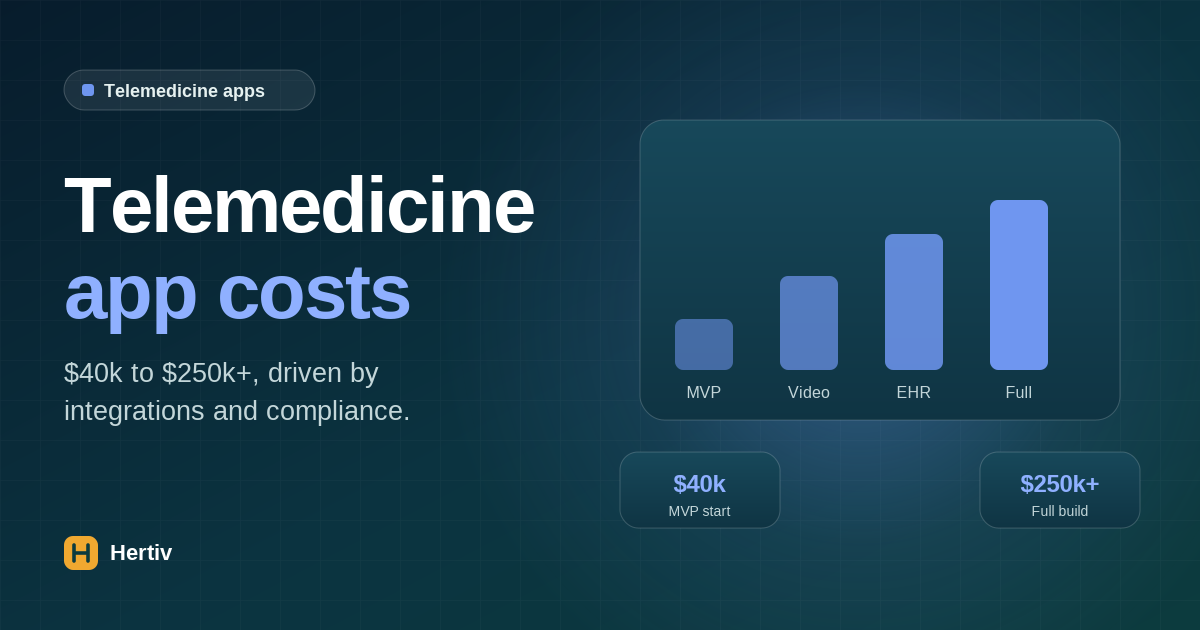
Telemedicine app development costs typically range from $40,000 for an MVP to over $250,000 for a full platform. Main cost drivers: video, compliance, integrations.
On this page
Short answer
Telemedicine app development typically costs $40,000 to $250,000 or more, depending on scope. An MVP with video visits and scheduling sits at the low end; EHR integrations, e-prescribing, multi-state compliance and native apps push it higher.
What does telemedicine app development actually include?
Telemedicine app development is the design, build and launch of software that lets patients and clinicians consult remotely, typically through video, messaging and scheduling. The cost depends less on the video call itself and more on everything around it: identity, consent, records, payments and compliance.
A typical build has five layers:
- Patient app (iOS, Android, sometimes web): registration, booking, intake forms, video, prescriptions, payments.
- Clinician app or dashboard: queue, patient history, notes, e-prescribing, video.
- Backend and APIs: scheduling logic, notifications, records, audit logs.
- Integrations: EHR/EMR, payment gateway, pharmacy, lab, identity verification.
- Compliance and security: HIPAA in the US, GDPR in the EU/UK, data residency in the Middle East, plus encryption and access controls.
Most budget overruns come from the last two layers, not from the UI. Teams that plan for them in discovery usually get a more accurate estimate. A short paid discovery is the cheapest way to turn a range into a number; see how Hertiv scopes an MVP before quoting.
Typical cost ranges by scope
The table below shows typical ranges that vary by scope, region and team. Treat them as planning bands, not quotes.
| Scope | What's included | Typical range (USD) |
|---|---|---|
| Clickable prototype | Figma flows, no code | $5k–$15k |
| Basic MVP | Scheduling, video, messaging, one platform | $40k–$90k |
| Cross-platform MVP | iOS + Android + web, payments, notifications | $70k–$140k |
| EHR-integrated platform | Above plus FHIR/HL7, e-prescribing, audit logs | $150k–$250k+ |
| Multi-tenant SaaS | Clinics onboard themselves, billing, admin | $200k–$400k+ |
| AI triage add-on | Symptom intake, summarisation, copilot | $25k–$80k |
Regional rates move these bands significantly. A US or UK agency typically charges more per hour than a team in Eastern Europe or parts of Asia, but the compliance work and integration effort stay roughly the same. The cheapest bid is rarely the lowest total cost once rework and delays are counted.
Which features drive the cost most?
Video, compliance and integrations drive most of the cost. Everything else is comparatively predictable. When a quote looks unusually low, one of these three is usually missing.
Video infrastructure. Building reliable WebRTC video with poor-network handling, waiting rooms, recording and screen sharing takes real engineering. Buying a managed video API (Twilio, Agora, Vonage, Daily) reduces build time but adds per-minute costs later.
Compliance. HIPAA requires a business associate agreement with every vendor that touches protected health information, plus audit logs, encryption at rest and in transit, access controls and breach procedures. GDPR adds lawful basis, data processing agreements and deletion rights. Middle East deployments often require local data residency.
Integrations. EHR/EMR connectivity (FHIR, HL7), e-prescribing via a pharmacy network, lab ordering and payment processing each take weeks and carry vendor approval steps. These are usually the longest-lead items and the ones most likely to slip.
AI features. Symptom intake, visit summarisation and clinician copilots are increasingly requested. They add cost and introduce a new risk surface; an AI security review is worth budgeting alongside them.
How long does it take to build a telemedicine app?
A focused MVP usually takes 3 to 5 months; a full EHR-integrated platform typically takes 7 to 12 months. Timelines track the cost bands closely, because most of the cost is engineering time.
Rough phases:
- Discovery (2–4 weeks). Define users, flows, compliance posture and integrations. Output: scope, architecture and a fixed estimate.
- Design (3–5 weeks). Patient and clinician journeys, accessibility, design system.
- Build (8–20 weeks). Backend and APIs first, then apps. Video and integrations run in parallel.
- Compliance and QA (3–6 weeks). Security review, penetration test, accessibility checks, real-device testing.
- Launch and stabilise (4–8 weeks). App store review, monitoring, fixes.
What are the ongoing costs after launch?
Ongoing costs typically run 15–25% of the initial build per year, covering hosting, vendor fees, maintenance and compliance. These are often underestimated because they never appear on the first quote.
Recurring items to budget for:
- Cloud hosting and databases: scales with usage and video minutes.
- Video API minutes: charged per participant-minute; grows with consultations.
- Push notifications, SMS and email: small per-message costs.
- App store fees: developer program fees and, for paid services, store commission.
- Security and compliance: annual penetration tests, log review, policy updates.
- Maintenance: OS and SDK updates, bug fixes, small enhancements.
- Support: a small team to handle incidents and clinician requests.
A reasonable planning figure is a maintenance retainer plus a per-consultation video cost. Both are easy to model once you know expected monthly consultations. For a broader set of benchmarks, see Hertiv's cost guides.
How to reduce telemedicine app cost without cutting corners
The reliable ways to cut cost are to narrow scope and reuse proven components, not to skip compliance or testing. Compliance rework after launch is the most expensive kind.
- Start with one care pathway. Pick a single use case (for example, urgent care consults) instead of every specialty at once.
- Buy video, don't build it. Managed WebRTC APIs are cheaper than a custom media server until you reach very high volume.
- Launch web-first if acceptable. A responsive web app can validate demand before native apps. See web application development for the trade-offs.
- Use a phased plan. MVP, then EHR integration, then AI features. Each phase funds the next.
- Reuse your existing systems. If you already have a booking or billing system, integrate rather than replace.
- Fix the compliance scope early. A HIPAA or GDPR assessment in week two prevents expensive redesign later.
Common mistakes that inflate the bill
Most overruns come from decisions made before coding starts. Avoiding them is cheaper than fixing them.
- No written compliance scope. "We'll handle HIPAA later" usually means rebuilding authentication and logging.
- Underestimating clinician workflow. Doctors need fast access to notes, history and prescriptions; a slow dashboard gets abandoned.
- Skipping discovery. A fixed price on an undefined scope leads to change orders, not savings.
- Ignoring app store review. Health apps face extra scrutiny; build review time into the plan.
- No accessibility planning. Legal requirements in the US and EU make retrofits costly.
- Overbuilding AI on day one. Start with one narrow, measurable AI feature rather than a full triage engine.
A disciplined discovery phase and a phased delivery plan address most of these. Hertiv's software engineering services and mobile app development teams work this way, and the same logic applies to adjacent builds such as AI agent development cost.
Key takeaways
- Core cost drivers are video infrastructure, HIPAA/GDPR compliance, EHR integration and native iOS/Android builds
- An MVP with scheduling, video consults and basic messaging usually falls in the $40k–$90k range
- EHR/EMR integration and e-prescribing are often the largest single line item after compliance
- Ongoing costs include hosting, video minutes, compliance audits and app store fees
- Building with a fixed-scope discovery phase reduces overruns more than choosing the cheapest quote
Frequently asked questions
How much does a basic telemedicine MVP cost?
A basic MVP with scheduling, video consultations, secure messaging and one platform typically costs $40,000 to $90,000. Adding native iOS and Android apps, payments and admin tools usually moves it into the $70,000 to $140,000 range.
Is telemedicine app development HIPAA compliant by default?
No. Compliance comes from architecture and process: signed business associate agreements with vendors, encryption, audit logs, access control and staff training. Budget for a compliance review and, typically, a penetration test before launch.
Can I use a white-label telemedicine platform instead of building?
Yes. White-label platforms can launch faster and cheaper for standard use cases, but they limit customisation, branding and integration. Building makes sense when the clinical workflow or integrations are a competitive advantage.
How long does it take to build a telemedicine app?
A focused MVP usually takes 3 to 5 months. A platform with EHR integration, e-prescribing and multi-tenant billing typically takes 7 to 12 months, depending on vendor approvals and compliance work.
What are the ongoing costs after launch?
Plan for roughly 15–25% of the build cost per year for hosting, video minutes, maintenance, security reviews and support. Video API usage grows with consultation volume, so model it against expected monthly visits.
Does adding AI features increase the cost much?
A narrow AI feature such as symptom intake or visit summarisation typically adds $25,000 to $80,000, depending on integration and safety work. Start with one measurable feature and expand once it proves useful.


