Generative AI Platforms for Travel: What They Do
A generative AI platform for travel plans trips, answers booking questions and writes travel content from live prices. Learn what it does and how to choose one.
On this page
Short answer
A generative AI platform for travel is software that uses large language models to help travellers plan trips and travel companies serve customers. It answers questions in plain language, drafts itineraries, handles booking questions and writes travel content, drawing on live prices, availability and the company's own travel data.
What is a generative AI platform for travel?
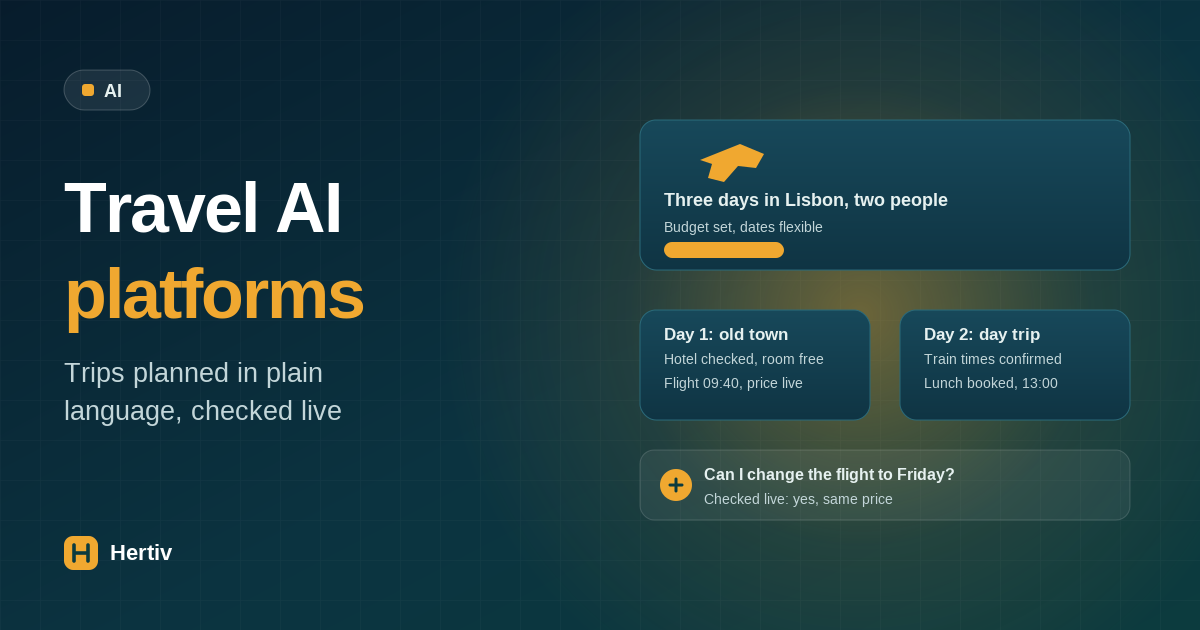
A generative AI platform for travel is software that uses a large language model to handle travel questions, planning and content in plain language. A traveller asks for a three-day trip for two people with a set budget, and the platform drafts an itinerary, checks what is available, and answers follow-up questions about flights, hotels and activities.
It is different from a search box or a booking form. Search returns a list of options; a generative platform holds a conversation, remembers what the traveller already said, and changes the plan when the traveller changes their mind. That conversation is the product, and the booking systems behind it are the parts that make the answers real.
The platform sits between the traveller and the company's travel data: flight and hotel inventory, prices, availability, policies and past trips. It uses the model to turn a question into a plan, and the company's systems to check that the plan can actually be booked.
What can it do for travellers?
A generative AI platform for travel helps a traveller most when the trip has several moving parts. It can turn a vague request, such as a quiet beach holiday with good food, into a shortlist of places, then into a day-by-day plan with travel times and costs. It can also compare options in plain language, such as whether a morning flight is worth the earlier start.
It also handles the questions that come after booking: changing a date, adding a bag, finding a hotel near a station, or checking what happens if a flight is cancelled. A traveller who can ask in plain language gets an answer faster than one who must find the right form, and the platform can carry the whole trip in one conversation instead of several separate searches.
The limits matter too. The platform should say when a price has changed, when a room is no longer available, and when it does not know the answer. A platform that guesses at prices or invents a hotel is worse than one that says it needs to check. For the wider picture of agent-style travel help, intelligent agents in travel covers what these systems do day to day.
What can it do for travel businesses?
For a travel business, a generative AI platform for travel takes over the routine questions that fill support queues: what is included, can I change this, what is the cancellation rule. It answers from the company's own policies and inventory, so the answer matches what the booking system would say. That keeps the human team for the cases that need judgement, such as a disrupted trip or a complaint.
It also writes the content that travel sites need in volume: destination guides, hotel descriptions and itinerary drafts. A human still edits, because the platform can get details wrong, but the first draft arrives in minutes instead of days. That speed matters for small operators who cannot keep a content team.
The third job is personalisation. A platform that remembers a traveller's past trips can suggest a hotel in the same style or a flight time that matches their habits, without the traveller repeating the details each time. That memory must be handled with care: the traveller should be able to see what is remembered and delete it.
Travel and hospitality teams can see how AI is used across travel and hospitality, from booking and support to content and personalisation.
How does a travel AI platform work?
A generative AI platform for travel works by combining a language model with live travel data and the company's own rules. The model understands the question and drafts the answer, while the booking systems supply prices, availability and policies. The two parts must be connected, or the platform will write confident answers about trips that cannot be booked.
| Part | Job | Example |
|---|---|---|
| Language model | Understands questions, drafts answers | Turns a request into an itinerary |
| Booking systems | Prices, availability, booking | Checks a room is free that night |
| Company knowledge | Policies, destinations, past trips | Cancellation rules for a fare |
| Guardrails | Checks facts and blocks bad answers | Refuses to invent a hotel |
| Human handover | Passes hard cases to staff | A cancelled flight, sent to an agent |
The guardrails are the part teams underestimate. The platform must check every price and date against live data before it shows them, and it must say when it cannot answer. A platform without that check will eventually sell a trip that does not exist, and the cost of that mistake is a refund and a lost customer.
Build or buy: which fits your team?
Buying a travel AI platform is usually the right call for a small operator, because the hard parts are the integrations with booking systems and the guardrails around live prices. A bought platform already connects to the inventory, and the team pays for the subscription and the setup. The cost is less control over the wording and the model, and a monthly fee that grows with use.
Building fits a larger operator with its own booking systems and a clear reason to own the experience, such as a brand voice or a loyalty programme that a bought platform cannot match. The build is not just the model: it is the data connections, the checks, the handover to staff and the monitoring. That work takes a team, not a single developer.
A common middle path is to buy the platform and connect it to the company's own knowledge: policies, destination guides and past trip data. That gives the platform something useful to say that a generic model cannot, without building the whole system from scratch. For the build itself, generative AI development teams usually start with one use case, such as support questions, before adding itinerary planning.
Example (hypothetical): a travel agency's first platform
Example (hypothetical): a travel agency with 12 staff answers 400 booking questions a week by email and phone. The team wants a platform that answers the routine questions and drafts itineraries, while staff handle changes and complaints.
The agency starts with support questions only. In the first month, the platform answers 200 of the 400 questions each week, and staff check the answers for the first two weeks. Checking takes 30 minutes a day, which is 2 hours and 30 minutes a week, against the roughly 10 hours a week the 200 answered questions used to take.
After two months, the team adds itinerary drafts. A draft that used to take a staff member 45 minutes now takes 10 minutes of editing, so a week with 20 itineraries saves about 11 hours and 40 minutes. The numbers are invented to show the arithmetic, not a real result. The point is that the saving comes from the routine work, and the staff time freed goes to the trips that need a human.
What are the common mistakes?
The common mistakes with a generative AI platform for travel are letting it quote prices it has not checked, launching it on every question at once, and forgetting the handover to a human.
- Unchecked prices. A price shown without a live check is a promise the company may not be able to keep.
- Too much scope. Launching support, itineraries and content at once makes it hard to tell what is failing.
- No human handover. A traveller with a cancelled flight needs a person, not a longer conversation with the platform.
- Stale knowledge. Policies and destination details change, and a platform trained once will go out of date.
- No measurement. Without tracking how often the platform is right, nobody knows when it starts to drift.
These mistakes share one root: the platform was treated as a finished product instead of a system that needs live data, checks and a person behind it. Start with one use case, measure it, and widen it only when the numbers hold up.
Key takeaways
- A travel AI platform pairs a language model with live prices, availability and company policies
- It helps travellers plan and change trips in plain language, and helps businesses answer routine questions
- Every price and date must be checked against live data before it is shown
- Start with one use case, such as support questions, and measure it before adding more
- A cancelled flight or a complaint still needs a human, so build the handover in from the start
Frequently asked questions
How much does a generative AI platform for travel cost?
It depends on whether you buy or build, and on volume. A bought platform charges a subscription that grows with the number of conversations, while a build needs a team for the integrations and the guardrails. Get quotes for the platform and the integration work before you budget, and see vendor site for current pricing.
Can a travel AI platform book a trip on its own?
It can draft the plan and check availability, but the booking itself should go through the company's booking system with a confirmation step the traveller can see. Fully automatic booking without a check is risky, because a price or a room can change between the draft and the booking.
What data does a travel AI platform need?
It needs live prices and availability from the booking systems, the company's policies on changes and cancellations, and destination information. Past trip data helps with personalisation, but only with the traveller's permission, and the traveller should be able to see and delete what is remembered.
How do you stop a travel AI platform inventing hotels?
By checking every fact it states against live data before it is shown, and by making it say when it does not know. The platform should refuse to answer a question it cannot check, and route it to a person. A test set of known questions, run every week, shows whether the checks are holding.
Is a travel AI platform useful for a small agency?
Yes, if it starts with one job, such as answering routine booking questions. A small agency gains most from the questions that repeat every day, not from a full itinerary planner on day one. Measure how often it is right for a month before adding more use cases.
What is the difference between a travel AI platform and a chatbot?
A chatbot usually answers one question at a time from a fixed set of answers. A travel AI platform holds a conversation, remembers the trip being planned, checks live prices and availability, and drafts a full itinerary. It is closer to a planning assistant than to a question-answer box.


