Generative AI in Medical Technology: What It Does Today
Generative AI in medical technology drafts scan reports, device concepts and clinical notes. Learn where it helps, where it must not decide, and how to start.
On this page
Short answer
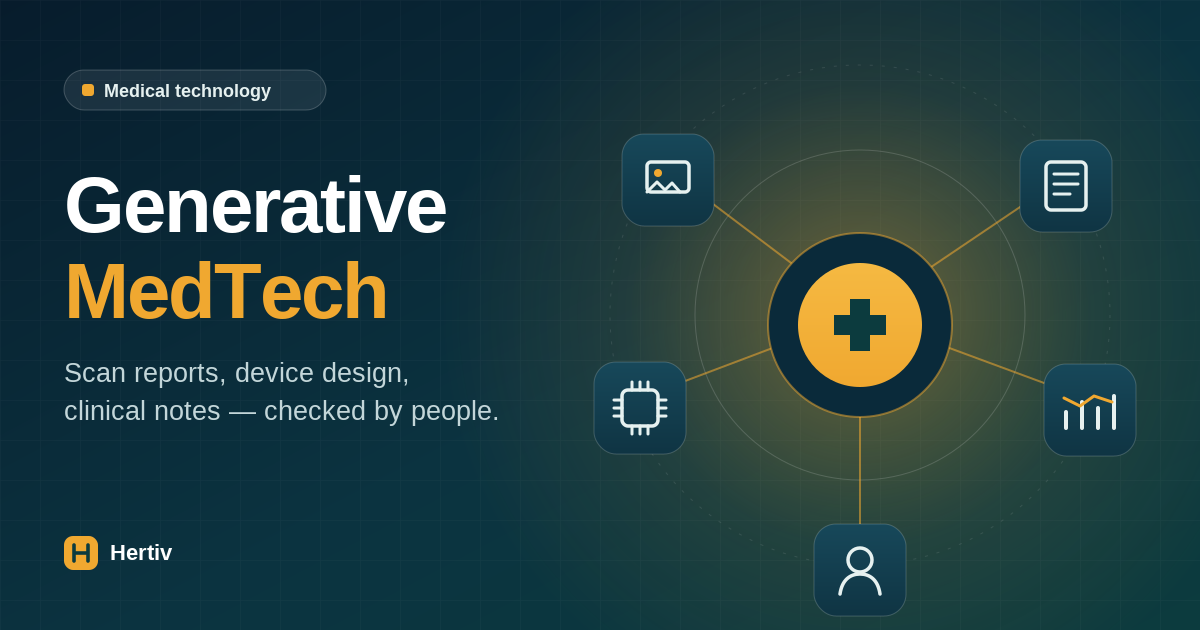
Generative AI in medical technology is the use of language and image models to draft, summarise and check the written and visual work behind medical devices and care, such as scan reports, device designs and clinical notes. It does not diagnose or treat a patient on its own. It produces drafts that a qualified person reviews before anything reaches a patient.
What is generative AI in medical technology?
Generative AI in medical technology is the use of language and image models to create, summarise and check the written and visual work behind medical devices and care, such as scan reports, device designs, clinical notes and patient instructions. It does not diagnose or treat a patient on its own. It works from data a clinician or engineer already holds and produces drafts that a qualified person reviews.
The tools sit inside the systems medtech teams already use: imaging software, electronic records, design tools and trial platforms. A model can read a scan and draft a first report, turn a set of requirements into a device concept, or turn a consultation transcript into a structured note. The output is always a draft, never a decision.
What makes it different from general-purpose AI is the setting. Medical data is sensitive, regulated and high stakes, so every deployment needs validation, human review and a clear record of what the model produced and who approved it. That discipline is part of the technology, not an extra. A plain introduction to the underlying models is in what generative AI is.
Where does generative AI help most in medical technology?
Generative AI helps most where medical work is repetitive, text-heavy or image-heavy, and where a trained person can check the output quickly. It is a poor fit for any step that must be exact without review.
| Medical task | What the model does | Who checks it |
|---|---|---|
| Imaging reports | Drafts first reports from scans | Radiologists |
| Device design | Generates concepts from requirements | Engineers |
| Clinical notes | Turns transcripts into structured notes | Clinicians |
| Surgical planning | Builds 3D views from scans | Surgeons |
| Patient messages | Writes plain-language instructions | Care teams |
The pattern is the same in each case: the model drafts, a person checks, and the record keeps both. Teams that skip the checking step get fast output that is sometimes wrong, which is worse in medicine than in almost any other field.
How does generative AI improve medical imaging?
Generative AI improves medical imaging by drafting the first version of a scan report, highlighting areas that deserve a closer look, and turning images into measurements a clinician can use. The model reads the scan alongside the patient history and writes a structured draft in the format the radiologist expects.
It also helps with the routine parts of imaging work: sorting scans by urgency, checking that the right views were captured, and comparing a new scan with older ones to spot changes. These jobs are slow when done by hand and easy to check when done by a model.
The model never signs the report. A radiologist reviews the draft, corrects it and takes responsibility for the final version. That boundary matters, because a model can be confident about a wrong reading, and only a trained clinician can catch it.
How does it help design medical devices?
Generative AI helps design medical devices by turning requirements into early concepts, variations and test plans faster than a team working by hand. An engineer describes the device, its size limits, materials and the patients it must fit, and the model produces sketches, dimensions and a list of trade-offs to test.
It is useful for the repetitive parts of design: generating variants of a housing, drafting the documentation a regulator expects, and summarising test results into a short report. Engineers still run the simulations, build the prototypes and sign off the design.
Design work benefits most when the model is paired with the team's own data, such as past device files and test records, rather than general knowledge. That is the same grounding pattern used across generative AI development for business workflows.
What are the safety and regulatory limits?
Safety and regulation set hard limits on generative AI in medical technology. In most countries, software that influences a diagnosis or a treatment decision counts as a medical device and needs approval before it can be used on patients. A model that drafts a report is treated differently from one that makes a decision, and the line between them must be written down.
Patient data adds another limit. Medical records cannot be sent to a general-purpose model without controls on where the data goes, who can see it and how long it is kept. Teams usually run models inside their own systems or with a provider that signs a data agreement.
Example (hypothetical): a radiology team clears its backlog
Example (hypothetical): a radiology team of six reads 120 scans a day. Each scan takes about 15 minutes to read and report, which is 120 times 15 minutes, or 1,800 minutes, about 30 hours of reporting a day.
The team adds a model that drafts each report from the scan, and a radiologist checks and signs it. Checked reports take about 9 minutes each, so 120 scans take 120 times 9 minutes, or 1,080 minutes, about 18 hours a day. That saves about 12 hours a day, roughly 40% of the reporting time.
The saving only holds because every draft is checked. In the first month, radiologists correct about one draft in five, mostly where the scan is unusual. The team does not cut staff; it uses the freed hours for the complex cases the model cannot handle.
How do you start using generative AI in a medtech team?
You start using generative AI in a medtech team by picking one small, checkable task and running it with human review, then expanding only when the checks hold up.
- Pick one task. Drafting scan reports or clinical notes is a good first choice because the output is easy to check and the risk is contained.
- Keep data inside your systems. Run the model where patient data already lives, or use a provider with a signed data agreement.
- Write the rules down. Decide what the model may draft, what it must never decide, and who approves each output.
- Run a pilot with review. Have clinicians check every draft for four to eight weeks and track how often they change it.
- Validate before expanding. Test on your own patients and scans, then add a second task only when accuracy holds up.
Measure the pilot by accuracy first and speed second. A draft that is wrong often saves no time at all, while a draft that is right most of the time is worth keeping. Keep the review step in place even after the pilot looks good. For health-sector teams, AI for healthcare providers covers the wider picture.
What are the common mistakes?
The most common mistakes are letting the model decide, feeding it data from one setting and trusting it in another, and skipping validation once the pilot looks good.
- Letting the model decide. A language model is not a clinician. Diagnoses and treatment choices stay with qualified people.
- Trusting one hospital's data everywhere. Performance drops when the patient mix or the scanners change.
- Sending patient data to an unvetted model. Check data handling before any real record leaves your systems.
- Dropping review too soon. Early accuracy often dips when new scan types or patient groups appear.
- No audit trail. If a draft and its approval are not stored, a later review has no record to check.
Key takeaways
- Generative AI drafts scan reports, device concepts and clinical notes, but it never diagnoses or treats a patient
- It helps most where output is repetitive and easy for a trained person to check
- Software that influences a diagnosis usually counts as a medical device and needs approval
- Patient data must stay inside controlled systems, with a signed data agreement when it leaves them
- Start with one small task, review every draft, and validate on your own patients and scans before expanding
Frequently asked questions
Can generative AI diagnose a patient?
No. It can draft reports and summaries from scans and records, but the diagnosis stays with a qualified clinician. Any software that influences a diagnosis is usually regulated as a medical device and needs approval before it is used on patients.
Is patient data safe with a language model?
It can be, if the setup limits what the model sees. Run the model inside your own systems or use a provider with a signed data agreement, keep records out of general-purpose tools, and check where data is stored and for how long.
Which medtech task should a team automate first?
Start with drafting scan reports or clinical notes. Both have clear inputs, the output is easy for a clinician to check, and a wrong draft is caught before it reaches a patient. Avoid starting with anything that decides a diagnosis.
How accurate do drafts need to be before you trust them?
Aim for clinicians changing fewer than one draft in five during a pilot of four to eight weeks. If corrections stay higher than that, narrow the task or improve the records the model reads from.
Does generative AI replace radiologists or device engineers?
No. It removes drafting and routine checking from their day, so they spend more time on the complex cases and decisions that need training and judgement. The model drafts; the professional decides and signs.
What does generative AI in medical technology cost?
Costs vary by volume, provider and whether the model runs inside your own systems, so check the current price on the vendor site before budgeting. The main costs are the model calls, the data connection and the staff time spent reviewing drafts during the pilot.


