Generative AI in Drug Discovery: 10 Uses That Matter
Generative AI helps drug teams propose new molecules, predict how they behave and plan trials faster. Here are ten uses, grouped by stage.
On this page
Short answer
Generative AI in drug discovery is the use of models that create new content, such as molecule structures, protein shapes and trial documents, to speed up the search for new medicines. Drug teams use it to propose candidate molecules, predict their properties, design trials and draft the paperwork, while lab tests and regulators still decide what is safe and effective. The models narrow the search; they do not replace evidence.
What is generative AI in drug discovery?
Generative AI in drug discovery is the use of models that create new content to help find and develop medicines. Where older tools sorted and ranked known molecules, generative models propose new ones, fill in missing data and draft the documents a trial needs.
The work falls into ten uses, grouped by stage:
| Use case | Stage | What the model does |
|---|---|---|
| Find new targets | Research | Links genes and proteins to disease |
| Propose molecules | Discovery | Creates new structures to test |
| Predict binding | Discovery | Scores how a molecule fits a target |
| Predict safety flags | Discovery | Flags toxic or unstable candidates early |
| Plan synthesis | Discovery | Suggests routes to make the molecule |
| Design proteins | Discovery | Creates proteins with a chosen shape |
| Repurpose drugs | Research | Finds new uses for known drugs |
| Design trials | Development | Drafts protocols and finds patients |
| Draft documents | Development | Writes trial and filing drafts |
| Read the literature | Research | Summarises papers and patents |
Each use is a narrow job with a human check at the end. The model proposes, and a scientist or a lab test confirms. That split is what keeps the work honest, and it is the same pattern used in AI use cases in biopharma more broadly.
How does it help find candidate molecules?
Generative AI helps find candidate molecules by searching a much larger space of possible structures than a team could draw by hand. The model learns the patterns in known molecules, then proposes new ones that share the features that made the known ones work.
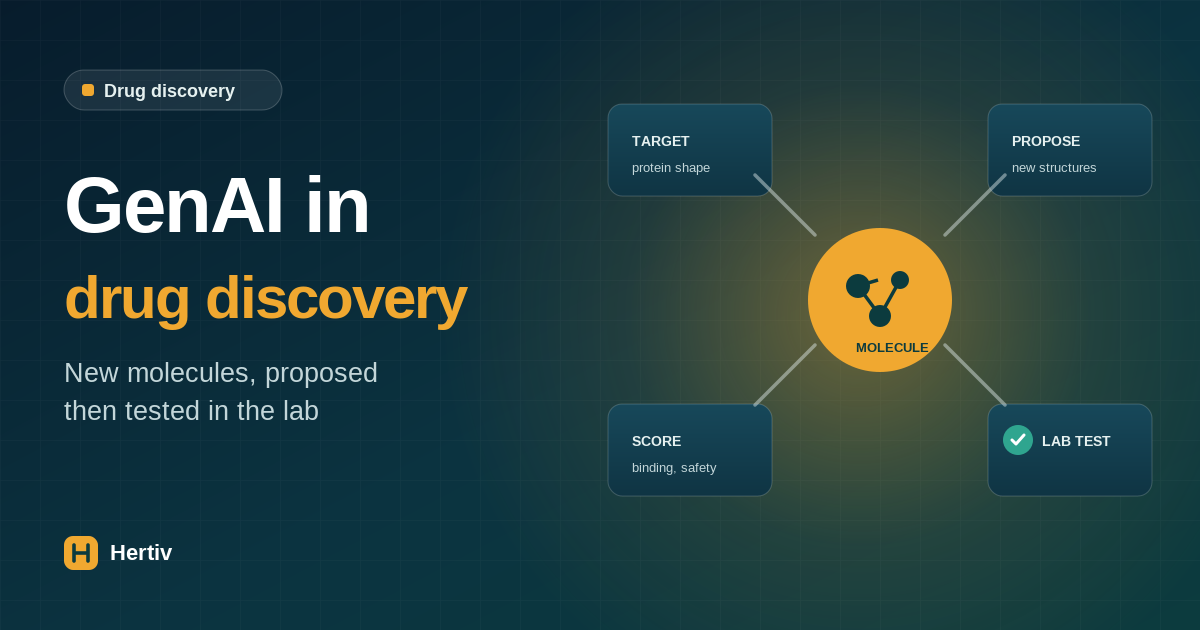
The usual flow starts with a target, such as a protein linked to a disease. The team gives the model the target's shape and the properties the molecule must have, and the model generates a shortlist of structures that fit. A chemist then reviews the shortlist for the ones that can actually be made.
The gain is speed in the early stage, not certainty. A model can propose thousands of structures in hours, where a team would take months to draw and check a few hundred. The lab still tests each candidate, so a bad proposal costs a test, not a trial.
Finding new targets works the same way in reverse: the model reads gene and protein data and links them to disease, which gives researchers a target to aim at. That is the first row of the table above, and it is often where a programme starts.
How does it help design new molecules?
Generative AI helps design new molecules by treating a molecule as a shape with properties, then searching for shapes that score well on all of them at once. A drug needs to bind to its target, dissolve in the body, stay stable and be possible to make, and the model can balance those demands together.
Design usually works in rounds. The model proposes a set of structures, a scoring step ranks them on binding, solubility and safety flags, and the best ones go back into the model for a second round. Each round tightens the search around the structures that scored best.
Protein design is the same idea applied to proteins: the model creates a protein with a chosen shape, for example one that binds to a disease protein and blocks it. This is useful for antibodies and other biologics, where the shape is the drug.
Planning synthesis is the step that keeps the design honest. A molecule that cannot be made is useless, so the model also suggests the chemical steps to build it, and the team checks that the route is practical before the molecule goes forward.
What can it predict before the lab?
Generative AI can predict several properties of a molecule before the lab tests it, which lets teams drop weak candidates early. The most useful predictions are how well a molecule binds to its target, whether it is likely to be toxic, and whether it will dissolve and stay stable in the body.
Binding prediction works by scoring how a molecule's shape fits the target protein. A good fit does not prove the drug works, but a bad fit is a reliable reason to drop the candidate before spending lab time on it.
Safety flags work the same way: the model compares a new molecule with known toxic ones and flags the parts that look risky. The flag is a warning, not a verdict, and the lab test still decides. But a candidate flagged early can be changed or dropped before it costs a test.
Repurposing drugs is a related use: the model matches known, approved drugs against new targets, which can find a treatment faster than starting from a new molecule. Because the drug is already known to be safe in people, the path to a trial is shorter, though the new use still needs its own evidence.
How does it help with trials and safety?
Generative AI helps with trials by drafting the documents and finding the patients, which are two of the slowest parts of a trial. The model can draft a protocol from the trial's goals, write patient information sheets in plain language, and search records for people who match the trial's criteria.
Drafting documents saves writing time, but the drafts are always reviewed by the trial team and, where needed, by regulators. A model that writes a protocol draft does not decide the dose or the endpoints; it turns the team's decisions into a first draft that humans check line by line.
Reading the literature is the quiet workhorse here. A team can ask a model to summarise papers and patents on a target, which keeps the team current without reading every paper. The summaries need checking against the source, since a model can misread a result, but they cut the reading load sharply.
For teams building these tools, the testing discipline matters as much as the model. The same checks used in how to test AI models apply here: hold out data the model has not seen, and measure against lab results, not against the model's own scores.
Example (hypothetical): a research team screens 200 candidates
Example (hypothetical): a research team has 200 candidate molecules for one target. Checking each one by hand takes about 3 hours of chemist time, so the full set would take 200 x 3 = 600 hours, or about 15 working weeks for one chemist.
The team uses a generative model to propose and score the candidates, then shortlists the 40 that score best on binding, solubility and safety flags. Checking those 40 by hand takes 40 x 3 = 120 hours, or about 3 working weeks.
The lab then tests the 40, and 8 pass the first screen. The team has saved 480 hours of chemist time, but the saving only matters because the 8 that passed are real candidates. If the model's scoring had been wrong, the team would have tested the wrong 40 and missed the good ones.
That is why the team keeps a control set: a few known good and bad molecules are run through the model first, and the model must rank them correctly before it is trusted with the real shortlist.
What are the common mistakes?
The most common mistakes in generative AI drug discovery are trusting the model's scores, training on the wrong data, and letting the model work without a lab check.
- Trusting the score. A high model score is not evidence. Only a lab test proves a molecule works.
- Training on narrow data. A model trained on one kind of molecule fails on others. Check what the training data actually covers.
- Skipping the control set. Without known good and bad molecules to test against, you cannot tell if the model is ranking well.
- Ignoring synthesis. A molecule that cannot be made is useless. Check the synthesis route before the molecule goes forward.
- Letting drafts go unchecked. A trial document with a wrong dose or endpoint is dangerous. Every draft needs a human review.
- Overclaiming to partners. Saying a model found a drug when it only proposed a candidate damages trust with labs and regulators.
How to start a small pilot
A pilot should prove the model helps on your data, not on a demo. Start small, with one target and one clear measure of success.
- Pick one target and one job. Choose a single target and one use from the table above, such as shortlisting candidates for binding.
- Build the control set. Gather known good and bad molecules for that target, and hold them out of training.
- Run the model and measure. Score the control set first. If the model cannot rank it correctly, stop and fix the data.
- Test the shortlist in the lab. Take the top candidates to the lab and compare the hit rate with the team's usual method.
- Decide on the numbers. Keep the model only if the lab hit rate and the time saved both beat the old method.
A pilot like this is a small, focused piece of work. A team that builds AI proof-of-concept projects can run it as a bounded experiment with a clear go or no-go decision at the end.
Key takeaways
- Generative models propose molecules; lab tests decide which ones work
- The ten uses run from finding targets to drafting trial documents
- Shortlisting saves time only if the model's ranking is checked against controls
- Safety flags and synthesis checks keep proposals realistic
- Every trial draft needs a human review before it goes anywhere
Frequently asked questions
Can generative AI discover a drug on its own?
No. Generative models propose candidate molecules and rank them, but they do not prove a drug works. Lab tests, animal studies and clinical trials provide the evidence, and regulators decide what can be sold. A model can make the search faster, but it cannot replace the evidence chain.
How is generative AI different from older AI in drug discovery?
Older tools mostly sorted and ranked molecules that already existed, while generative models create new structures that have never been made. That lets teams search a much larger space of possible molecules. The trade-off is that new structures need more checking, since there is no history to lean on.
What data does a generative drug model need?
It needs structures of known molecules, their measured properties, and data on the target protein. The quality of the data matters more than the size: a small, clean dataset with measured results beats a large dataset with errors. Teams should check what their training data covers before trusting the model.
How long does it take to see results from a pilot?
A focused pilot on one target can run in a few months: build the control set, run the model, and test the shortlist in the lab. The lab test is the slow part, so the pilot's length depends on how fast the lab can test candidates. Plan the pilot around the lab's schedule, not the model's.
Can generative AI help with drug repurposing?
Yes. The model matches known, approved drugs against new targets, which can find a treatment faster than starting from a new molecule. Because the drug is already known to be safe in people, the path to a trial is shorter, though the new use still needs its own clinical evidence.
What should a team check before trusting a model's scores?
Check that the model was tested on molecules it had not seen during training, and that it ranks a control set of known good and bad molecules correctly. Ask what data the model was trained on and what it cannot do. If the team cannot answer those questions, the scores are not evidence.


