Generative AI Anomaly Detection: How It Works
Generative AI anomaly detection spots unusual patterns by learning what normal looks like, then flagging what does not fit. Here is how it works and where it helps.
On this page
Short answer
Generative AI anomaly detection uses generative models to learn the shape of normal data, then flags the records, readings or transactions that do not fit that shape. Instead of fixed rules, it builds a model of what is usual and measures how far each new item sits from it, which catches problems that no rule was written for.
What is generative AI anomaly detection?
Generative AI anomaly detection is a method that uses generative models, such as autoencoders and diffusion models, to learn what normal data looks like, and then flags anything that does not match. An anomaly is an item that is rare, wrong or out of place: a fraudulent payment, a failing sensor reading, or a network login at an odd hour.
The generative part matters because these models learn the whole pattern of the data, not just a list of rules. A rule can say a payment over $10,000 is suspicious, but a generative model can notice that a $200 payment is unusual for this customer, at this time, from this device, even though no single value looks wrong.
The output is a score, not a verdict. Each item gets a number for how unusual it is, and a human or a second system decides what to do with the highest scores. That keeps the model as a helper, not a judge.
How is it different from traditional anomaly detection?
Traditional anomaly detection uses fixed rules or simple statistics, while generative AI learns the pattern of normal data and can spot unusual combinations that no rule covers.
| Approach | How it works | Where it is weak |
|---|---|---|
| Fixed rules | Flags values over a set limit | Misses unusual combinations |
| Statistics | Flags values far from the average | Struggles with complex data |
| Classic machine learning | Learns from labelled examples | Needs many labelled anomalies |
| Generative AI | Learns the shape of normal data | Needs clean data and review |
The practical difference is the training data. Classic machine learning needs many labelled examples of fraud or failure, which are rare by definition. Generative AI mostly needs normal data, which is plentiful, and it learns the shape of normal so that anything else stands out.
Where does generative AI anomaly detection help?
Generative AI anomaly detection helps wherever normal behaviour has a clear pattern and the cost of missing a problem is high: payments, equipment, networks and quality control.
- Payments and fraud. Flags transactions that do not fit a customer's usual pattern, even when the amount is ordinary.
- Equipment and sensors. Spots a machine drifting from its normal vibration or temperature pattern before it fails.
- Networks and security. Notices logins or traffic that do not match the usual pattern for a user or a system.
- Quality control. Finds products whose measurements differ from the usual range, including subtle combinations of small defects.
- Healthcare data. Highlights patient readings or records that do not fit the expected pattern, for a clinician to review.
The common thread is that the anomaly is a pattern, not a single number. A sensor reading that is slightly high, slightly early and slightly irregular can be normal on its own, but the combination is the signal. For the wider question of testing AI systems, how to test AI models covers the checks that apply here too.
How does it work, step by step?
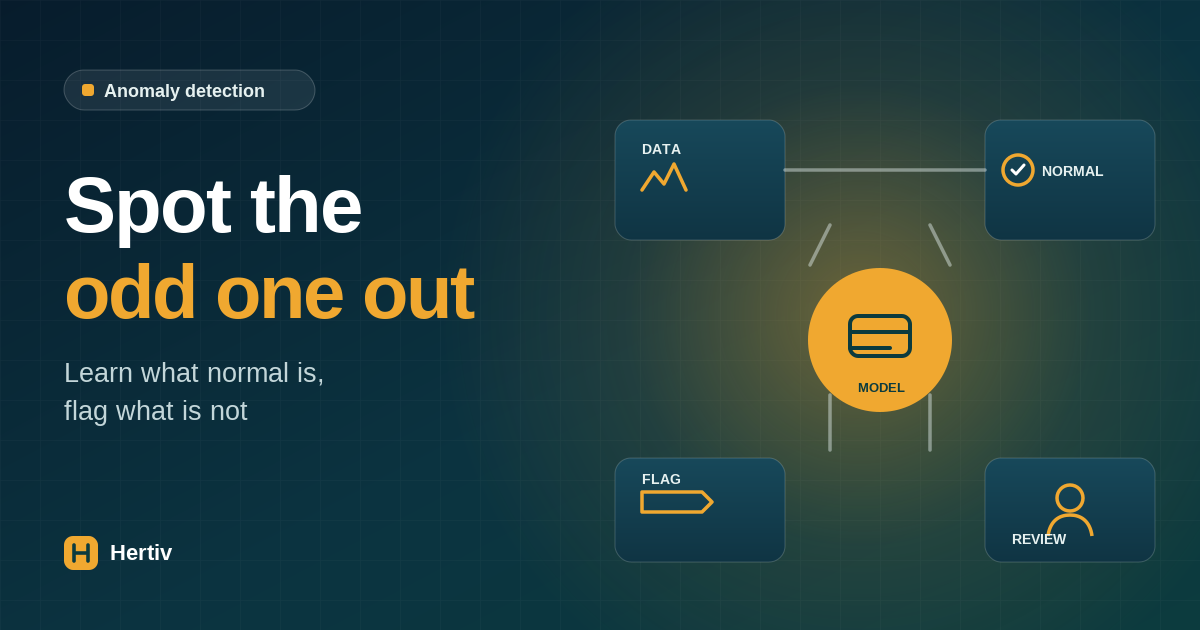
Generative AI anomaly detection works by training a model on normal data, scoring new items against that model, and sending the highest scores for human review.
- Collect normal data. Gather a large set of ordinary records, readings or transactions, and clean out known faults so the model learns the right shape.
- Train the model. The model learns to rebuild normal data, so it becomes good at reproducing the usual and bad at reproducing the unusual.
- Score new items. Each new item is passed through the model, and the difference between the item and the model's rebuild becomes its anomaly score.
- Set a threshold. Decide which scores are high enough to flag, based on how many alerts the team can review each day.
- Review and correct. A human checks the flagged items, and the corrections feed back into the data for the next round of training.
The threshold is a business decision, not a technical one. A low threshold catches more problems but creates more false alarms, and a team that drowns in false alarms soon stops checking. Start with a threshold that flags a number the team can actually review.
What data and checks does it need?
Generative AI anomaly detection needs clean, representative normal data, a way to measure false alarms, and a human review step, because the model cannot tell a real problem from a rare but harmless event.
Data quality is the main work. If the training data contains old faults, the model learns them as normal and stops flagging them. If it contains only one kind of normal, such as weekday data, it will flag every weekend as an anomaly. The data must cover the full range of ordinary behaviour.
Two checks matter most. First, measure the false alarm rate: how many flagged items turn out to be harmless. Second, keep a human in the loop for anything that leads to an action, such as blocking a payment or shutting a machine down. How to build an AI proof of concept shows how to run this as a small pilot before it touches live decisions.
Example (hypothetical): a payment team flags unusual transactions
Example (hypothetical): a payment team processes 10,000 transactions a day and adds a generative model to flag unusual ones. In the first week the model flags 120 transactions a day, and a reviewer checks each one, taking 2 minutes per check, which is 240 minutes, or 4 hours of review a day.
Of the 120 flagged transactions, 90 turn out to be real problems, such as stolen cards or account takeovers, and 30 are harmless, such as a customer travelling abroad. That is 90 out of 120, or 75% of flags being real, which the team finds worth the 4 hours of review.
The team then tunes the threshold so the model flags 80 transactions a day instead of 120. Review time falls to 160 minutes, or about 2 hours 40 minutes, and 72 of the 80 are real problems, which is 90% of flags. The team catches fewer problems in total, but each hour of review now finds more of them, and the reviewers stop missing flags because they are no longer overloaded.
What are the common mistakes?
The most common mistakes with generative AI anomaly detection are training on dirty data, setting the threshold too low, and letting the model act without a human check.
- Dirty training data. If known faults stay in the training data, the model learns them as normal and stops flagging them.
- Too low a threshold. Flagging everything creates so many false alarms that reviewers stop checking, and real problems slip through.
- No human review. An anomaly is a signal, not a verdict. Blocking a payment or stopping a machine on a score alone is a risk.
- Ignoring drift. Normal changes over time: seasons, new products, new customers. A model that is never retrained slowly goes stale.
- Measuring the wrong thing. Counting flags is not success. Count problems found and false alarms, and track both over time.
Anomaly detection is often used beside forecasting, and predictive analytics in retail shows how the same data habits apply when the goal is prediction rather than detection.
Key takeaways
- Generative AI learns the shape of normal data, so it can flag unusual combinations no rule covers
- It needs normal data, which is plentiful, instead of labelled anomalies, which are rare
- The output is a score, and a human should decide what happens to the highest scores
- The threshold is a business choice: too low, and reviewers drown in false alarms
- Retrain as normal changes, or the model slowly goes stale
Frequently asked questions
What is the difference between anomaly detection and fraud detection?
Anomaly detection finds anything unusual in the data. Fraud detection is one use of it: finding transactions that do not fit a customer's pattern. The same method also works for failing machines, network intrusions and quality defects, wherever normal has a clear shape.
Do I need labelled fraud examples to train it?
No, and that is the main advantage. Generative models learn from normal data, which is plentiful, and flag what does not fit. Labelled examples of fraud are still useful for testing, because they show whether the model actually catches real cases.
How accurate is generative AI anomaly detection?
It depends on the data and the threshold, so there is no single number. Measure two things: how many flagged items are real problems, and how many real problems were missed. A useful system finds most real problems while keeping false alarms low enough for the team to review.
Can it work in real time?
Yes, for most uses. Scoring one transaction or sensor reading takes far less time than the transaction itself. The slow part is usually the human review, which is why teams tune the threshold so the number of flags matches the review capacity.
What data do I need to start?
A large set of normal records, readings or transactions, cleaned of known faults, covering the full range of ordinary behaviour, including weekends, seasons and different customer types. If the data only covers one kind of normal, the model will flag the rest.
Does it replace rule-based fraud checks?
No. Rules are still useful for clear cases, such as a payment over a set limit or a login from a blocked country. Generative models add the cases no rule covers, such as a small payment that is unusual for this customer at this time. Most teams run both together.


