Gartner Generative AI Vendors: How to Read the Research
Gartner rates generative AI vendors through Magic Quadrants, Market Guides and peer reviews. Here is how to read that research and shortlist vendors with confidence.
On this page
Short answer
Gartner is an analyst firm that evaluates generative AI vendors through reports such as the Magic Quadrant, Market Guides and Peer Insights reviews. Its research rates vendors on product ability, vision, security and support, but it is a starting point, not a verdict. Use it to build a shortlist, then test the vendors yourself against your own use cases, data and budget.
What does Gartner say about generative AI vendors?
Gartner is a research and advisory firm that evaluates technology vendors and publishes its findings as reports that buyers use to compare options. For generative AI, it covers vendors that build large language models, coding assistants, customer-service tools, document tools and the platforms that run them.
Gartner does not publish one single ranking. It publishes several kinds of research, each with a different purpose. The Magic Quadrant places vendors on a chart. Market Guides describe a young market where products differ widely and no single leader is clear. Critical Capabilities score vendors against specific use cases. Peer Insights collects reviews from buyers who use the products.
Together, these reports answer different questions: which vendors are established, which are strong in a specific job, and what real buyers say after using the product. A team choosing a generative AI vendor usually starts with the Magic Quadrant or Market Guide for its category, then reads the deeper reports for the vendors on its shortlist.
That sequence is what makes the research useful. It narrows the field before you spend weeks on demos and trials, and it flags risks such as weak security controls or thin support that a sales demo may not show. A guide to the top machine learning vendors shows the same shortlist thinking applied to ML platforms.
How does the Magic Quadrant rate vendors?
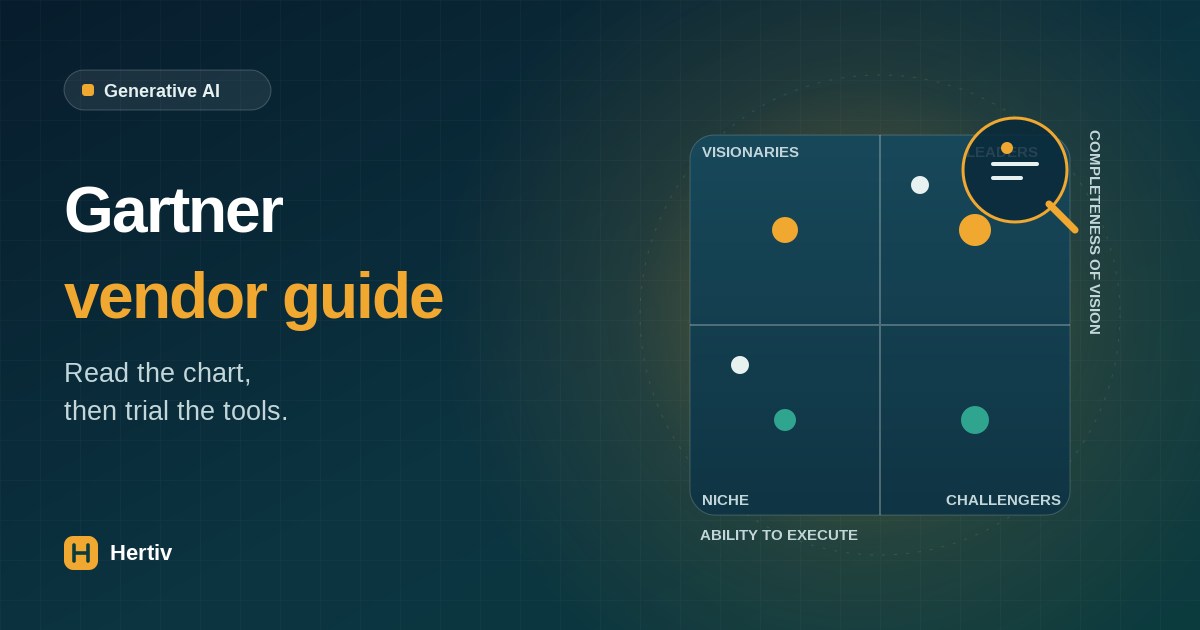
The Magic Quadrant rates vendors on two axes: completeness of vision and ability to execute. Completeness of vision covers product strategy, innovation and how well the vendor understands where the market is heading. Ability to execute covers product quality, sales reach, support and financial strength.
Those two axes create four groups. Leaders score high on both and are usually safe choices for large deployments. Challengers execute well today but have a narrower vision. Visionaries have strong ideas and newer products but a smaller footprint. Niche Players focus on one segment or region and can be the right fit for a specific job.
The position on the chart is a snapshot, not a score. Two vendors in the same group can still differ a lot on the things that matter to you, such as data residency, model choice or pricing. Gartner updates each Magic Quadrant on a cycle, so a report from last year may place a vendor differently from the current one.
Always check the publication date before you rely on a chart, and read the strengths and cautions Gartner lists for each vendor rather than judging by position alone.
What other Gartner research should you read?
Before you shortlist vendors, read the research that matches the question you are asking. Each Gartner format serves a different purpose, and using the wrong one leads to the wrong shortlist.
| Research type | What it answers | When to use it |
|---|---|---|
| Magic Quadrant | Which vendors lead a mature market | Comparing established vendors |
| Market Guide | How a young market is organised | New categories with no clear leader |
| Critical Capabilities | Which vendor fits a specific use case | Choosing between close finalists |
| Peer Insights | What real buyers say after using it | Checking support and ease of use |
| Hype Cycle | How mature a technology is | Deciding whether to adopt now or wait |
Market Guides are often the most useful starting point for generative AI, because the market is still young and products change fast. Critical Capabilities help when two finalists look alike on the chart but differ on your use case, for example code generation versus document review.
Peer Insights adds what analyst reports cannot: how the vendor responds when something breaks. Read at least one analyst report and a set of peer reviews before you invite vendors to demo.
What criteria does Gartner use for generative AI vendors?
Gartner judges generative AI vendors on product ability and on the vendor behind the product. The product criteria test what the tool can do today; the vendor criteria test whether the company can support you for years.
| Area | What Gartner checks | Why it matters to you |
|---|---|---|
| Model quality | Accuracy, tone, and handling of edge cases | Bad output costs time to fix |
| Data controls | How your data is stored and used for training | Your data must stay yours |
| Security | Access controls, audit logs, and prompt safety | Protects staff and customers |
| Integration | APIs, connectors, and existing tools | Avoids a separate silo |
| Pricing | How charges scale with use | Costs grow with adoption |
| Support | Response times and onboarding help | Problems need fast answers |
Apply the same checks in your own trial. Ask each vendor whether your prompts and documents are used to train models, and get the answer in writing. Test the tool on your own documents and your own edge cases, not on the vendor's demo data.
Check how pricing changes as usage grows, because a tool that looks cheap for a pilot can become expensive once every team uses it. The vendor criteria matter as much as the product: a strong product from a vendor with thin support becomes a risk once it is woven into daily work.
How do you use Gartner research to shortlist vendors?
You use Gartner research to narrow a long list to a short one you can test properly. The research does the first filter; your own trial does the second.
- Define the job first. Write down the task, the users, the data involved and what good output looks like. A vendor that is strong for coding may be weak for customer support.
- Find the right report. Use the Magic Quadrant or Market Guide for your category, not a general AI report. Check that the report is current.
- Build a long list. Take every vendor in the report that fits your size, region and budget, and add any vendor your team already uses.
- Apply your hard constraints. Remove vendors that fail on data residency, security, pricing model or required integrations. This usually cuts the list by half.
- Read the cautions. For each remaining vendor, read the strengths and cautions in the report and the recent Peer Insights reviews.
- Trial three vendors. Give each the same test tasks, the same data and the same scoring sheet, then compare results side by side.
Keep the shortlist small. Three trials done properly tell you more than ten demos watched passively. If you need help running a structured vendor trial, generative AI consulting can set up the scoring and the test data.
Example (hypothetical): a finance team shortlists three vendors
Example (hypothetical): a finance team wants a generative AI tool to draft client summaries from meeting notes. It starts with a Gartner Market Guide and finds 12 vendors in the category.
The team applies its hard constraints first. Four vendors are removed because they store data outside the team's region, and three more because they have no audit log for generated drafts. That leaves five. The team reads the cautions for each and drops two more: one has weak support hours and the other charges per seat in a way that would double costs once the whole team joins. Three vendors remain.
Each vendor is given the same trial: 20 meeting notes, 5 criteria scored from 1 to 5. Vendor A scores 4, 4, 3, 5 and 4, for a total of 20. Vendor B scores 5, 3, 4, 4 and 3, for a total of 19. Vendor C scores 3, 5, 4, 3 and 5, for a total of 20.
The totals are close, so the team looks at the detail: Vendor A is strongest on accuracy, Vendor C on audit logs. Because the drafts go to clients, the team picks Vendor A and keeps Vendor C as a backup. The research narrowed the field; the trial made the decision.
What are the common mistakes?
The most common mistakes when using Gartner research are treating the chart as a ranking, using an old report, and skipping your own trial.
- Reading position as a score. A Leader is not the best vendor for every job. A Niche Player can be the right choice for a specific use case or region.
- Using an outdated report. Generative AI products change in months. A report from last year may describe a product that no longer exists in that form.
- Skipping the trial. No report can tell you how a tool handles your documents, your tone and your edge cases. Test with your own data.
- Ignoring the cautions. The strengths get quoted in sales decks; the cautions are where the real risks are listed.
- Forgetting total cost. Licence fees are only part of the cost. Add integration, training, review time and the cost of fixing bad output.
- Choosing on brand alone. A famous vendor name does not guarantee the tool fits your workflow or your budget.
Key takeaways
- Gartner evaluates generative AI vendors through Magic Quadrants, Market Guides, Critical Capabilities and Peer Insights
- The Magic Quadrant plots vision against execution, but position is a snapshot, not a score
- Read the strengths and cautions for each vendor, not just the chart
- Apply your hard constraints first, then trial three vendors on the same tasks and data
- Check the publication date, because generative AI products change fast
Frequently asked questions
What is the Gartner Magic Quadrant for generative AI?
It is a chart that places vendors on two axes, completeness of vision and ability to execute, grouping them as Leaders, Challengers, Visionaries or Niche Players. It helps buyers compare established vendors in a category, but it is a snapshot at one date and should be read with the strengths and cautions for each vendor.
Is a Leader always the best choice?
No. A Leader scores well on both axes overall, but may not fit your specific use case, budget, region or data rules. A Niche Player or Visionary can be a better fit for a focused job, so compare vendors against your own criteria rather than chart position alone.
What is a Gartner Market Guide?
A Market Guide describes a young or fast-changing market where products differ widely and no single leader is clear. It explains how the market is organised, who the main vendors are and what buyers should look for, which makes it a good starting point for generative AI categories.
Do I need a Gartner subscription to read the research?
Full reports usually need a paid subscription, though vendors often share reprints of the Magic Quadrant or Market Guide they appear in. You can also read Peer Insights reviews and vendor summaries without a subscription, then request the full report through a trial or a partner.
How often does Gartner update its generative AI research?
Update cycles vary by report, and many generative AI reports are refreshed yearly or when the market shifts. Because products change quickly, always check the publication date on any report you rely on and look for a newer version before making a decision.
Can small teams use Gartner research?
Yes, though the reports are written for large buyers. Small teams can use the same method at a smaller scale: define the job, read the Market Guide or vendor summaries, apply hard constraints, and trial two or three vendors on the same tasks before choosing.


