P2P Crypto Exchange Development: 8 Trends to Watch
P2P crypto exchanges are adding safer escrow, smarter matching and wider payment options. Here are eight trends shaping how they are built.
On this page
Short answer
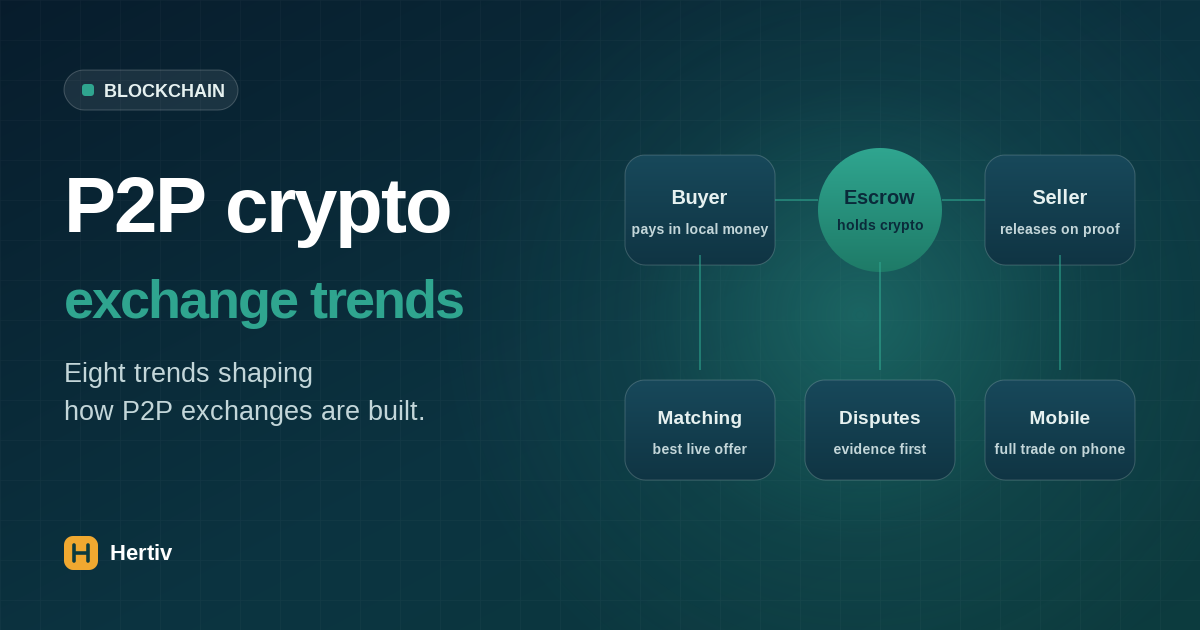
Peer-to-peer crypto exchanges are marketplaces where buyers and sellers trade directly with each other, while the platform holds funds in escrow until both sides confirm the deal. The eight trends below cover safer escrow, better matching, wider payment methods and clearer rules, and each one changes what a development team should build first.
What is changing in P2P crypto exchange development?
P2P crypto exchange development is changing because traders now expect the safety of a large exchange with the freedom of a direct trade. The platform no longer just lists offers; it must hold funds safely, settle disputes fairly, check identities and support local payment methods.
The trends below are the ones teams are actually building: escrow that releases automatically, matching that finds the best offer fast, and compliance checks that run without slowing honest traders down. Each trend is rated for how much it matters to users and how hard it is to build.
| Trend | What it changes | Build effort |
|---|---|---|
| Smart escrow | Funds release automatically on proof | Medium |
| Smarter matching | Best price found across more offers | Medium |
| Local payments | More ways to pay in each country | High |
| On-chain reputation | Trust follows the trader, not the account | High |
| AI dispute help | Disputes sorted faster with evidence | Medium |
| Stablecoin settlement | Less price movement during a trade | Low |
| Compliance checks | Identity and sanctions checks built in | High |
| Mobile-first trading | Full trading from a phone | Medium |
The rest of this listicle explains each trend in turn, with what it does for traders and what it asks of the team building it. No trend here needs a specific coin or price to make sense, which is deliberate: the patterns matter more than any single token.
These trends build on the basics of how a blockchain works and on the token economics behind every trade.
Teams that have already worked through how to create a cryptocurrency will find the escrow and settlement trends the most familiar.
<h3>1. Smart escrow: best for safer trades</h3>
Smart escrow holds the seller's crypto in a smart contract that releases it only when the agreed condition is met, such as a confirmed payment or a deadline passing. It replaces the old pattern where a staff member checked screenshots and released funds by hand.
For traders, the benefit is speed and fairness: a buyer who paid is not left waiting for a human, and a seller is not asked to release funds before payment arrives. For the platform, the benefit is fewer disputes and fewer staff hours spent on routine releases.
Pros: faster settlement, fewer manual errors, clear rules both sides can read. Cons: contract bugs are costly, and some payment methods cannot be proven on-chain, so a fallback process is still needed.
2. Smarter matching: best for finding the best price
Smarter matching scans more offers at once and ranks them by price, payment method, trader history and amount, instead of showing a long list sorted by one field. A buyer who wants $500 in a local currency sees the three best offers for that exact trade, not the three cheapest offers in the wrong currency.
The hard part is not the ranking itself but keeping it honest: offers must be live, amounts must be real, and stale listings must drop out quickly. Teams that get this right see more completed trades per visit, because traders stop scrolling and start trading.
Pros: better prices for buyers, more completed trades, less time wasted. Cons: needs live data and careful caching, and a bad ranking can hide good offers.
<h3>3. Local payment methods: best for reaching more traders</h3>
Local payment methods decide whether a P2P exchange works in a country at all. Bank transfers, mobile money, cash deposits and local wallets are what most traders actually use, and a platform that only supports one of them will stay small in that market.
Adding a payment method is not just a button. Each method needs a way to confirm payment, a dispute process for when the buyer says they paid and the seller says they did not, and limits that fit how the method is normally used. That is why this trend is the most expensive to build well.
Pros: far more traders, more completed trades, stronger local position. Cons: each method adds confirmation and dispute work, and fraud patterns differ by method.
4. On-chain reputation: best for trust that travels
On-chain reputation records a trader's history in a way that does not depend on one platform's account. Completed trades, dispute outcomes and account age can be checked by any platform the trader joins, so a good trader does not start from zero every time.
The idea is simple but the details matter: the record must be hard to fake, it must not expose private trade details, and it must give new traders a fair starting point. Platforms that adopt it can offer faster trades to proven traders and tighter limits to new ones.
Pros: trust follows the trader, less fraud from fresh accounts, faster trades for proven users. Cons: privacy design is hard, and a bad record can follow a trader unfairly.
<h3>5. AI dispute help: best for faster resolutions</h3>
AI dispute help reads the evidence in a dispute, such as payment receipts, chat messages and trade timing, and suggests a resolution to a human reviewer. It does not decide the dispute on its own; it organises the facts so the reviewer decides in minutes instead of hours.
Disputes are where P2P platforms lose the most money and trust, because a slow or unfair decision pushes both sides away. A system that sorts disputes by clarity, flags missing evidence and drafts a summary can cut resolution time sharply without removing human judgement.
Pros: faster decisions, more consistent outcomes, less staff time per dispute. Cons: needs clean evidence to work, and traders must be able to appeal a bad suggestion.
<h3>6. Stablecoin settlement: best for steady prices</h3>
Stablecoin settlement lets a trade settle in a coin designed to hold its value, so the price agreed at the start is close to the price at the end. In a fast-moving market, a trade agreed in a volatile coin can change value by several percent before the payment arrives, which neither side wants.
For the platform, stablecoins simplify the escrow math and the dispute math, because the amount does not move while the trade is open. The trade-off is dependence on the stablecoin's own backing and rules, so teams usually support more than one and let traders choose.
Pros: predictable amounts, simpler escrow, fewer price disputes. Cons: depends on the stablecoin's issuer and rules, and not every trader wants to hold one.
7. Built-in compliance checks: best for operating legally
Built-in compliance checks run identity verification and sanctions screening as part of the trade flow, instead of as a separate process traders must finish later. The checks happen when they are needed: at signup, when limits rise, or when a trade looks unusual.
The balance is delicate. Checks that are too slow or too strict push traders to platforms with fewer rules, while checks that are too weak put the platform at risk. The trend is toward checks that run in the background and only interrupt the trader when something actually needs a human look.
Pros: fewer regulatory surprises, smoother onboarding for honest traders, clearer audit trail. Cons: expensive to build, and rules differ by country.
<h3>8. Mobile-first trading: best for everyday use</h3>
Mobile-first trading means the full trade, from finding an offer to confirming payment and releasing escrow, works well on a phone. Most P2P traders use a phone as their main device, so a desktop-only design quietly excludes the majority of the market.
Building mobile-first changes the design: large touch targets, clear status at each step, notifications that arrive when a trade needs attention, and an interface that works on a slow connection. It also changes testing, because the team must check the flow on real devices and real networks, not just on a fast office connection.
Pros: reaches the largest group of traders, faster responses, more completed trades. Cons: more design and testing work, and app store rules add another review step.
How to choose which trends to build first
Choose which trends to build first by asking what your traders complain about most, then building the trend that fixes it. A platform with slow disputes should build dispute help before it builds on-chain reputation, and a platform with few local payments should add payment methods before it adds smarter matching.
- List the top three trader complaints. Use support tickets and failed trades, not guesses.
- Match each complaint to a trend. Slow releases point to smart escrow; few traders point to local payments.
- Estimate the build cost honestly. Include dispute handling, testing and support, not just the feature itself.
- Ship one trend at a time. Measure completed trades and dispute time before starting the next one.
- Keep the basics solid. Escrow, matching and support matter more than any new trend.
The trends that pay back fastest are usually the boring ones: better escrow, better matching and better dispute handling. A platform that does those three well will keep traders longer than a platform that ships a flashy feature on top of a weak core.
What are the common mistakes?
The most common mistakes in P2P exchange development are adding payment methods without a dispute process, trusting reputation too quickly, and automating decisions that need a human.
- Payments without proof. Every payment method needs a way to confirm it arrived, or disputes become guesswork.
- Instant trust for new accounts. New traders need limits until they build a record, however good their first trade looks.
- Full automation of disputes. An automated decision with no appeal will eventually get one badly wrong, in public.
- Ignoring mobile. A desktop-only P2P exchange misses most of its market.
- One stablecoin only. If that coin has a bad day, every trade on the platform feels it.
Key takeaways
- P2P exchanges are moving from simple offer lists to escrow, matching and compliance built into the trade flow
- Smart escrow and stablecoin settlement make trade amounts predictable and releases faster
- Local payment methods and mobile-first design decide whether a platform reaches most traders in a market
- On-chain reputation and AI dispute help cut fraud and resolution time, but both need human oversight
- Build one trend at a time, starting with the one that fixes your traders' biggest complaint
Frequently asked questions
What is a P2P crypto exchange?
A peer-to-peer crypto exchange is a marketplace where buyers and sellers trade directly with each other, while the platform holds the seller's crypto in escrow until the payment is confirmed. The platform earns fees for matching, escrow and dispute handling.
Is P2P trading safe?
It can be, when the platform uses escrow, limits for new traders and a clear dispute process. The main risks are fake payment proof and traders who rush the other side, so never release escrow before the payment is confirmed.
What is smart escrow?
Smart escrow is a contract that holds crypto during a trade and releases it only when the agreed condition is met, such as a confirmed payment or a deadline passing. It replaces manual release by staff and makes settlement faster and more consistent.
Why do P2P exchanges need compliance checks?
Because they move money between people, regulators in most countries expect identity checks and sanctions screening. Built-in checks let honest traders pass quickly while flagging the trades that need a human review.
Which trend should a new P2P exchange build first?
Start with solid escrow, clear matching and a dispute process, then add local payment methods for your first market. Those basics decide whether traders stay; the other trends matter once the core works.
Do P2P exchanges need their own coin?
No. Most P2P exchanges work with existing coins and stablecoins, and traders usually prefer coins they already hold. A platform coin adds complexity and regulatory questions without helping the core trade.


