The Future of DePIN: 8 Predictions and Trends to Watch
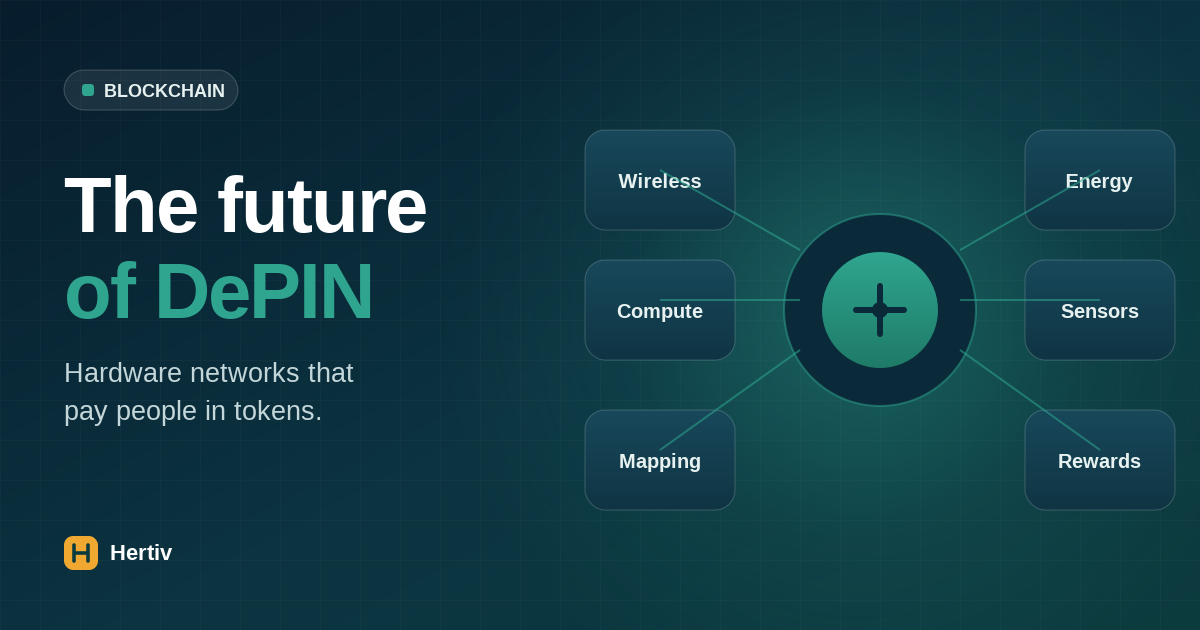
DePIN is moving from crypto experiments to real infrastructure: wireless, energy, compute and mapping networks that pay people in tokens for running hardware.
On this page
Short answer
Decentralised physical infrastructure networks, known as DePIN, pay ordinary people in tokens for running real hardware: wireless hotspots, solar panels, sensors, storage drives and graphics cards. The eight trends below are the ones that will decide whether DePIN grows into everyday infrastructure or stays a niche for crypto users.
What does the future of DePIN look like?
The future of DePIN is a shift from experiments to infrastructure that people use without thinking about tokens. The networks that last will be the ones where the service itself is useful, such as a wireless network that covers a dead zone, or a map that updates faster than the big providers.
Use this comparison to see which trends matter most. The table lists each trend, what changes, and who benefits first.
| Trend | What changes | Who benefits first |
|---|---|---|
| Wireless networks | Community hotspots fill coverage gaps | People in underserved areas |
| Energy grids | Home solar and batteries trade power | Households with solar panels |
| Compute and storage | Spare GPUs and drives rent out | AI teams needing cheap compute |
| Mapping and sensors | Dashcams and sensors map the world | Logistics and delivery firms |
| AI data networks | People earn for sharing data | Data contributors and model builders |
| Rewards get real | Token rewards tie to real revenue | Long-term network participants |
| Clearer rules | Regulators define what tokens are | Teams that want to operate openly |
| Enterprise buyers | Companies buy DePIN services | Networks with proven uptime |
Watch the demand side, not the token price. A network is healthy when someone pays for the service in ordinary money, not only when the token goes up. That is the test that separates infrastructure from speculation.
Wireless and energy: the networks closest to everyday use
1. Wireless networks: best for covering gaps the big carriers skip
Community wireless networks put small hotspots in homes and shops, and pay the owners in tokens for carrying data. The model works best where big carriers have not built coverage, such as rural areas, warehouses and large venues. Riders of the network get a connection, and hotspot owners get paid for hardware they already own.
The prediction is that wireless DePIN grows street by street, not country by country. A hotspot is only useful where people actually use it, so the networks that map demand first and place hardware second will grow faster than those that scatter hardware and hope.
Pros: real demand in underserved areas; cheap hardware to start; coverage grows with each new hotspot.
Cons: carriers can undercut prices once they notice; token rewards fall when too many hotspots join; quality varies by location.
2. Energy grids: best for households that already own solar panels
Energy DePIN lets households with solar panels and batteries sell spare power to neighbours, with the trade recorded on a blockchain. The household earns for power that would otherwise go unused, and the buyer gets local power without going through a distant grid.
The prediction is that energy networks grow where power prices are high and solar panels are common, because the saving is easy to see on a bill. The hard part is the rules: energy is regulated in most places, so a network needs to work with the local grid operator, not around it.
Pros: clear saving on a household bill; uses hardware people already own; local power is more reliable in outages.
Cons: energy rules differ by country and change often; the hardware is costly to install; trading needs a local grid partner.
Compute, mapping and data: selling spare capacity
3. Compute and storage: best for AI teams that need cheap capacity
Compute DePIN rents out spare graphics cards and storage drives, so AI teams can run training and inference without buying hardware or signing a cloud contract. The network matches jobs with idle machines and pays the owners in tokens for the work done.
The prediction is that compute networks grow as AI demand grows, because the gap between what teams need and what they can afford is wide. The risk is quality: a job that fails halfway wastes time and money, so networks need a way to check work and to replace machines that drop out.
Pros: cheaper than buying hardware for short jobs; huge supply of idle machines; no long cloud contract needed.
Cons: quality varies between machines; a job can fail if a machine drops out; data privacy is harder on shared hardware.
4. Mapping and sensors: best for logistics firms that need fresh data
Mapping DePIN pays drivers and device owners for dashcam footage and sensor readings, then turns them into maps that update daily instead of yearly. Delivery firms, insurers and city planners buy the data because fresh maps save them time and money.
The prediction is that mapping networks grow where the data has a clear buyer. A map that updates every day is worth paying for, while a map that nobody buys is just a hobby. The networks that sign a paying customer first, then recruit drivers, will outlast the ones that collect data and hope.
Pros: fresh data has a clear buyer; dashcams are already on the road; each new driver improves the map.
Cons: privacy rules cover faces and plates; data quality depends on the camera; the buyer market is small at first.
Rewards and rules: what makes a network last
5. AI data networks: best for people who want to earn from their data
AI data networks pay people for the data that trains models: recordings, photos, driving data and sensor readings. The contributor keeps control of the data and earns when a model team uses it, instead of giving it away for free.
The prediction is that data networks grow as model builders look for data they can legally use. Data scraped from the web brings legal risk, while data bought from a network comes with a clear record of consent. That record is the product, not the data itself.
Pros: contributors earn for data they already make; buyers get data with a clear consent record; the supply is large.
Cons: checking data quality is hard at scale; consent rules differ by country; the price of data falls as supply grows.
6. Rewards get real: best for networks that survive a bear market
Early DePIN networks paid generous token rewards to attract hardware, and many of them paid more than the service earned. The trend is towards rewards that are tied to real revenue: the network pays out a share of what customers pay, so the reward survives when the token price falls.
The prediction is that the next wave of networks will launch with the reward tied to revenue from day one. That is slower to grow, but the networks that do it will still be running when the hype fades, while the ones that pay from new token sales will run out of buyers.
Pros: rewards that survive a price fall; honest economics attract serious operators; revenue proves the service is wanted.
Cons: slower growth at the start; smaller rewards attract fewer early operators; the model needs real customers first.
Rules and enterprise buyers: the path to the mainstream
7. Clearer rules: best for teams that want to operate openly
Regulators in several countries are starting to say how DePIN tokens should be treated, and the teams that welcome clear rules will find it easier to raise money, sign partners and sell to companies. A token that is clearly a reward for a service is easier to defend than one that looks like an investment.
The prediction is that regulation splits the field: networks that design their token as a payment for a service will keep operating, while networks that promise returns will face trouble. Teams should get legal advice on their token design before launch, not after.
Pros: clear rules attract companies and investors; compliant networks can sell to enterprises; the legal risk falls.
Cons: the rules are still being written; compliance costs time and money; a wrong token design can be hard to fix later.
8. Enterprise buyers: best for networks with proven uptime
Enterprise buyers are starting to buy DePIN services: a logistics firm buying map data, a telecom firm buying coverage, an AI team buying compute. These buyers care about uptime, support and a contract, not about tokens, so the networks that win them are the ones that can prove their service works.
The prediction is that the first DePIN networks to sign a large enterprise customer will set the standard for the rest. A signed contract is the strongest proof that a network is infrastructure, and it gives the network the revenue to keep growing without new token sales.
Pros: enterprise contracts bring steady revenue; a big customer proves the service works; the network stops depending on token sales.
Cons: enterprises want support and contracts; uptime promises are hard to keep; sales cycles are long and slow.
How to choose a DePIN trend to follow
Choose the trend where the service has a paying customer you can name, not the trend with the loudest token. A good trend has a clear buyer, a clear job, and hardware that people already own or can buy cheaply.
- Name the buyer. Write down who pays for the service and what they pay today. If you cannot name the buyer, the trend is not ready.
- Check the hardware. Work out what the hardware costs, how long it lasts, and what it earns. If the payback takes years, the trend is slow.
- Read the token design. A token that pays for a service is healthier than one that pays for holding. Ask where the reward money comes from.
- Look at the rules. Check the rules in your country before joining a network, and get advice if the token looks like an investment.
- Start small. Run one device, measure what it earns and what it costs, and only then decide whether to add more.
For what DePIN already does today, see DePIN use cases.
For the investment angle, see how to invest in DePIN.
For the tokens themselves, see top DePIN cryptocurrencies.
What are the common mistakes?
The most common DePIN mistakes are buying hardware before checking the earnings, trusting token rewards that come from new sales, and ignoring the rules.
- Buying hardware first. Check what a device earns in your area before buying ten of them.
- Trusting the token price. A token that falls by half cuts your earnings by half, even if the network works.
- Ignoring the rules. Energy, telecom and data rules apply even when the network is on a blockchain.
- No buyer in sight. A network with no paying customer is a hobby, not infrastructure.
- Overpromising uptime. One device in a home is not a data centre. Plan for downtime.
Key takeaways
- DePIN pays people in tokens for running real hardware, not for holding coins
- The networks that last will be the ones with a paying customer for the service
- Wireless, energy, compute and mapping are the trends with the clearest buyers
- Rewards tied to real revenue survive a price fall; rewards from new token sales do not
- Start with one device, measure what it earns, and check the local rules first
Frequently asked questions
What is DePIN in simple terms?
DePIN stands for decentralised physical infrastructure networks. People run real hardware, such as wireless hotspots, solar panels or sensors, and earn tokens for the service that hardware provides. The network is the group of hardware owners plus the software that matches them with users who pay for the service.
Is DePIN the same as mining?
No. Mining earns tokens for securing a blockchain by solving puzzles, while DePIN earns tokens for providing a useful service, such as carrying data or mapping a street. Mining rewards depend on the network's rules, while DePIN rewards should depend on how much service the hardware actually provides.
Can I earn money running a DePIN device?
Sometimes, but it depends on the device, the area and the token price. A hotspot in a busy area earns more than one in an empty field, and a token that falls by half cuts the earnings by half. Run one device first, measure what it earns over a month, and only then decide whether to buy more.
What is the biggest risk in DePIN?
The biggest risks are a token price fall and a network with no paying customer. If the reward comes only from new token sales, the network runs out of buyers. If the token falls, the earnings fall with it. A network with real customers paying real money is the safest kind.
Do companies use DePIN, or is it only for crypto users?
Companies are starting to use it: logistics firms buy map data, telecom firms buy coverage and AI teams buy compute. These buyers care about uptime and support, not tokens, so the networks that win them are the ones that can prove their service works under a contract.
How do I start with DePIN?
Pick one network with a clear buyer, buy one device, and run it for a month while tracking earnings and costs. Check the rules in your country first, and do not spend more on hardware than you can afford to lose. The measurement, not the marketing, tells you whether it is worth it.


