How Much Does a Foundation Model Cost to Build?
Building a foundation model means paying for data, compute, people and running costs. Here is what each part costs and how to size a budget before you start.
On this page
Short answer
A foundation model costs whatever its data, compute, people and running time add up to, and the range is wide: a small fine-tune can cost a few thousand dollars, while training a large model from scratch can cost millions. Most teams spend far less by fine-tuning an existing model or paying per use through an API.
What is a foundation model?
A foundation model is a large machine learning model trained on broad data so it can be adapted to many tasks, such as writing, coding, search or image work. It is called a foundation because other applications are built on top of it rather than trained from nothing.
Training one from scratch means teaching the model patterns from a huge body of text, code or images. Fine-tuning means taking a model someone else trained and teaching it your task with a smaller, focused set of examples. The two paths have very different price tags, and most teams only ever pay for the second one.
Cost questions usually mix up three different bills: the one-off cost of training, the ongoing cost of running the model, and the cost of the people who build and maintain it. This article separates them so you can budget each one. For the basics of what these models are, see what a foundation model is.
What are the parts of the cost?
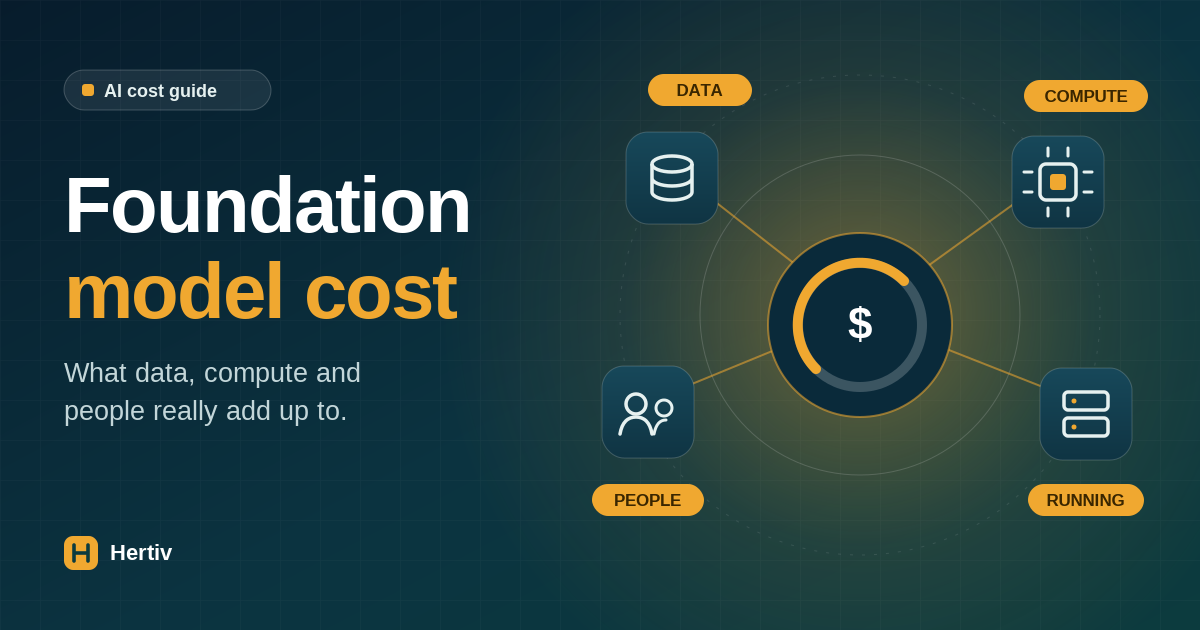
The parts of the cost are data, compute, people and running time. Each one can be small or large depending on the size of the model and how it will be used.
| Cost part | What you pay for | When you pay it |
|---|---|---|
| Data | Collecting, cleaning and labelling training examples | Before and during training |
| Compute | GPU or TPU time for training and testing | During training, in large blocks |
| People | Engineers, data staff and reviewers | Through the whole project |
| Running | Servers, requests and monitoring once live | Every month, while in use |
| Evaluation | Tests, safety checks and human review | Before launch and after each change |
Data and people are easy to underestimate. A model trained on messy or wrongly labelled examples needs extra rounds of fixes, and each round buys more compute. Clean data up front is usually the cheapest money in the project.
How much does training cost?
Training cost depends on model size, data size and how many training runs you need. A small fine-tune on a hosted service can cost a few hundred to a few thousand dollars in compute, while a large model trained from scratch needs weeks of rented GPU time and a budget in the millions.
Three things push training cost up. First, bigger models need more compute for every training step. Second, more training data means more steps before the model is ready. Third, most teams run several training attempts before one works well, and each failed attempt still costs compute.
Fine-tuning changes the maths. You start from a model that already knows language or images, so you only train the last part of the job with your own examples. That is why the cost gap between training from scratch and fine-tuning is so large.
LLM fine-tuning is the usual starting point for a team with a specific task, because it spends the bigger money only where your own examples can improve the result.
If you are weighing the two paths, the difference between a foundation model and an LLM helps to frame the choice.
What does it cost to run a foundation model?
Running a foundation model costs money per request, per month of hosting, or both. Hosted APIs charge by the amount of text or images processed, so the bill grows with usage. Self-hosted models charge by the server time you reserve, so the bill stays high even when nobody is using the model.
API pricing is the simplest to predict: you pay for what you send and receive. It is also the easiest to overspend on, because a long prompt or a chatty agent can process far more text than you expect. Set a per-day or per-user limit before launch and watch the first month closely.
Self-hosting makes sense when usage is steady and high, or when data must stay inside your own systems. It needs someone to keep the servers running, update the model and watch for failures. Add that staffing cost to the server bill before comparing it with an API, or the comparison will flatter self-hosting.
Should you build, fine-tune or use an API?
You should use an API when you need results quickly and your task fits a general model with good prompts. You should fine-tune when you have a clear set of examples and the general model keeps making the same mistakes. You should train from scratch only when no existing model fits your data or your rules, which is rare.
| Path | Up-front cost | Best when |
|---|---|---|
| API | Low | You need speed and usage is uneven |
| Fine-tune | Medium | You have examples and a repeatable task |
| Train from scratch | High | No existing model fits your data or rules |
Most teams start with an API, then fine-tune once they know which mistakes matter. That order keeps the early spend low and spends the bigger money only on a task that is already proving its value. Smaller models can also be enough: the cost of a small language model is often a fraction of a large one for the same task.
What drives the cost up or down?
Model size drives cost most directly. A model with more parameters needs more compute to train and more memory to run, and it answers more slowly. Pick the smallest model that answers well enough for your task, and test that claim with your own examples rather than trusting a general benchmark.
Data quality is the second driver. Clean, well-labelled examples cut the number of training rounds, while messy data forces extra rounds and extra review. Prompt design is a third driver for API users: short, direct prompts process fewer tokens and cost less per request.
Usage patterns matter too. A model that answers a few hundred requests a day costs little to run, while one behind a customer-facing chat can cost far more than the training did within a year. Budget the running cost for a full year, not just the launch month, before you commit to a path.
Example (hypothetical): a team pricing a small fine-tune
Example (hypothetical): a support team wants a model that drafts replies in its own tone. It gathers 2,000 past replies and labels them, which takes 40 hours at $50 an hour, or $2,000. It then fine-tunes a hosted model for 200 hours of compute at $4 an hour, or $800.
Human review adds 10 hours at $60 an hour, or $600. The one-off total is $2,000 plus $800 plus $600, which is $3,400. Running it costs about 10,000 requests a month at $0.002 each, or $20 a month.
The team also prices the alternative: training a model from scratch would need far more data and weeks of compute, so it would cost many times more for no clear gain on this task. The fine-tune wins because the task is narrow, the examples exist, and the running cost is small.
What are the common mistakes?
The most common foundation model cost mistakes are budgeting only for training, picking a model that is too large, and skipping evaluation until after launch.
- Forgetting running costs. A cheap training run can turn into an expensive monthly bill once real users arrive.
- Choosing the largest model first. A smaller model often answers just as well on a narrow task, for a fraction of the price.
- Training on messy data. Bad labels cause extra training rounds, and each round costs compute and time.
- Skipping evaluation. Without tests on your own examples, you find out the model fails from users, not from a test run.
- No usage limits. An API with no caps can run up a large bill from one misbehaving integration.
Key takeaways
- A foundation model's cost is data, compute, people and running time added together
- Fine-tuning an existing model usually costs far less than training one from scratch
- Running costs can pass training costs within a year once real users arrive
- Start with an API, fine-tune once you know which mistakes matter
- Budget a full year of running costs before you commit to a path
Frequently asked questions
How much does it cost to train a foundation model from scratch?
Training from scratch can cost from hundreds of thousands to millions of dollars, depending on model size, data size and how many training runs are needed. Most teams avoid this by fine-tuning an existing model or using an API, which costs far less.
Is fine-tuning cheaper than using an API?
Fine-tuning has a higher up-front cost but can be cheaper per request once usage is steady, because a smaller tuned model processes less text. An API is cheaper to start and better when usage is low or uneven. Compare a full year of both before deciding.
What is the cheapest way to use a foundation model?
The cheapest way is usually an API with short prompts and a small model, or a fine-tuned small model if the task is narrow and repeated. Pick the smallest model that answers well on your own examples, and set usage limits to stop runaway bills.
Do foundation models cost money when nobody uses them?
Hosted APIs cost nothing when idle, because you pay per request. Self-hosted models cost money all the time, because you pay for the servers whether or not anyone sends a request. That difference matters most for tools with quiet nights and weekends.
How much data do you need to fine-tune a foundation model?
It depends on the task. Some teams get good results with a few hundred labelled examples, while others need several thousand. Start with the smallest set you can label well, test the result, and add more examples only where the model still fails.
Can a small model replace a large foundation model?
Often yes, for a narrow task. A small model fine-tuned on your own examples can match a large general model on that one job, while costing less to run and answering faster. Test both on your own examples before choosing.


