The Five Pillars of AI Readiness: What Each One Covers
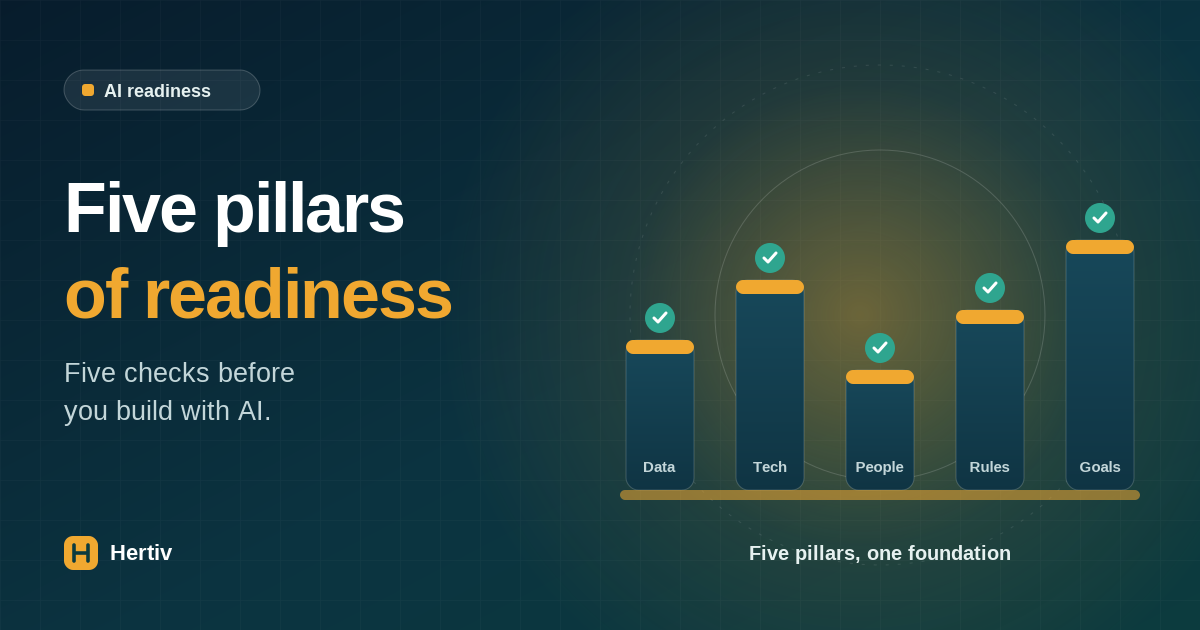
AI readiness rests on five pillars: data, technology, people, governance and business alignment. Here is what each pillar covers and how to check yours.
On this page
Short answer
The five pillars of AI readiness are data, technology, people, governance and business alignment. A team is ready when its data is clean and reachable, its tools fit the work, its people know their roles, its rules cover risk, and its first use cases have a clear owner and a measurable result.
What are the five pillars of AI readiness?
AI readiness rests on five pillars: data, technology, people, governance and business alignment. Each pillar is a part of the organisation that has to work before an AI system can deliver value, and a weak pillar limits what the others can do.
The pillars are not a sequence. Teams usually strengthen them in parallel, starting with the weakest one, because a strong model on weak data, or a good use case with no owner, fails in the same way.
| Pillar | What it covers | Sign it is ready |
|---|---|---|
| Data | Quality, access, labels, history | One trusted source per fact |
| Technology | Tools, infrastructure, integration | Systems connect without rework |
| People | Skills, roles, training, habits | Everyone knows their part |
| Governance | Rules, risk, review, accountability | Decisions are written down |
| Business alignment | Use cases, owners, measures | First use case has a named owner |
Why does data readiness come first?
Data readiness comes first because every AI output is only as good as the data behind it. A model trained on incomplete records, duplicated customers or stale prices will produce confident answers that are wrong, and no prompt or tool fixes that.
Check three things. First, can you find one trusted source for each fact the model needs? Second, is the data fresh enough for the decision it supports? Third, do you know who owns each source and who fixes it when it breaks?
Teams that skip this step pay for it later in rework. Cleaning data after launch means retraining, re-testing and re-explaining results, which costs more than fixing the source before the first build. An AI readiness assessment usually starts here for that reason.
What does technology readiness mean in practice?
Technology readiness means your tools, systems and infrastructure can support the AI work you plan. It is not about buying the newest model. It is about whether your data can reach the model, whether the model output can reach the people who act on it, and whether the whole path is secure.
Look for the gaps that block real use. Data trapped in spreadsheets, systems with no way to connect, and manual steps between the model and the decision are the usual blockers. Each one adds delay and a place where the work can fail silently.
Security belongs in this pillar too. Access controls, logging and a way to roll back a bad change matter from the first pilot, not only at full rollout. A small pilot that cannot be secured will not be allowed to grow.
How do people and skills shape readiness?
People readiness is about skills, roles and habits. A team needs someone who understands the data, someone who can judge the output, and someone who owns the result. Without those three roles, even a good model sits unused or gets used badly.
Training matters more than hiring at first. The people who already know the work are the ones who can spot a wrong answer, and they need enough understanding of the tool to challenge it. Short, practical sessions tied to real tasks work better than long courses about the technology in general.
Habits matter as well. Teams that already review each other's work, write decisions down and share what went wrong adapt faster, because AI work needs the same review habits as any other skilled work.
What does governance add to AI readiness?
Governance is the set of rules that decides what an AI system may do, who is accountable when it is wrong, and how problems get fixed. It sounds formal, but for most teams it is a short written page: what the system is for, what it must never decide alone, and who reviews its output.
Start with the risks that matter to your work. Wrong prices, wrong advice to customers, leaked personal data and biased decisions are the common ones. For each risk, name the check that catches it and the person who acts when the check fails.
Governance also protects the team. When the rules are written down, nobody has to guess whether a shortcut is acceptable, and a new joiner can see how decisions are made. Keep the rules short enough that people actually read them.
How does business alignment decide what to build?
Business alignment means the AI work serves a real goal with a named owner and a way to measure the result. Without it, teams build interesting demos that nobody uses, because no one is responsible for the outcome.
Pick the first use case by value and by risk, not by novelty. A good first use case saves measurable time or cuts a clear cost, and a wrong answer is caught by a human before it reaches a customer. That combination lets the team learn safely.
Agree on the measure before you build. Hours saved, errors cut, or decisions made faster are all fine, but the measure has to be one the owner can check. An AI return on investment check only works when the baseline was written down first.
Example (hypothetical): a manufacturer scores its five pillars
Example (hypothetical): a manufacturer with 400 staff wants an AI assistant for its maintenance team. Before building, it scores each pillar from 1 to 5. Data scores 2, because machine logs live in three systems with different part names. Technology scores 3, people 4, governance 2 and business alignment 4.
The team spends six weeks on the two weak pillars. It maps part names to one list, which lifts data to 4, and writes a one-page rule for what the assistant may and may not advise, which lifts governance to 4. The build then takes four weeks instead of the eight it would have taken with dirty data.
After three months the assistant answers 300 questions a week, and technicians accept about 8 in 10 answers without changes. The team credits the early pillar work, not the model, for that result. Running an AI readiness assessment follows the same pattern of fixing the weak pillar first.
What are the common mistakes?
The most common mistake is treating readiness as a technology purchase. Buying a model or a platform does not fix bad data, missing owners or unclear rules, and it often hides those gaps until launch.
Another mistake is scoring the pillars once and never revisiting them. Readiness changes as the team learns, so a short review after each project keeps the picture honest. A pillar that was strong can weaken when a key person leaves or a system changes.
A third mistake is starting with the hardest use case. Pick the one with a clear owner, a measurable result and a human check on the output. Early wins build the trust that harder projects need. Pricing an AI readiness assessment helps to set a realistic budget for this work.
Key takeaways
- Readiness has five pillars: data, technology, people, governance and business alignment.
- A weak pillar limits the others, so start with the weakest one.
- Data readiness means one trusted source per fact, fresh enough for the decision.
- Governance is a short written page: what the system may do and who is accountable.
- Pick the first use case by value and risk, with a named owner and a measure.
Frequently asked questions
What is the first step in checking AI readiness?
Score the five pillars honestly, then fix the weakest one before building. Most teams find data or governance is the weak pillar, and fixing it first saves rework later.
How long does it take to become AI ready?
It depends on the starting point. A team with clean data and clear owners can be ready for a small pilot in weeks, while a team with scattered data may need months of cleanup first.
Do small companies need all five pillars?
Yes, but at a smaller scale. A small team still needs clean data, a named owner, and a written rule for what the system may decide alone. The pillars do not need a large budget.
What is the difference between readiness and maturity?
Readiness asks whether you can start safely. Maturity asks how well you run AI at scale over time. Readiness comes first, and maturity grows from the lessons of early projects.
Who should own AI readiness in a company?
A named owner from the business side, supported by data and technology people. Readiness fails when it belongs to no one, so the owner should be able to make decisions and set priorities.
Can you build AI while improving readiness?
Yes, if the first use case is small and a human checks the output. Building and improving readiness together works, as long as the weak pillars are being fixed at the same time.


