Why Family Offices Turn to Tokenization Advisors
Family offices hire tokenization advisors because turning a real asset into tokens touches law, tax, platform choice and investor rules at once.
On this page
Short answer
Family offices turn to tokenization advisors because turning a real asset into tokens touches law, tax, platform choice and investor rules at once, and a mistake in any one of them is expensive to fix. An advisor brings the structure, the diligence and the market contacts that a family office rarely has in house, and helps the family decide whether tokenization is even the right move for a given asset.
What is a tokenization advisor?
A tokenization advisor is a specialist who helps an asset owner turn a real-world asset, such as a building or a fund share, into tokens on a blockchain, covering the legal structure, the platform and the investor process. The advisor does not usually build the platform; they design the deal and bring in the lawyers, the platform and the buyers.
Family offices hire advisors because tokenization is not one decision but a bundle of them. The asset must be held in the right vehicle, the tokens must fit the securities rules of each jurisdiction involved, the platform must handle the investor checks, and there must be someone willing to buy. Each of those is a field of its own, and a family office's in-house team rarely covers all four.
An advisor's job starts before any token is minted. The first question is whether the asset should be tokenized at all, because for many assets a normal fund or a direct sale is simpler and cheaper. A good advisor will say no when the numbers do not work.
What does a tokenization advisor actually do?
A tokenization advisor covers five areas, and the value is in how they fit together. A legal structure that ignores the platform's limits, or a platform chosen before the investor rules are known, will need to be redone.
| Area | What the advisor does |
|---|---|
| Legal structure | Picks the vehicle and jurisdiction for the asset |
| Asset checks | Diligence, valuation and document review |
| Platform | Selects the tokenization platform and its terms |
| Compliance | Investor checks, limits and filings |
| Distribution | Finds buyers and secondary market options |
The advisor usually works with the family's existing lawyers and tax advisers rather than replacing them. Their role is to keep the tokenization work aligned with the family's wider structure, so a tokenized holding does not create a tax or reporting problem in another part of the portfolio.
Why family offices hire tokenization advisors
Family offices hire tokenization advisors for three reasons: access, structure and risk. Access, because tokenization can open an asset to investors who could not buy it before, such as smaller buyers of a share in a building. Structure, because the deal needs a vehicle that fits the family's tax and governance setup. Risk, because the rules are still settling and a wrong step can be hard to undo.
Liquidity is the reason most often given, and the one most often overstated. Tokens can make a share in an asset easier to sell, but only if there is a market for it, and most tokenized assets trade thinly. An honest advisor will say that liquidity is a possibility, not a promise, and will point to the assets where it has actually happened.
The quieter reason is succession and governance. Splitting an asset into tokens can make it easier to divide among family members, to pass on, or to sell in part rather than whole. For a family holding a single large property, that flexibility can matter more than any trading volume. For the asset side of this, see the RWA tokenization guide.
What good advice looks like
Good advice starts with the family's goal, not with the token. An advisor who begins by pitching a platform has the order backwards; the asset, the investors and the rules decide the platform, not the other way round.
A good advisor will also give a clear cost picture before work starts, including their own fee, legal costs, platform costs and the cost of running the tokenized asset afterwards. Tokenization adds ongoing costs, such as investor reporting and platform fees, that a normal holding does not have, and those costs decide whether the deal makes sense.
Finally, good advice includes an exit. The family should know how it can sell the tokens, who would buy them, and what happens if the platform closes. An advisor who cannot describe the exit has not finished the job. RWA tokenization platform development covers the platform side in more depth.
Example (hypothetical): a family office tokenizes part of a property portfolio
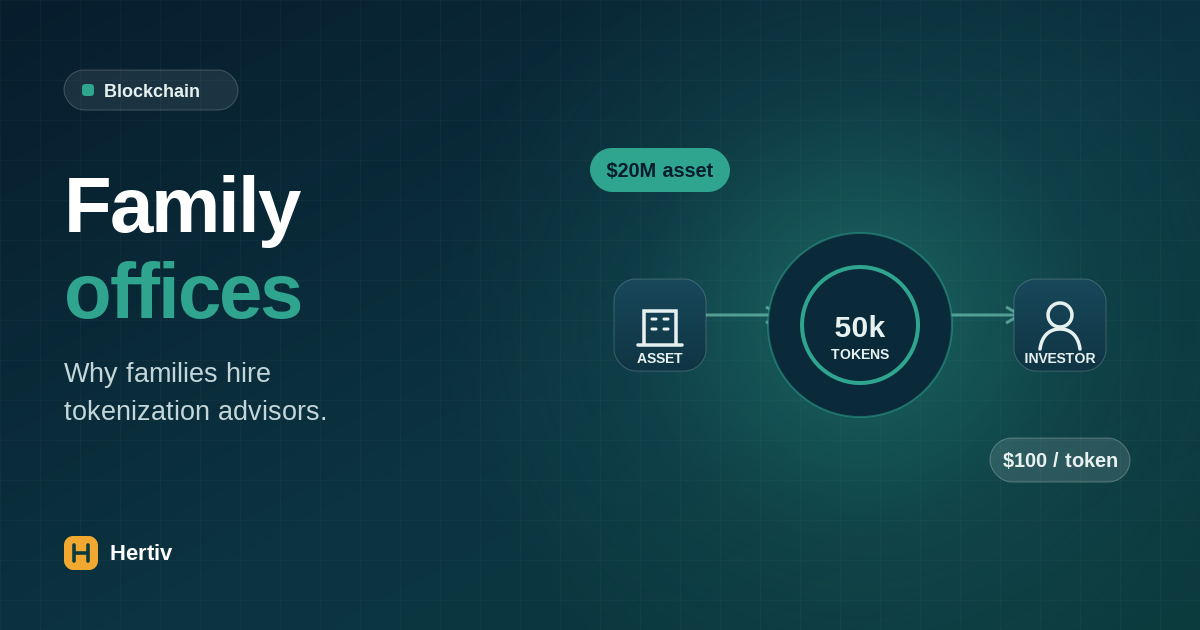
Example (hypothetical): a family office holds a $20 million office building and decides to tokenize 25% of it, which is $5 million. The tokens are priced at $100 each, so 50,000 tokens are issued. The advisor's fee is 2% of the tokenized value, which is $100,000, and legal and platform costs add $150,000.
The total cost to set up is $250,000, which is 5% of the $5 million tokenized. The family sells $3 million of tokens to outside investors and keeps $2 million itself. The outside buyers get a share in a building they could not have bought alone, and the family frees $3 million of capital without selling the building.
The family also takes on ongoing costs: investor reporting, platform fees and annual compliance checks, which the advisor estimates at $60,000 a year. The family accepts this because the freed capital earns more elsewhere than the running cost, but the deal would not make sense for a much smaller asset, where the same fixed costs would eat the benefit.
How to choose a tokenization advisor
You choose a tokenization advisor by checking their completed deals, their independence from platforms, and whether they will tell you not to tokenize.
- Ask for completed deals. Look for assets actually tokenized and sold, not just announced, and ask to speak to a past client.
- Check platform independence. An advisor paid by a platform will recommend that platform; an independent advisor compares several.
- Test their honesty. Ask which assets they would not tokenize and why; a good advisor has a clear answer.
- Get the full cost picture. Ask for their fee plus legal, platform and running costs, in writing, before work starts.
- Confirm the exit. Ask how the tokens can be sold, who would buy them and what happens if the platform closes.
Take your time with this choice. The advisor shapes the legal structure and the platform, and both are expensive to change once tokens are issued.
Common mistakes when hiring a tokenization advisor
The most common mistakes are hiring on a platform's recommendation, skipping the cost picture, and assuming liquidity will follow.
- Hiring on a platform's recommendation. An advisor recommended by a platform is likely to recommend that platform back.
- Skipping the cost picture. Setup costs of 5% or more make small deals uneconomic, and running costs continue every year.
- Assuming liquidity. Tokens do not create buyers; without a market, a tokenized share is as hard to sell as the asset itself.
- Tokenizing the wrong asset. Assets with unclear title, heavy regulation or no buyer demand are poor candidates.
- No exit plan. A deal with no way to sell the tokens leaves the family holding a complex asset it cannot exit.
Key takeaways
- Tokenization touches law, tax, platform and investor rules at once, so families hire specialists
- An advisor designs the deal and brings in lawyers, platform and buyers
- Liquidity is a possibility, not a promise, and most tokenized assets trade thinly
- Setup costs of about 5% and ongoing running costs decide whether a deal makes sense
- Check completed deals, platform independence and the exit plan before hiring
Frequently asked questions
What does a tokenization advisor do?
A tokenization advisor helps an asset owner turn a real asset into tokens, covering the legal structure, asset checks, platform choice, compliance and finding buyers. They design the deal and bring in the lawyers and the platform, rather than building the platform themselves.
Why do family offices use tokenization advisors?
Because tokenization touches law, tax, platform choice and investor rules at once, and a family office rarely has all four in house. An advisor also helps the family decide whether tokenization is the right move at all, since for many assets a normal fund or sale is simpler.
How much does tokenization advice cost?
Fees vary by deal size and scope, and most advisors quote per project. Expect the advisor's fee plus legal and platform costs to reach about 5% of the tokenized value on a mid-size deal; ask for the full picture in writing before work starts.
Does tokenization make an asset liquid?
Not on its own. Tokens can make a share easier to sell, but only if buyers exist for it, and most tokenized assets trade thinly. An honest advisor will point to the assets where liquidity has actually happened rather than promising it.
Can a family office tokenize an asset without an advisor?
It can, but the family would need legal, tax, platform and investor expertise in house, and the cost of a mistake in any one area is high. Most families find an advisor cheaper than building that expertise for a single deal.
What should I ask before hiring an advisor?
Ask for completed deals with real buyers, whether they are independent of any platform, the full cost picture including running costs, and how the tokens can be sold later. Also ask which assets they would not tokenize and why.


