ERC-1400 Token Standard: How Security Tokens Work
ERC-1400 is an Ethereum standard for security tokens, adding transfer rules, partitions and linked documents to ERC-20. Learn how it works and when it fits.
On this page
Short answer
ERC-1400 is an Ethereum token standard for security tokens, built on top of ERC-20. It adds three things that regulated assets need: transfer restrictions that can block a sale, partitions that split one token into groups with different rules, and a link between the token and the legal documents that describe it.
What is the ERC-1400 token standard?
The ERC-1400 token standard is a set of smart contract rules for issuing tokens that represent regulated assets, such as shares, bonds or fund units, on Ethereum. It starts with ERC-20, the familiar fungible token standard, and adds the controls that securities law requires: who may hold the token, when it may move, and which documents govern it.
A plain ERC-20 token can move to any address, which is a problem for a regulated asset. A share cannot be sold to a person who has not passed identity checks, or during a lock-up period, or in a country where the offering is not registered. ERC-1400 gives the issuer a way to enforce those rules on chain, so an invalid transfer fails instead of settling.
The standard is sometimes called the security token standard, and it grew out of work by Polymath and others in 2018. It is not the only approach: ERC-3643 takes a stricter, identity-first route, which is why teams often compare the two. For that comparison, see ERC-3643 vs ERC-1400.
How do partitions work in ERC-1400?
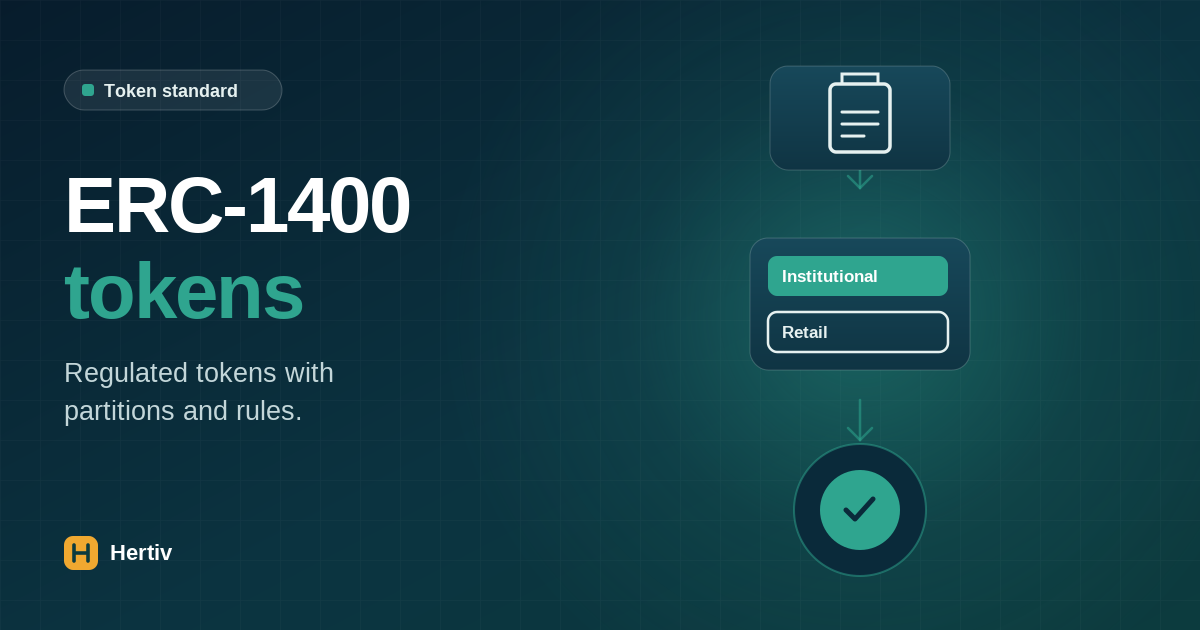
Partitions in ERC-1400 split one token into named groups, each with its own rules, while the token stays a single asset. A company might have an institutional partition, a retail partition and a locked partition for founders, all under one token contract.
Each partition has its own balance per holder. An investor can hold 500 tokens in the retail partition and 2,000 in the institutional partition, and the two balances follow different rules. A transfer within a partition is checked against that partition's rules; a transfer between partitions is a separate operation that the issuer can allow or block.
Partitions are useful because one offering often has several investor classes. Early investors may have a lock-up, employees may have a vesting schedule, and the public may have no restrictions at all. Instead of issuing three different tokens, the issuer uses one token with three partitions, which keeps trading, reporting and custody simpler.
The standard does not fix what the partitions are called. The issuer defines them when the token is created, and the names are stored on chain so that wallets, exchanges and auditors can read them.
What do transfer restrictions and controllers do?
Transfer restrictions and controllers are the two control mechanisms in ERC-1400. Restrictions decide whether a transfer may happen; controllers let the issuer act on tokens that are already held. The table below shows the main features and what each one does.
| Feature | What it does | Example |
|---|---|---|
| Transfer restrictions | Checks a transfer before it settles | Blocks a sale during a lock-up period |
| Partitions | Splits tokens into groups with own rules | Institutional and retail balances |
| Documents | Links legal papers to the token | Offering memorandum hash on chain |
| Controllers | Lets the issuer move or freeze tokens | Forced transfer after a court order |
| Operator roles | Delegates actions to a custodian | A transfer agent moves tokens for holders |
| Granularity | Sets the smallest divisible unit | Tokens divisible to 2 decimal places |
Restrictions are checked by a function that returns a code explaining why a transfer would fail, which is useful for wallets and exchanges: they can warn the user before submitting a transaction that will not settle. Controllers are a stronger power, so they should be held by a regulated party and limited by the offering documents, not by an anonymous admin key.
How is an ERC-1400 token issued?
An ERC-1400 token is issued in five steps, starting with the legal work and ending with the first transfer. The order matters, because the contract cannot fix a missing legal step after tokens exist.
- Define the offering. Decide what the token represents, who may hold it, which partitions exist, and what the lock-ups and transfer rules are. This is legal work, not code.
- Write and audit the contract. Implement the token with its partitions, restrictions, documents and controller roles, then have it audited by a firm that knows security token standards.
- Publish the documents. Store the offering memorandum and other legal papers, link them to the token by hash, and make them readable by holders, auditors and exchanges.
- Register holders. Complete identity checks for the first holders and record which partition each one belongs to. No one can receive tokens before this step.
- Issue and transfer. Mint tokens into the right partitions, test a transfer that should fail, and only then open the token to trading.
The failed-transfer test is the step teams skip most often, and it is the one that catches configuration errors. If a transfer that should be blocked goes through, the offering has a compliance problem, not a software bug. For the wider picture of launching a regulated token, see how to launch a security token.
Example: a company tokenises its shares
Example (hypothetical): a private company tokenises its shares as an ERC-1400 token. It issues 500,000 tokens at 20 units each, a total value of 10,000,000 units. The tokens are split into two partitions: 300,000 in the institutional partition and 200,000 in the retail partition.
An investor in the retail partition tries to buy 250,000 tokens from another retail holder. The transfer is checked against the retail partition balance, which is 200,000 tokens in total, so the transfer fails: you cannot move more tokens than the partition holds. The investor instead buys 150,000 tokens, which leaves 50,000 tokens in the retail partition.
Meanwhile, a founder's 60,000 tokens sit in a locked partition with a 12-month lock-up. A transfer attempt in month 6 fails the restriction check and returns a code explaining that the lock-up is still active. After month 12 the same transfer succeeds, and the tokens move to the retail partition.
How does ERC-1400 compare with ERC-20 and ERC-3643?
ERC-1400 compares with ERC-20 as a regulated extension, and with ERC-3643 as a lighter, more flexible alternative. The three standards answer different questions, so the choice depends on how strict the compliance needs to be.
ERC-20 is the base: a simple fungible token with no transfer rules, no partitions and no document links. It is the right choice for utility tokens and other unregulated assets, but it cannot represent a security, because nothing stops an invalid transfer.
ERC-3643 is the stricter standard. It checks holder identity on chain before every transfer, using an identity registry and a compliance module. That gives stronger guarantees, but it also means more infrastructure and more work to connect to exchanges and custodians. ERC-1400 is lighter: it adds partitions and transfer checks to ERC-20 without requiring a full identity system on chain.
A team issuing a straightforward security token with a few investor classes usually picks ERC-1400. A team that needs on-chain identity checks for every holder, such as a fund with strict investor eligibility rules, usually picks ERC-3643. For the details of the stricter standard, see what is ERC-3643.
What are the common mistakes?
The most common mistakes with ERC-1400 are treating it as a complete compliance solution, leaving controller keys unprotected, and skipping the failed-transfer test. Each one turns a paperwork problem into a real one.
- Assuming the standard is the law. ERC-1400 enforces rules you define; it does not decide what the rules should be. A lawyer must define them first.
- Unprotected controller keys. A controller can freeze or move tokens. If the key is held by one person with no controls, the token has a single point of failure.
- Skipping the failed-transfer test. If a transfer that should fail goes through, you find out too late. Test the restrictions before opening trading.
- Too many partitions. Each partition adds rules and testing. Start with the fewest partitions that match the investor classes.
- Documents not linked. A token with no linked offering documents is hard for an auditor or an exchange to accept. Link them at issuance.
- No plan for upgrades. Standards evolve and rules change. Decide in advance how the contract can be updated without stranding holders.
Key takeaways
- ERC-1400 extends ERC-20 with transfer restrictions, partitions and linked legal documents
- Partitions split one token into investor classes with their own rules and balances
- Transfer checks return a reason code, so wallets can warn users before a failed transfer
- Controllers can freeze or force-move tokens, so their keys need strong controls
- ERC-1400 is lighter than ERC-3643, which checks holder identity on chain before every transfer
- Legal work comes first: the contract enforces rules the offering documents define
Frequently asked questions
Is ERC-1400 the same as a security token?
Not exactly. ERC-1400 is a token standard for building security tokens, but whether a token is a security depends on the law in each country, not on the standard used. A token built on ERC-1400 is usually a security token because it represents a regulated asset with transfer rules.
Can ERC-1400 tokens trade on an exchange?
Yes, on exchanges that support the standard and can enforce its transfer rules. The exchange must check the same restrictions the contract checks, otherwise a trade could settle off chain and fail on chain. Not all exchanges support ERC-1400.
What is a partition in ERC-1400?
A partition is a named group of tokens inside one token contract, each with its own balance per holder and its own rules. A company might use partitions for institutional investors, retail investors and locked founder shares, all under one token.
Do I need ERC-1400, or is ERC-20 enough?
ERC-20 is enough for unregulated tokens with no transfer rules. If the token represents shares, bonds or fund units, you need transfer restrictions, partitions and document links, which is what ERC-1400 adds. A lawyer should confirm the classification first.
How is ERC-1400 different from ERC-3643?
ERC-1400 adds partitions and transfer checks to ERC-20, while ERC-3643 adds on-chain identity checks before every transfer. ERC-3643 is stricter and needs more infrastructure; ERC-1400 is lighter and easier to connect to exchanges and custodians.
Who can act as a controller?
A controller is a role the issuer assigns, usually to a regulated party such as a transfer agent or a custodian. Controllers can freeze or force-move tokens, for example after a court order, so the role should be held by a named party with clear limits in the offering documents.


