EOS vs Ethereum: How They Differ
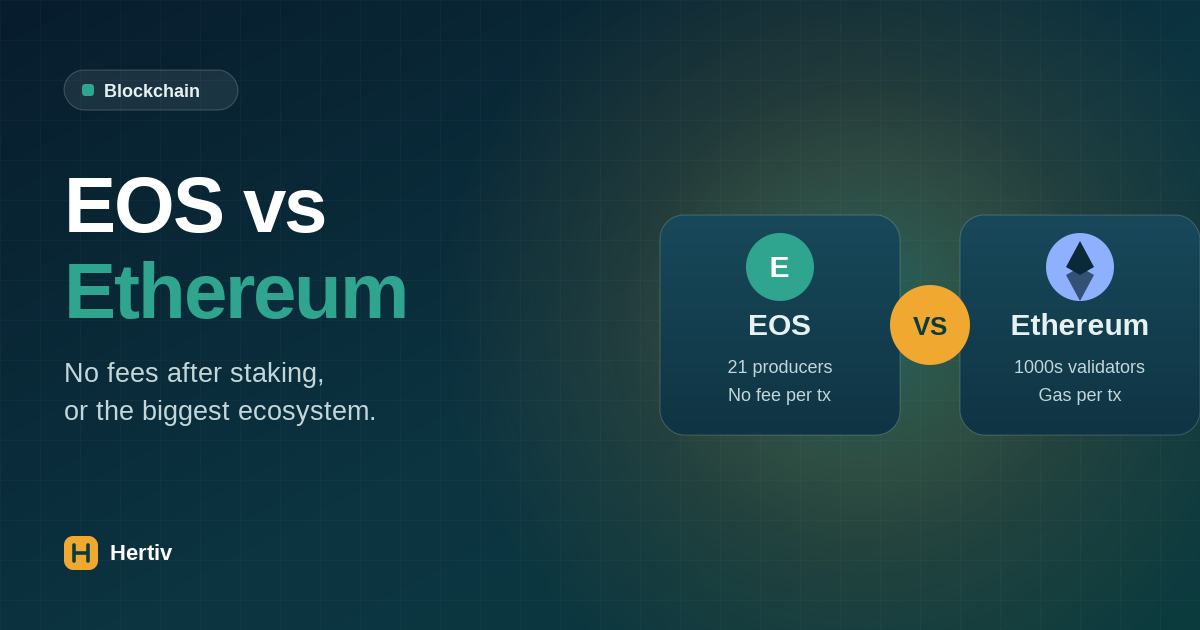
EOS offers fast transactions with no per-transaction fee, while Ethereum offers the largest ecosystem. Pick EOS for cheap volume and Ethereum for trust.
On this page
Short answer
EOS and Ethereum are both smart contract platforms, but EOS uses 21 voted block producers and staked resources with no per-transaction fee, while Ethereum uses thousands of proof-of-stake validators and charges a gas fee per transaction. EOS suits products with many cheap transactions, while Ethereum suits products that need the largest developer ecosystem and user base.
What is the difference between EOS and Ethereum?
EOS and Ethereum are both blockchain platforms for smart contracts, but they differ in how they reach agreement, charge for transactions and govern upgrades. Ethereum is the older and larger network, while EOS was built to offer faster transactions with no per-transaction fee.
The practical difference is who pays and how much. On Ethereum, every transaction pays a gas fee that rises when the network is busy. On EOS, users stake tokens to reserve network resources and then transact without paying a fee per transaction.
Neither is the right choice for every project. Ethereum has far more developers, tools and users, while EOS suits projects that need many cheap transactions and are happy with fewer block producers. Ethereum is the safer default for most teams.
How does EOS work?
EOS runs on delegated proof of stake. Token holders vote for 21 block producers, who take turns producing blocks every half second. Because only 21 producers agree on the order of transactions, the network confirms them quickly.
Resources on EOS are staked, not bought per transaction. An account stakes EOS tokens to reserve CPU time, network bandwidth and storage, and gets the stake back when it no longer needs the resources. This makes frequent small transactions cheap once the stake is in place. Smart contracts on EOS are written in C++ and can be upgraded after deployment.
Governance is on-chain: token holders vote on producers and on changes to the network. The trade-off is centralisation. With 21 producers, the network is faster but easier to influence than a network with thousands of independent validators.
How does Ethereum work?
Ethereum runs on proof of stake. Thousands of validators stake ETH and are chosen at random to propose and confirm blocks, roughly every 12 seconds. Anyone with enough ETH and a server can become a validator.
Every transaction on Ethereum pays a gas fee in ETH. The fee rises when the network is busy and falls when it is quiet. Layer 2 networks built on Ethereum cut the fee by processing transactions off the main chain and settling them in batches.
Ethereum's strength is its ecosystem: the most developers, the most audited smart contract code, the most wallets and the most users. A team building on Ethereum can reuse tools and contracts that have been tested by thousands of other projects.
EOS vs Ethereum side by side
The table below compares the two networks on the points that matter most when choosing a platform. Treat the figures as typical values for planning, not as promises, because fees and speeds change with network load.
| Point | EOS | Ethereum |
|---|---|---|
| Agreement | Delegated proof of stake, 21 producers | Proof of stake, thousands of validators |
| Block time | About 0.5 seconds | About 12 seconds |
| Transaction fee | No per-transaction fee after staking | Gas fee per transaction, varies with load |
| Smart contracts | C++ contracts, upgradable | Solidity contracts, usually fixed |
| Developers and tools | Smaller community | Largest community in crypto |
| Governance | On-chain votes by token holders | Off-chain proposals, client teams |
Speed is EOS's clearest advantage and ecosystem is Ethereum's. A project that needs thousands of cheap transactions a day will feel the difference in fees, while a project that needs audited code and ready-made integrations will feel the difference in tooling.
Which one fits your project?
Choose EOS when the product needs many small transactions and the fee per transaction would eat the margin. Games, social apps and ticketing are the usual cases, because users will not pay a fee every time they act.
Choose Ethereum when the product needs trust, liquidity or other protocols. Lending, trading and tokenised funds live on Ethereum because that is where the users and the money already are. Creating a token is also simpler on Ethereum, because the tooling and the wallet support are already in place.
Consider a third option: build on an Ethereum layer 2. It keeps the Ethereum ecosystem and cuts the fee, at the cost of extra complexity. Many teams start on a layer 2 rather than choosing between EOS and Ethereum at all.
Example (hypothetical): a ticketing dApp
Example (hypothetical): a festival sells 10,000 tickets a day through a dApp, and each sale is one on-chain transaction. The team compares the daily cost on each network.
The arithmetic: on Ethereum at a fee of $0.50 per transaction, 10,000 sales cost $5,000 a day. On EOS, the same 10,000 sales cost no per-transaction fee after staking tokens worth $20,000 once, so the daily cost is close to zero and the saving is about $5,000 a day.
The team still has to weigh the saving against the smaller EOS audience. If most buyers already hold ETH and use Ethereum wallets, the cheaper network may cost more in lost sales than it saves in fees.
What about layer 2 networks and other chains?
Before you choose between EOS and Ethereum, look at the layer 2 networks built on Ethereum. They process transactions off the main chain and settle them in batches, which cuts the fee while keeping the Ethereum tools and wallets.
A layer 2 adds complexity: bridging funds in and out, and a second network to monitor. For a product with many small transactions, that complexity is often worth it, because the fee saving is large and the audience stays on Ethereum.
Other chains, such as Solana and Polygon, offer the same trade-off in different forms: lower fees and faster confirmation in exchange for a smaller ecosystem. Compare them on the same points — fees, audience, tools and audit history — before you commit to one.
Common mistakes
The most common mistake is choosing on fees alone. A network with no fees but no users is a worse home for a product than a network with fees and a real audience.
Another mistake is assuming smart contracts work the same on both networks. EOS contracts are written in C++ and can be upgraded, while Ethereum contracts are usually written in Solidity and fixed once deployed. The team you hire must know the platform you choose.
- Ignoring the audience. Build where your users already are, not where the fees are lowest.
- Skipping the audit. Get the contracts checked by an independent auditor on either network.
- Forgetting the stake. On EOS, budget for the token stake and the RAM the accounts need.
- Betting on one chain. Design the product so the chain can change if the project outgrows it.
Key takeaways
- EOS uses 21 voted producers; Ethereum uses thousands of validators.
- EOS has no per-transaction fee after staking; Ethereum charges gas.
- Ethereum has the largest developer and user ecosystem.
- EOS suits many cheap transactions; Ethereum suits trust and liquidity.
- Consider an Ethereum layer 2 before choosing between the two.
Frequently asked questions
Is EOS faster than Ethereum?
Yes, EOS confirms blocks in about half a second, while Ethereum confirms blocks in about 12 seconds. EOS is faster because only 21 voted producers agree on transactions, while Ethereum uses thousands of validators. Speed is not the whole story, because Ethereum has far more users and tools.
Does EOS really have no fees?
EOS has no fee per transaction, but it is not free. Users stake EOS tokens to reserve CPU, bandwidth and storage, and they need RAM for their accounts. The stake is returned when the resources are no longer needed, so frequent transactions cost little once the stake is in place.
Is Ethereum more secure than EOS?
Ethereum is more decentralised, with thousands of independent validators, which makes it harder for any small group to control. EOS has 21 block producers, which is faster but easier to influence. Both networks have run for years without a successful attack on the base chain.
Can I move a dApp from EOS to Ethereum?
Not directly. The smart contracts are written in different languages, C++ on EOS and usually Solidity on Ethereum, so the contracts must be rewritten. Design the product so the chain can change, and keep the business logic separate from the chain code where possible.
Which is better for an NFT project?
Ethereum is usually the better choice for NFTs, because that is where the buyers, marketplaces and wallets already are. EOS suits NFT projects where users make many small transactions, such as games, and the fee per transaction would put them off.
What is a layer 2, and should I use one?
A layer 2 is a network built on Ethereum that processes transactions off the main chain and settles them in batches, which cuts the fee. Many teams start on a layer 2 to keep the Ethereum ecosystem with lower fees, at the cost of extra complexity.


