Enterprise LLMs: What They Are and How Companies Use Them
Enterprise LLMs are language models run for a company with control over data, access and cost. This guide covers the deployment choices and the governance rules.
On this page
Short answer
An enterprise LLM is a large language model used inside a company under rules for data privacy, access, quality and cost. Companies use them for support, documents, code and internal search, choosing between an API, a private deployment or a fine-tuned model depending on how sensitive the data is.
What is an enterprise LLM?
An enterprise LLM is a large language model run for a company under rules that cover data privacy, access, quality and cost. It is the same kind of model that powers public chatbots, but it is used inside a business with controls on what data it can see, who can use it, and what it is allowed to do with company information.
Companies do not buy a model and switch it on. They pick a deployment path, connect it to their own data, set guardrails, and measure whether it helps. The model may answer support tickets, draft documents, explain code or search internal wikis, but it always works inside the company's own rules.
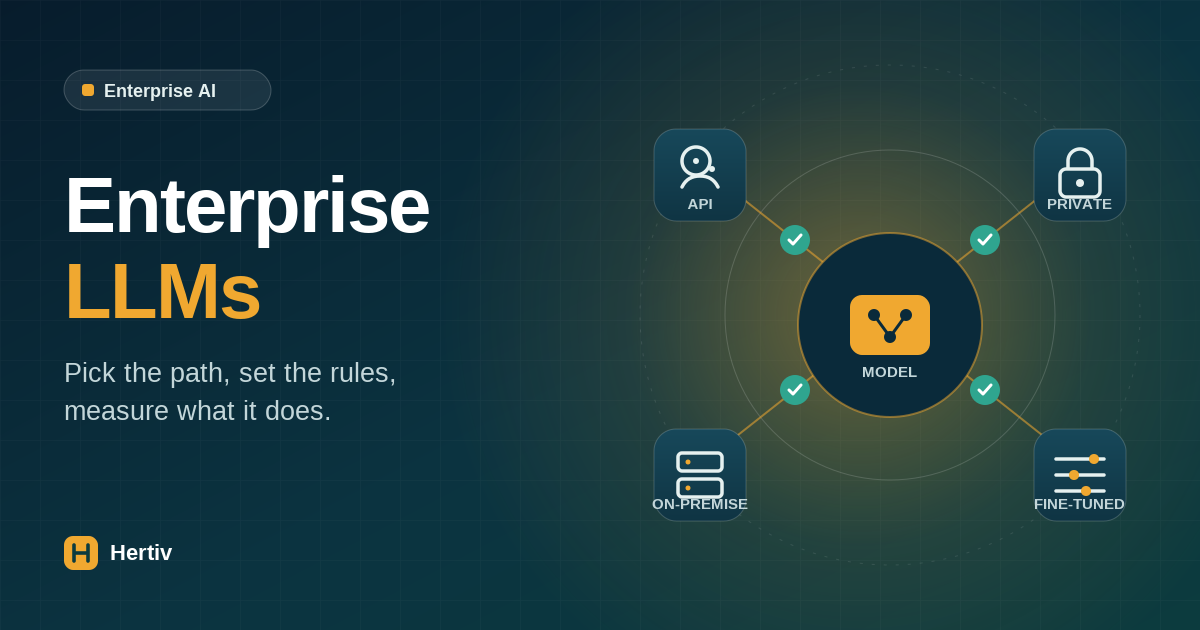
The table below shows the four deployment paths most companies choose between.
| Path | How it works | Best when |
|---|---|---|
| Public API | Send prompts to a vendor API | Data is not sensitive |
| Private cloud | Model runs in your cloud account | You need data control |
| On-premise | Model runs on your own servers | Rules demand it stays inside |
| Fine-tuned | Model trained further on your data | Format or tone must match |
For the build side of the private path, see how to build enterprise-grade proprietary LLMs.
Where do enterprises use LLMs?
Support is the most common use. A model drafts replies from the knowledge base, summarises long tickets and suggests the next step, while a person stays in charge of the final answer. The return is easy to measure: tickets per hour, resolution time and customer satisfaction.
Documents are next. Models summarise contracts, pull fields from invoices, draft reports and turn meeting notes into actions. The pattern that works is extraction plus a check: the model drafts, a rule or a person verifies, and only then does the result move on.
Code and internal search follow. Developers ask the model to explain code, draft tests and review changes, while staff search policies and wikis in plain language instead of hunting through folders. Each use needs its own evaluation set, because what works for support may fail for legal text.
How do you choose between API, private and fine-tuned models?
Start with the data. If the prompts contain customer data, contracts or trade secrets, a public API may be off the table unless the vendor contract covers data handling in writing. Private cloud or on-premise keeps the data inside your own boundary, at a higher running cost.
Next, test the models on your own work. Run the same set of real tasks through each option and score the answers for accuracy, format and speed. A model that tops a public benchmark may still fail on your documents, so the test set matters more than the marketing.
Fine-tuning is worth it only when prompting and retrieval cannot reach the quality you need, for example when the output must follow a strict format every time. For help comparing the options, see how to choose an LLM for your business.
What governance and security rules apply?
Every enterprise LLM needs written rules for data, access and review. The rules should state which data the model may see, who may use it, what it may do with the answers, and how long prompts and outputs are kept. Without them, staff will paste sensitive data into the first tool that works.
Access should follow the same permissions as the documents behind it. If a person cannot open a salary file, the model should not quote it to them either. Log every prompt and output, and review the logs on a schedule, so misuse or a data leak is found early rather than after months.
Review the outputs too. A model can produce confident but wrong text, and in regulated work that error has consequences. Decide which outputs need a human check and which can run straight through, and write that decision down. The private-versus-public trade-off is covered in private LLM vs public LLM.
How do you measure whether it works?
Pick one outcome per use case and measure it on a fixed test set. For support, that may be time to first draft or resolution time. For document work, it may be extraction accuracy against a labelled sample. For code, it may be the share of suggestions the developer accepts.
Track cost the same way. Record the cost per task, not just the monthly bill, so you can compare a cheap model that needs heavy review with a dearer one that needs none. A model that saves ten minutes per task but needs five minutes of checking has saved five minutes, not ten.
Review the numbers monthly with the team that owns the use case. If the score stalls, the fix is usually better data or a clearer prompt, not a bigger model. Change one thing at a time and re-run the same test set, so you know what actually helped.
Example (hypothetical): a retailer picks an LLM for support
Example (hypothetical): a retailer handles 1,000 support tickets a day and tests an LLM that drafts replies for the 600 tickets that are routine order questions. By hand, each of those 600 tickets takes about 6 minutes, which is 600 times 6 minutes, or 3,600 minutes, about 60 hours a day.
With the model drafting and staff reviewing, each ticket takes about 3 minutes: 600 times 3 minutes is 1,800 minutes, or 30 hours a day. The saving is about 30 hours a day, which the team spends on the 400 complex tickets that need a person from the start.
The retailer keeps the public API off the table for order data and picks a private deployment instead, accepting a higher running cost for data control. After a month, the review rate and the resolution time both hold steady, so the rollout widens to a second product line.
What are the common mistakes?
Most enterprise LLM projects fail on process and data, not on the model. The mistakes below show up again and again, and each one is easy to avoid with a slower start.
- Starting with a broad assistant instead of one workflow with an owner.
- Sending sensitive data to a public API without a written data agreement.
- Skipping the evaluation set, so quality debates are anecdotal.
- Measuring usage instead of outcomes such as time saved or error rate.
- Fine-tuning before testing whether prompting and retrieval are enough.
- Giving the model broad write access before permissions and logs exist.
- Assuming the vendor benchmark predicts performance on your own data.
If you need help picking and running a model for your own team, LLM development covers the build, the deployment and the guardrails around it.
Key takeaways
- An enterprise LLM is a language model run inside a company under rules for data, access and cost.
- Pick the deployment path from the data first: API, private cloud, on-premise or fine-tuned.
- Test models on your own tasks, not on public benchmarks, before you commit.
- Give the model the same permissions as the people using it, and log every prompt and output.
- Measure one outcome per use case on a fixed test set, and review it monthly.
Frequently asked questions
What is the difference between an enterprise LLM and a public chatbot?
An enterprise LLM runs under company rules for data privacy, access, quality and cost, while a public chatbot runs on the vendor's terms. The model may be the same, but the controls around it are different.
Should a company use a public API or a private LLM?
It depends on the data. Public APIs suit non-sensitive work and cost less to start, while private deployments keep data inside your own boundary. Check the vendor's data terms in writing before you decide.
When is fine-tuning worth it for an enterprise?
Fine-tuning is worth it when prompting and retrieval cannot reach the quality you need, such as a strict output format or a house tone. Test prompting first, since it is cheaper and faster to change.
How do enterprises keep LLM data private?
They limit what data the model can see, use private deployments for sensitive work, strip personal data from prompts, and log access. Permissions should match the documents the model reads from.
How do you measure an enterprise LLM?
Pick one outcome per use case, such as time saved or extraction accuracy, and measure it on a fixed test set. Track cost per task as well, so you can compare models fairly.
What is the biggest risk with enterprise LLMs?
The biggest risk is confident but wrong output reaching a customer or a regulator. Keep a human check on high-stakes answers, log everything, and review the logs on a schedule.


