How to Choose the Right LLM for Your Business
Choosing an LLM means matching a model to one real task, then testing it on your own data. Here is how to compare options, cost and risk before you commit.
On this page
Short answer
To choose an LLM for your business, define one task and its success measure, shortlist two or three models that fit your data and privacy needs, and test them on a fixed set of your own examples. Pick the cheapest model that clears your quality bar, with a fallback and a human review step.
What does choosing an LLM actually mean?
Choosing an LLM for your business means picking the model that answers your tasks well enough, at a cost and speed you can afford, under controls you can defend. It is a fit decision, not a search for the most powerful model on the market.
The biggest model is often the wrong answer. It may cost ten times more per request than a smaller one, answer more slowly, and still make the same mistakes on your specific documents. A model that is weaker in general can be the better choice if it handles your task, your data and your budget.
Five dimensions decide the fit: the task itself, the quality you need, the cost per request, the speed your users expect, and where your data is allowed to go. A model that fails any one of these is the wrong model, however good its demo looks. LLM development work starts from the same five questions.
Which LLM options should you compare?
Most business choices fall into four broad options. Compare them on the same task, not on marketing claims, and judge each one by what it costs you to run it well.
| Option | Best for | Main trade-off | Cost pattern |
|---|---|---|---|
| Hosted general-purpose model | Varied tasks, fast start | Data leaves your systems | Pay per token, see vendor site |
| Open-weight model, self-hosted | Strict privacy, steady volume | You run and update it | Fixed infrastructure, see vendor site |
| Small model, fine-tuned | One repeated task, set format | Needs training data and upkeep | Lower per-request cost over time |
| Hosted multimodal model | Text plus images or audio | Higher cost, harder to test | Pay per token and per media unit |
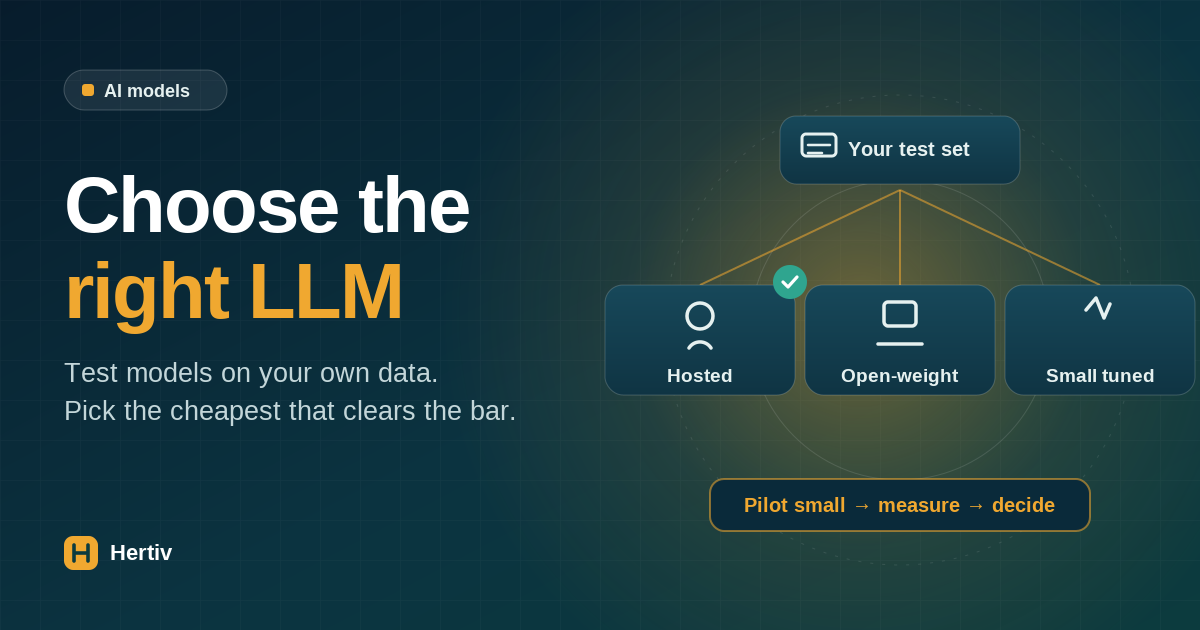
Start with the hosted general-purpose option for a first pilot. It is the fastest way to learn what the task really needs, and you can move to a smaller or self-hosted model once the task is stable and the volume is known.
How do you test models on your own work?
You test models by running them on your own examples, not on public benchmarks. A benchmark score tells you how a model does on someone else's questions; your examples tell you how it does on yours.
Build a fixed test set of 20 to 50 real cases from your work: past tickets, real documents, real customer questions, with the correct answer written down for each one. Score every candidate model on the same set, and have a person check the answers the model got wrong.
Score on more than correctness. Check whether the model cites the right source, whether it refuses when it does not know, whether the format is usable, and whether the tone fits your customers. A model that is right but rude, or right but in the wrong format, still fails the task.
Keep the test set fixed while you compare models. If you change the questions between candidates, the comparison is meaningless. Our guide to how to evaluate an LLM application covers the scoring and review setup in more depth.
What do cost, speed and limits look like?
Hosted models are usually priced per token, with separate rates for input and output, and output tokens cost more than input tokens. A chat that asks the model to write a long reply costs more than a chat that asks for a short classification, even with the same input.
Work out the cost per completed task, not per token. Multiply the tokens per request by the requests per day, then by the price per token, which you should read on the vendor's pricing page. A model that looks cheap per token can be expensive if it needs long prompts or writes long answers.
Speed matters where users wait. A model that takes 20 seconds to answer will lose users in a live chat, even if its answers are better. Check the response time on your longest realistic input, not on a short demo prompt.
Watch the limits too: how many requests per minute the vendor allows, how much text fits in one request, and what happens when the limit is hit. A model that stops working at peak hours is a poor fit for a customer-facing product. LLM fine-tuning can cut cost later, once you know which task is worth optimising.
How to choose an LLM in five steps
A short, structured selection process beats weeks of debate. Five steps, done in order, are enough for most business decisions.
- Write the task down. One task, one input, one output, one measure of success. If you cannot write it in two sentences, the task is too broad.
- Set the constraints. Where may data go, what may it cost per month, how fast must it answer, and who reviews the output?
- Shortlist two or three models. One hosted general-purpose model, and one cheaper or more private option for contrast.
- Test on your fixed set. Score all candidates on the same 20 to 50 cases, with a person reviewing the failures.
- Pilot with a fallback. Ship the winner to a small group, keep a human review step, and measure the same success metric for a month.
Do not skip the pilot. A model that wins on a test set can still fail in production, where inputs are messier and users ask questions your test set never covered. An AI proof of concept with a fixed evaluation set is the cheapest way to find out.
Example (hypothetical): a support team picks a model
Example (hypothetical): a support team handles 500 chats a day and wants a model to draft replies for agents. Two hosted models are tested on the same 50 past chats.
Model A costs $0.004 per chat. At 500 chats a day, that is $2.00 a day, or $60 a month. It drafts a usable reply for 400 of the 500 chats, which is 80%. Model B costs $0.02 per chat, which is $10.00 a day, or $300 a month. It drafts a usable reply for 450 chats, which is 90%.
Model B costs $240 more per month and resolves 50 more chats without an agent rewrite. If each rewrite takes an agent 4 minutes, those 50 chats save 200 minutes a day, or about 3 hours and 20 minutes of agent time. For this team, Model B is worth the extra $240 a month.
The same arithmetic can point the other way. If the team handled 50 chats a day, Model B would save only 20 minutes a day, and the extra cost would be hard to justify. The decision depends on volume, not on which model is better in general.
What are the common mistakes?
The most common mistakes are choosing on reputation, skipping the test set, and ignoring the running cost until the bill arrives.
- Picking the biggest model by default. It costs more, answers more slowly, and may still fail your specific task.
- Testing on demo prompts. Short, clean prompts flatter every model. Test on real, messy inputs.
- Forgetting the fallback. Every model fails sometimes. If there is no human review or safe refusal, failures reach customers.
- Ignoring data rules. Sending customer data to a hosted model may break your privacy promises or contracts.
- Judging on one example. A single impressive answer proves nothing. Score a fixed set and look at the failures.
- Locking in too early. Model prices and abilities change. Keep the prompt and test set portable so you can switch.
Key takeaways
- Define one task and one success measure before comparing any model
- Test candidates on a fixed set of your own examples, not on public benchmarks
- Judge cost per completed task, not per token, and check speed on realistic inputs
- The cheapest model that clears your quality bar is usually the right pick
- Pilot with a human review step and a fallback, and keep your prompts portable
Frequently asked questions
Should we pick the most powerful LLM available?
Usually not. The most powerful model costs more per request and answers more slowly, and it can still fail your specific task. Pick the cheapest model that clears your quality bar on your own test set, and only move up when the test set shows a real gap.
How many test cases do we need to compare models?
A fixed set of 20 to 50 real cases is enough for a first comparison. Use real inputs from your work, with the correct answer written down, and have a person review the failures. A larger set helps later, once the choice is close.
Is a self-hosted open-weight model cheaper than a hosted one?
It depends on volume. Self-hosting has fixed infrastructure and maintenance costs, so it can be cheaper at high, steady volume. At low or spiky volume, a hosted model with pay-per-token pricing usually costs less, since you pay only for what you use.
When should we fine-tune instead of switching models?
Fine-tune when one repeated task has a stable format and you have enough labelled examples, and prompting alone does not reach your quality bar. Fine-tuning a small model can cut per-request cost, but it adds training and upkeep work, so test it after the task is stable.
What privacy questions should we ask before choosing?
Ask where your data is stored, whether it is used to train the vendor's models, how long it is kept, and whether you can delete it. Check your contracts and privacy promises too. If the answers do not fit, a self-hosted model may be the safer choice.
How often should we re-check our LLM choice?
Review it at least twice a year, and sooner if your volume, task or budget changes. Model prices and abilities change quickly, so re-run your fixed test set against one or two newer candidates and switch only when the test set shows a clear improvement.


