7 Emerging DeFi Trends Worth Watching in 2026
DeFi keeps changing fast, and a few trends look ready to move from experiment to everyday use. Here are seven to watch, and the risks to check first.
On this page
Short answer
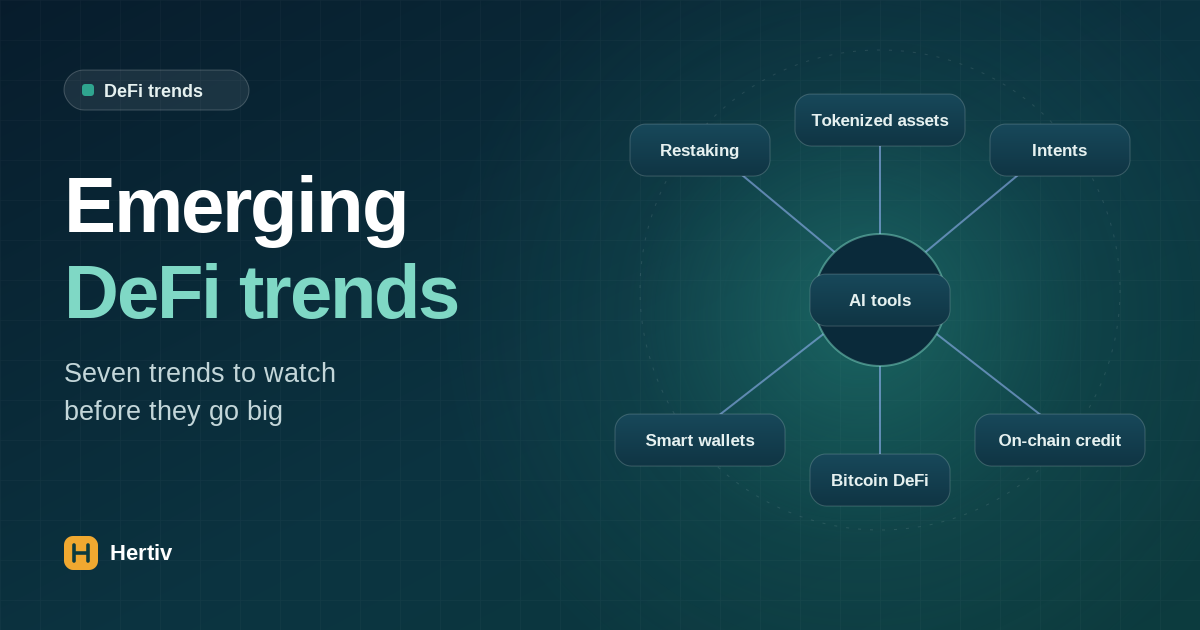
Seven DeFi trends look ready to matter in 2026: restaking, tokenized real-world assets, intent-based trading, account abstraction, Bitcoin-layer DeFi, on-chain credit and AI-assisted tools. Each one changes how users earn, trade or borrow, but each also carries new risks. This list explains what each trend does, who it suits, and what to check before you use it.
Which DeFi trends are emerging now?
DeFi moves quickly, and most new ideas fade before they matter. The seven trends below are different: each one already has working products, real users and a clear reason to grow. They are worth watching whether you build, invest or simply use DeFi products.
Use the table to compare them at a glance, then read the trend that fits your interest. Every trend has a short list of strengths and risks, so you can judge it on its own terms. A look at how DeFi trends shape exchanges shows how these changes reach real products, and the same test applies here: a trend matters when it changes what a product can do.
| Trend | What it does | Who should watch |
|---|---|---|
| Restaking | One stake secures extra services | Yield seekers |
| Real-world asset tokenization | Real assets trade on a chain | Traditional finance teams |
| Intent-based trading | Users state the outcome, solvers find the route | Busy traders |
| Account abstraction | Wallets become smart accounts | New users |
| Bitcoin-layer DeFi | DeFi products built on Bitcoin | Bitcoin holders |
| On-chain credit | Loans based on reputation, not only collateral | Lenders and borrowers |
| AI-assisted DeFi tools | Tools that read on-chain data and advise | Active users |
Restaking and tokenized real-world assets
1. Restaking: best for yield seekers
Restaking lets people who already stake a token use the same stake to secure extra services, such as data layers or oracle networks. Instead of locking capital in one place, the stake does two jobs at once, and the staker earns extra rewards for the extra risk.
The idea grew because staking already locks large amounts of capital, and restaking puts that capital to more work. The risk is that a failure in one of the extra services can now affect the original stake, so the reward comes with a new kind of shared risk.
Pros
- Extra yield from the same stake
- More services secured by existing capital
- Growing choice of restaking protocols
Cons
- One failure can affect several services
- Slashing rules are still new and vary
- Returns depend on demand for the extra services
2. Real-world asset tokenization: best for traditional finance teams
Tokenization puts real assets such as bonds, funds and property on a chain, so they can be traded, used as collateral or settled in minutes. Banks and fund managers use it to reach new buyers and to cut the time and cost of settlement.
This trend matters because it brings regulated assets into DeFi, which opens the market to far more capital. The hard parts are legal: who owns the token, what happens if the issuer fails, and which rules apply in each country.
Pros
- Regulated assets reach DeFi users
- Faster settlement than paper-based systems
- New collateral for lending markets
Cons
- Legal treatment varies by country
- Issuer risk stays even when the token is on-chain
- Liquidity is thin for many tokenized assets
Intent-based trading and account abstraction
3. Intent-based trading: best for busy traders
Intent-based trading lets a user state what they want, buy this token at this price, or swap with as little loss as possible, and lets solvers compete to deliver it. The user sets the outcome, and the solver works out the route.
This suits traders who do not want to study every pool and route. The risk is trust: the solver sees the intent and could use that knowledge, so users need clear rules on how solvers are chosen and checked.
Pros
- Simpler for users than manual routing
- Solvers compete, which can improve prices
- Works across chains and venues
Cons
- Solver behaviour needs clear rules
- A bad solver can deliver a poor price
- New standards are still forming
4. Account abstraction: best for new users
Account abstraction turns a wallet into a smart account that can do more than hold keys. It can pay fees in a stablecoin, recover access through trusted contacts, and approve a set of actions in one step instead of many.
This matters because wallet setup is one of the largest barriers for new users. A smart account can hide the hard parts, gas fees, seed phrases, chain switching, while keeping the user in control of the funds.
Pros
- Easier start for new users
- Fees can be paid in stablecoins
- Lost access can be recovered
Cons
- Smart accounts add new code to audit
- Recovery contacts must be chosen with care
- Support varies across wallets
Bitcoin-layer DeFi and on-chain credit
5. Bitcoin-layer DeFi: best for Bitcoin holders
Bitcoin-layer DeFi builds lending, trading and yield products on top of Bitcoin, either on sidechains or on layers that settle back to Bitcoin. Holders can earn or borrow without selling their Bitcoin.
The trend grew because Bitcoin holds the largest share of crypto value, yet most of it sits idle. The risk is that many of these layers are new, and their security depends on bridges and contracts that have had less testing than the main Bitcoin chain.
Pros
- Idle Bitcoin can earn yield
- Borrowing without selling
- New products for the largest crypto market
Cons
- Many layers are new and lightly tested
- Bridges add security risk
- Yields vary widely
6. On-chain credit: best for lenders and borrowers
On-chain credit gives loans based on a borrower's history and reputation instead of only on collateral. Lenders use past repayments, on-chain activity and third-party checks to judge who is likely to repay.
This could open borrowing to people and small firms that lack the collateral DeFi usually demands. The risk is defaults: without collateral, a lender needs strong checks and a clear plan for what happens when a borrower does not pay.
Pros
- Borrowing without large collateral
- New markets for lenders
- Credit history becomes portable
Cons
- Default risk is higher than with collateral
- Identity checks raise privacy questions
- Recovery rules are still new
AI-assisted DeFi tools
7. AI-assisted DeFi tools: best for active users
AI-assisted tools read on-chain data and turn it into plain advice: which pool pays best, when a position needs attention, or how a trade might play out. They do the reading that used to take hours of manual checks.
These tools suit users who manage several positions across chains. The risk is that the advice is only as good as the data and the model behind it, and a confident-sounding answer can still be wrong. Treat the tool as a helper, not as a decision-maker.
Pros
- Faster view across many positions
- Alerts when a position needs attention
- Plain-language summaries of complex data
Cons
- Advice can be wrong with confidence
- Data quality varies
- Users may stop checking for themselves
How to choose which trend to follow
Start with the problem you already have. A trader who loses time on routing should look at intent-based trading, while a team that holds Bitcoin should look at Bitcoin-layer products. A trend that solves no problem you have is a distraction, however large it looks.
- Write down the one job you want DeFi to do for you.
- Shortlist the trends that serve that job, and ignore the rest for now.
- Check that the trend has working products, not only promises.
- Read the risks for each shortlisted trend, and decide which risks you can accept.
- Try a small amount first, and review the result before you commit more.
If you want a trend built into a product rather than only followed, DeFi development services cover lending, staking and yield protocols from the protocol side.
What are the common mistakes?
The most common mistake is chasing a trend because it is loud. A trend with heavy promotion and thin products can lose value fast, while a quiet trend with working products grows steadily. Judge a trend by its products, not by its posts.
The second mistake is ignoring the new risks. Restaking, on-chain credit and AI tools each add a risk that older DeFi products did not have. Read the risk list for each trend before you use it, and keep the amount small until you understand it.
The third mistake is putting everything into one trend. DeFi rewards spread-out use: a small test in two or three trends teaches more than a large bet on one, and it limits the damage if one trend fails. A guide to popular DeFi use cases shows where DeFi already works today, which is a useful base before you try what is new.
Key takeaways
- Seven trends are worth watching, from restaking to AI-assisted tools
- Each trend has working products, but each adds a new risk to check
- Restaking and tokenized assets bring new capital and new shared risk
- Account abstraction and intent trading make DeFi easier to use
- Judge a trend by its products, not by how loud it is
- Start small, and spread a test across two or three trends
Frequently asked questions
What is restaking in DeFi?
Restaking lets a person use a stake they already hold to secure extra services, such as data layers or oracle networks. The same stake does two jobs and earns extra rewards, but a failure in one of the extra services can now affect the original stake.
What is tokenization of real-world assets?
Tokenization puts assets such as bonds, funds and property on a chain so they can be traded, used as collateral or settled in minutes. It brings regulated assets into DeFi, but the legal treatment varies by country and issuer risk stays.
What is intent-based trading?
Intent-based trading lets a user state the outcome they want, such as a price or a limit on loss, and lets solvers compete to deliver it. The user sets the goal and the solver finds the route, but users need clear rules on how solvers are chosen.
What is account abstraction?
Account abstraction turns a wallet into a smart account that can pay fees in a stablecoin, recover access through trusted contacts and approve several actions in one step. It makes wallets easier for new users while keeping the user in control.
Is Bitcoin-layer DeFi safe?
It depends on the layer. Many Bitcoin layers are new and rely on bridges and contracts that have had less testing than the main Bitcoin chain. Check the audit history and how the layer settles back to Bitcoin before you use it.
Is on-chain credit risky?
Yes, more than collateral-based lending, because a borrower can default without losing locked funds. Lenders need strong checks on repayment history and a clear plan for recovery. Start with small amounts until the checks prove themselves.


