Edge Computing in Enterprise: What It Is and When It Pays
Edge computing moves processing closer to where data is created, so enterprise systems respond faster and keep working when links fail.
On this page
Short answer
Edge computing in enterprise is the practice of running data processing on servers, gateways or devices near where the data is created, instead of sending everything to a distant cloud data centre. It cuts response times, reduces bandwidth use and keeps local systems running when the network link drops.
What is edge computing in enterprise?
Edge computing in enterprise is a way of placing computing power close to where data is created, such as a factory floor, a retail store, a hospital ward or a remote site. Instead of sending every sensor reading, video frame or transaction to a central cloud, an edge server or gateway processes the data on site and sends only what matters onward.
The idea is simple: distance costs time and bandwidth. A camera that checks parts on a production line cannot wait for a round trip to a data centre hundreds of kilometres away. A local edge node can make that decision in milliseconds, then report a short summary to the cloud.
Edge computing is not a replacement for the cloud. The two work together: the edge handles fast, local decisions, while the cloud handles training models, long-term storage and analysis across many sites. This split is the core of most enterprise designs.
It also differs from edge AI, which is specifically about running machine learning models on devices. Edge computing is the wider infrastructure idea, covering any processing at the edge, and edge AI is one workload that often runs on it.
Why are enterprises moving to the edge?
Enterprises move to the edge for three practical reasons: speed, resilience and cost control. Each one matters most where data is heavy, decisions are urgent, or the network cannot be trusted.
- Speed. Local processing answers in milliseconds, which matters for safety checks, quality inspection and real-time control.
- Resilience. A store, plant or clinic keeps working during a network outage, and only syncs when the link returns.
- Cost control. Sending raw video or sensor streams to the cloud is expensive. Processing locally and sending summaries cuts bandwidth bills.
Privacy is a fourth driver. Some data, such as health records or factory process data, is easier to keep on site than to move across networks. Edge processing lets teams keep sensitive data local while still using central analytics.
How does an edge architecture work?
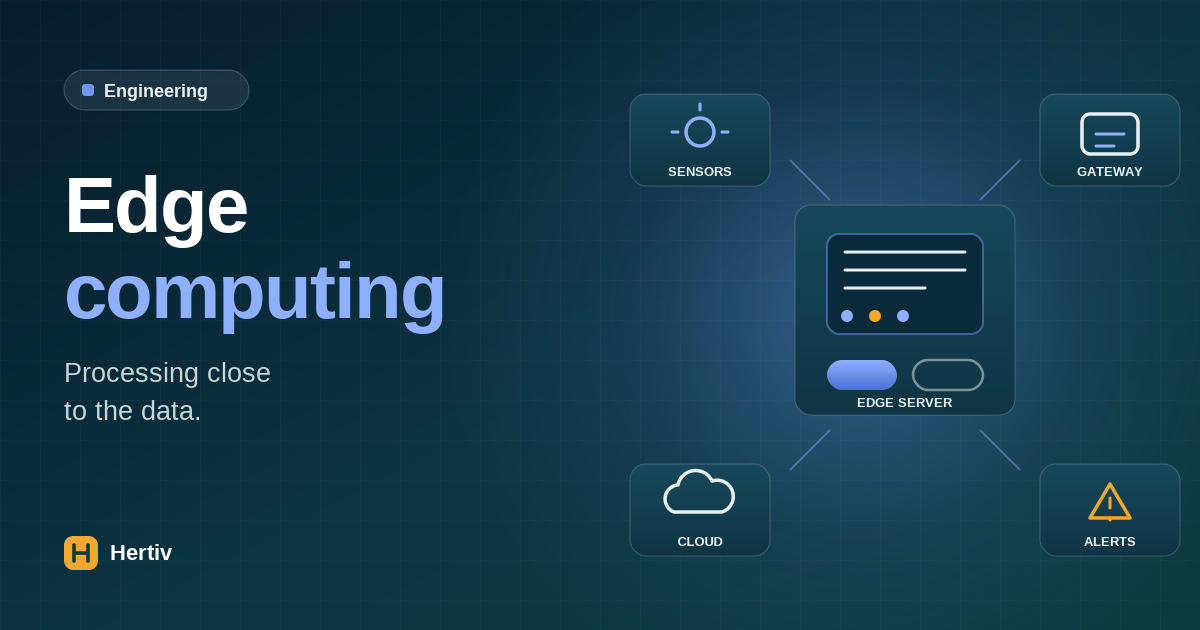
An edge architecture has three layers: devices that create data, edge nodes that process it nearby, and the cloud that coordinates across sites. Data moves up the layers only when it is needed there.
| Layer | What it does | Typical hardware |
|---|---|---|
| Device layer | Creates data and takes simple actions | Sensors, cameras, PLCs, tills |
| Edge layer | Filters, analyses and decides locally | Gateways, rugged servers, on-site clusters |
| Cloud layer | Trains models, stores history, manages fleets | Public cloud, central data centre |
A common pattern is a gateway on site that collects sensor data, runs rules or a model, and raises alerts in real time. It batches the rest into summaries that go to the cloud once an hour or once a day, where teams compare sites and retrain models.
Management is centralised even though processing is local. Updates, model versions and security patches are pushed from the cloud to many edge nodes at once, so a hundred sites can be kept in step without visiting each one.
Where does edge computing fit best?
Edge computing fits best where the cost of delay, disconnection or bandwidth is high. The table below shows the most common enterprise use cases and what the edge adds in each one.
| Use case | What runs at the edge | Why local matters |
|---|---|---|
| Factory quality checks | Camera inspection and defect alerts | Decisions needed in milliseconds |
| Retail stores | Till, stock and loss-prevention processing | Stores keep trading during outages |
| Energy and utilities | Grid and meter data aggregation | Remote sites with weak links |
| Healthcare | Device data and patient monitoring | Sensitive data stays on site |
| Logistics | Vehicle telemetry and route updates | Vehicles move in and out of coverage |
| Security | Video analysis and access alerts | Raw video is too heavy to stream |
It fits less well for work that needs a wide view of many sites at once, such as comparing sales across a whole chain or training a model on a year of data. Those jobs still belong in the cloud, fed by the summaries the edge sends up.
What does an enterprise edge deployment cost?
An enterprise edge deployment costs money in three places: hardware on site, software and management, and the people who keep it running. The balance between them depends on how many sites you have and how much processing each one needs.
| Cost item | What it covers | Typical range |
|---|---|---|
| Edge hardware | Gateways, rugged servers, storage | $2,000–$20,000 per site |
| Connectivity | Links, failover, private networks | $200–$2,000 per site per month |
| Platform and licences | Device management, security, monitoring | $1,000–$10,000 per month |
| Operations | Updates, support, incident response | Part of existing IT or a new role |
These are indicative ranges, not quotes, and vendor prices should be checked on the vendor site. The business case usually rests on what the edge avoids: downtime, rejected products, bandwidth charges or manual checks.
Start with one site and measure the result before rolling out to many. A pilot that proves the savings on one line or one store makes the wider case far easier to fund.
Example (hypothetical): a packaging plant cuts inspection delays
Example (hypothetical): a packaging plant runs 4 lines, each with a camera that checks 120 packs a minute for seal defects. Sending every frame to the cloud takes about 400 milliseconds per check, and the line has to slow down to wait.
The plant installs one edge server per line at $8,000 each, so $32,000 in hardware, plus $1,500 a month for platform licences and support. The edge server checks each frame in 40 milliseconds, so the lines run at full speed again.
Before the change, the plant rejected about 900 packs a day because of late checks. After it, rejections fall to 300 a day, saving 600 packs a day. At $0.50 a pack, that is $300 a day, or about $7,500 a month on 25 working days.
The monthly saving of $7,500 against $1,500 of running cost leaves $6,000 a month, so the $32,000 hardware pays for itself in about 6 months. The cloud still receives a daily summary of defect rates, which the quality team uses to compare lines.
What are the common mistakes?
The most common edge computing mistakes are putting the wrong work at the edge, forgetting that edge nodes need managing, and skipping the security basics.
- Moving everything to the edge. Work that needs a cross-site view belongs in the cloud. Only time-sensitive or bandwidth-heavy work earns a place on site.
- Forgetting fleet management. Ten edge nodes are easy; a hundred need remote updates, monitoring and spare hardware planned from the start.
- Weak physical security. Edge hardware sits in stores and plants, not locked data centres. Encrypt data at rest and limit who can touch the box.
- No offline plan. The point of the edge is surviving disconnection, so test what happens when the link drops and how the node catches up.
- Skipping the pilot. Rolling out to every site before one site proves the value locks in the wrong design.
Key takeaways
- Edge computing moves processing close to where data is created, cutting response times and bandwidth use
- The edge handles fast local decisions while the cloud handles training, history and cross-site analysis
- It fits best where delay, disconnection or heavy data streams make cloud-only processing too slow or costly
- A pilot on one site with one clear metric is the safest way to prove the business case
- Edge nodes still need central management, updates and physical security, just like any other server
Frequently asked questions
What is the difference between edge computing and cloud computing?
Cloud computing runs workloads in central data centres, while edge computing runs them near where data is created. Most enterprises use both: the edge makes fast local decisions and the cloud handles long-term storage, training and analysis across sites.
Is edge computing the same as edge AI?
No. Edge computing is the wider idea of processing data near its source. Edge AI is one workload that runs on that infrastructure, using machine learning models on devices or local servers to make decisions without waiting for the cloud.
Do small businesses need edge computing?
Most small businesses do not. Edge computing pays when you have many sites, heavy data such as video, or decisions that cannot wait for the cloud. A single office or shop usually gets everything it needs from cloud services.
What happens when an edge site loses its network connection?
A well-designed edge node keeps working locally, storing results until the link returns and then syncing summaries to the cloud. This is one of the main reasons enterprises choose the edge for stores, plants and remote sites.
How do you manage hundreds of edge devices?
Through a central platform that pushes software updates, model versions and security patches to all nodes at once, and monitors their health. Without that, each site becomes a separate server to visit and maintain.
Is edge computing more secure than the cloud?
It is different, not automatically safer. Keeping sensitive data on site can help privacy, but edge hardware sits in physical locations that are harder to guard, so encryption, access control and monitoring matter as much as in the cloud.


