Edge AI Development for Enterprises: A Practical Guide
Edge AI runs models on devices and local servers instead of the cloud, so factories, shops and vehicles get answers in milliseconds without sending data away.
On this page
Short answer
Edge AI is artificial intelligence that runs on a device or a local server close to where the data is created, instead of in a distant cloud data centre. A camera that spots a defect, a sensor that predicts a machine failure or a vehicle that reads a road sign are all edge AI. It gives fast answers, works without a constant internet connection and keeps sensitive data on site.
What is edge AI development?
Edge AI development is the work of building AI systems that run on devices and local servers close to where data is created, rather than in a cloud data centre. The model lives on the device itself: a factory camera, a shop terminal, a vehicle computer or a gateway box on a shop floor. The device reads its own sensors, runs the model and acts on the result in milliseconds.
The difference from cloud AI is where the work happens. Cloud AI sends data to a data centre, waits for the answer and sends it back, which takes time and needs a steady connection. Edge AI skips the round trip, so it answers faster and keeps working when the connection drops.
| Where it runs | Speed | Needs internet? | Best for |
|---|---|---|---|
| On the device | Milliseconds | No, for inference | Real-time checks |
| Local server or gateway | Milliseconds | No, for inference | One site, many devices |
| Cloud data centre | Seconds | Yes | Heavy training and analysis |
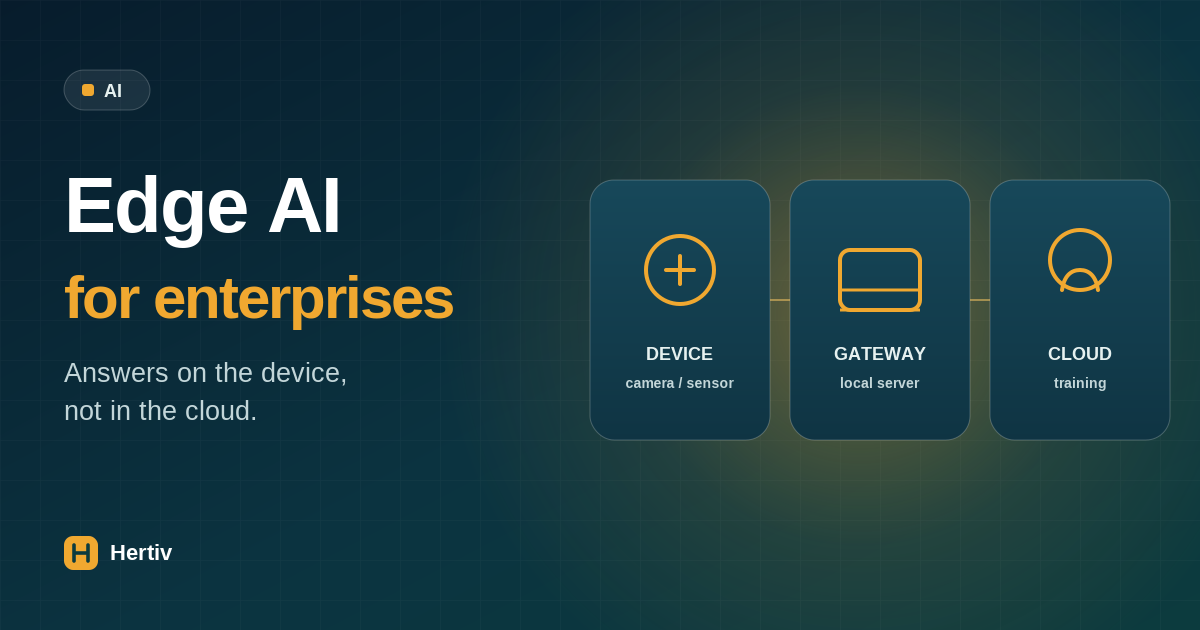
Most enterprise systems use both. Training usually happens in the cloud, where the compute is cheap and plentiful, and the finished model is then sent to the edge to run. For how a first test is usually run, see AI proof of concept development.
Where do enterprises use edge AI?
Enterprises use edge AI wherever a fast answer matters more than a deep one. Factories use it to spot defects on a line, retailers use it to count footfall and check shelves, logistics teams use it to read labels and track parcels, and energy companies use it to watch equipment for early signs of failure.
Vehicles are another large use. Driver assistance systems read the road, spot hazards and warn the driver, all without waiting for a cloud answer. In healthcare, edge AI runs on imaging devices and monitors where patient data must stay on site. The common thread is that the decision has to happen at the place and the moment the data appears.
Privacy is often the reason a team picks the edge. A camera in a shop or a microphone in a meeting room can process data locally and send only the result, such as a count or an alert, instead of the raw video or audio. That keeps sensitive data inside the building.
What makes edge AI different from cloud AI?
Edge AI differs from cloud AI in three ways: the hardware is weaker, the model must be smaller, and updates are harder to ship. A cloud model can use as much memory and compute as the data centre offers, while an edge model must fit on a chip with limited memory, power and cooling.
That limit forces a trade-off. Teams shrink the model by quantisation, which stores weights in fewer bits, or by pruning, which removes parts of the model that add little. Both methods make the model faster and smaller, but they can cost a little accuracy, so teams measure the result on real device data before shipping.
Updates are the third difference. A cloud model can be replaced in minutes, while an edge model must be pushed to hundreds or thousands of devices, some of which are offline. Teams plan for that with staged rollouts, version checks and a way to roll back if a new model misbehaves.
What hardware and software do edge AI teams need?
Edge AI hardware ranges from small chips in cameras and sensors to gateway boxes and rugged servers on a factory floor. Common choices include dedicated AI accelerators, which run models fast at low power, and general-purpose boards that are easier to program but slower. The right choice depends on the model size, the speed needed and the power available.
On the software side, teams use model formats built for the edge, such as ONNX and TensorFlow Lite, and runtimes that run those formats on the target chip. They also need a way to collect device data, label it and send it back for retraining, because a model trained once will drift as the real world changes.
Testing needs real hardware from the start. A model that runs well on a laptop can be too slow on the target chip, so teams test on the actual device early. For how teams test models before release, see how to test AI models.
How do teams build an edge AI product?
Building an edge AI product works best in six steps, starting with the decision the device must make rather than the model.
- Name the decision the device must make and how fast it must make it.
- Collect real data from the actual devices and setting.
- Train a model in the cloud and measure it on that real data.
- Shrink the model to fit the target chip and re-test it there.
- Pilot on a few devices with a human check on the results.
- Roll out in stages with a way to update and roll back the model.
The pilot is the step most teams rush. A model that scores well in the lab can still fail on the shop floor, where light, angle and wear change the data. A pilot on a few devices with a human checking the results finds those failures before they reach every device.
Plan the update path before the first rollout. Devices need a way to receive new models, report their version and roll back if a new model misbehaves. A product without that path becomes hard to fix once it is in the field.
Example (hypothetical): defect checks on a factory line
Example (hypothetical): a factory checks 1,000 parts a day by hand. Each check takes 30 seconds, so the daily check costs 1,000 times 30 seconds, or 30,000 seconds, which is about 8.3 hours of staff time.
With edge AI, a camera on the line checks each part as it passes and flags only the ones it is unsure about, say 100 a day. Staff check those 100 by hand, which takes 100 times 30 seconds, or 3,000 seconds, which is 50 minutes. The team saves about 8.3 minus 0.8, or 7.5 hours a day, and the check happens on every part instead of a sample.
The saving only holds if the model is right most of the time. If it flags half the parts, staff spend more time checking than they did before. That is why teams measure the model on their own line before trusting it, and keep a human check on anything the model is unsure about. For real-world uses across industries, see computer vision use cases.
What are the common mistakes?
The most common edge AI mistakes are training on the wrong data, shrinking the model too far, and shipping without an update path.
- Training on lab data. Models trained on tidy photos fail on real footage with glare, dust and odd angles.
- Shrinking too far. A model cut down too much loses the accuracy the job needs.
- No update path. Devices in the field need a way to receive new models and roll back.
- Testing on a laptop only. A model that runs well on a laptop can be too slow on the target chip.
- Ignoring drift. Real-world data changes over time, so models need retraining on fresh data.
Key takeaways
- Edge AI runs models on devices close to where the data is created
- It answers in milliseconds and works without a constant connection
- Models must be shrunk to fit the chip, which can cost a little accuracy
- Pilot on a few devices with a human check before a wide rollout
- Plan the update and rollback path before the first rollout
Frequently asked questions
What is edge AI?
Edge AI is artificial intelligence that runs on a device or a local server close to where data is created, instead of in a cloud data centre. A factory camera, a shop terminal or a vehicle computer runs the model and acts on the result in milliseconds.
How is edge AI different from cloud AI?
Cloud AI sends data to a data centre and waits for the answer, which takes time and needs a steady connection. Edge AI runs the model on the device, so it answers faster, works offline and keeps sensitive data on site.
What hardware does edge AI need?
It depends on the model and the speed needed. Small models run on AI accelerator chips in cameras and sensors, while larger ones need gateway boxes or rugged servers. Test on the actual device early, because a model that runs well on a laptop can be too slow on the target chip.
Is edge AI more private than cloud AI?
Often yes, because the device can process raw data locally and send only the result, such as a count or an alert. That keeps video, audio and other sensitive data inside the building instead of sending it to a data centre.
How do teams update edge AI models?
They push new model files to the devices in stages, with a version check and a way to roll back if the new model misbehaves. Devices that are offline get the update when they reconnect, so the rollout must handle devices at different versions.
When should a team choose cloud AI instead?
Cloud AI fits when the task needs heavy compute, large models or data from many sites at once, such as training or cross-site analysis. Many systems use both: training in the cloud and the finished model running on the edge.


