Digital Twins in Retail: What They Do and Where They Pay
A retail digital twin is a live virtual copy of a store or warehouse that a team can test and change before touching the real thing. Here is how retailers use it.
On this page
Short answer
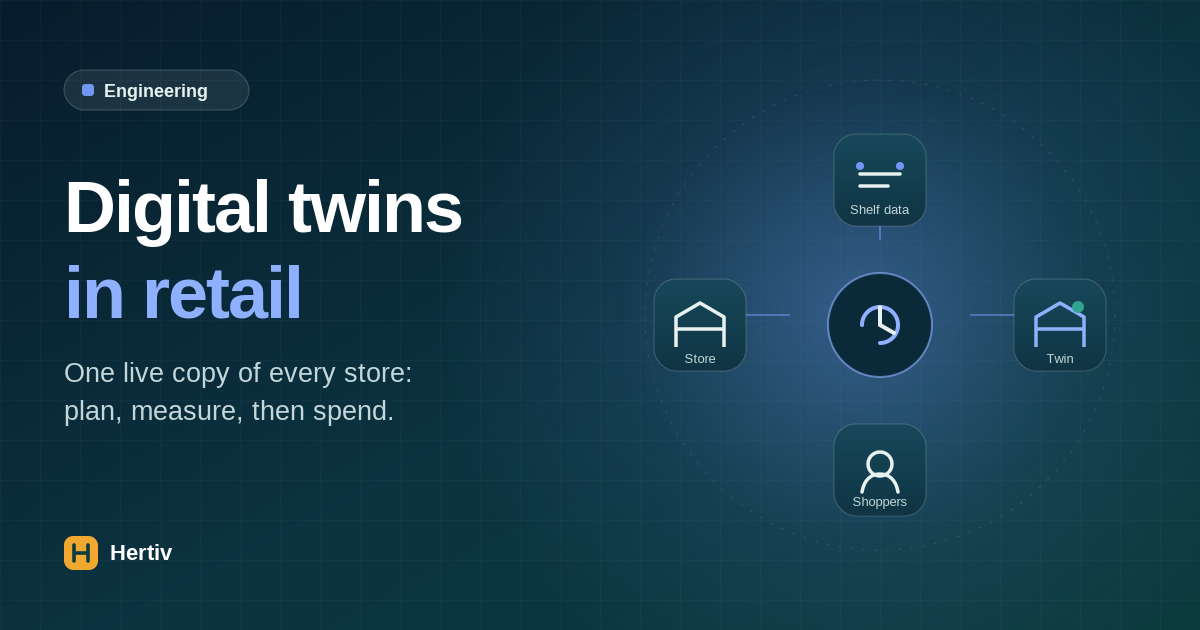
A digital twin in retail is a live virtual copy of a physical store, warehouse or supply chain, kept up to date with data from sensors, cameras and sales systems. Teams use it to plan layouts, predict problems and test changes before spending money in the real store.
What is a digital twin in retail?
A digital twin in retail is a live virtual copy of a physical store, warehouse or supply chain, kept up to date with data from sensors, cameras and sales systems. It mirrors the space: floor plans, shelving, refrigeration, heating and plumbing, plus the stock and the people moving through it.
The twin is more than a 3D model. A model is a picture; a twin is connected to live data, so it changes as the store changes. When a shelf empties, a fridge warms up or a queue grows, the twin shows it, and the team can act without visiting the site.
Large retailers already use this at scale. Walmart has built digital replicas of its stores, and Lowe's has digitally represented every one of its stores. The pattern is the same in both cases: one accurate copy of each location, used by many teams. For the wider technology, see digital twin technology for business.
How do twins help with store layout?
Twins help with store layout because merchandising teams can walk through a store remotely and test fixture and planogram changes before committing to a rollout. A new shelf arrangement can be tried in the twin, measured and changed, without moving a single fixture.
Remote measurement is the practical payoff. A twin gives aisle widths, ceiling heights, doorway clearances and fixture footprints on demand, so a team can check whether a new display fits before ordering it. As-built floor plans can be generated from the same twin, which removes the need for repeated site visits.
The same copy supports the whole estate. A retailer can compare store models side by side, rank remodels by need, and decide whether to renew a lease or close a site, all from the same data. For how twins are built, see how to build a digital twin app.
What about inventory and the supply chain?
Twins help inventory because they model how stock moves through warehouses and stores, so a team can see where replenishment is slow and where space is wasted before it becomes a lost sale. A twin of a warehouse can test different layouts and picking routes and show which one is fastest.
| Area | What the twin shows | What the team decides |
|---|---|---|
| Store layout | Customer flow and shelf visibility | Where to place displays and promos |
| Warehouse | Picking routes and storage use | How to arrange stock and staff |
| Supply chain | Delivery times and bottlenecks | When to reroute or reorder |
| Equipment | Fridge and HVAC condition | What to fix before it fails |
| Energy | Power use by area and hour | Where to cut waste |
Supply chain twins go further: they model deliveries and demand together, so a team can simulate a delayed shipment or a demand spike and see the effect on every store. That is the difference between reacting to a stockout and planning around one.
How do twins help run the store day to day?
Twins help day-to-day running because they turn the store into something a team can monitor from anywhere. A facilities manager can check every fridge, light and air-conditioning unit across the estate from one screen, and see which ones need attention before they fail.
AI layered on the twin adds more. It can count items on a shelf, spot lights that are out, or check where fire extinguishers are, from the same capture. That replaces manual checks that used to need a visit to every store.
Brand teams use twins too. They can check that every store matches the brand standard, and during a merger they can compare the two estates side by side before deciding what to keep. A twin makes the whole portfolio visible, which is why executives use it to answer questions like how many stores are still operating in a city, or how many tills a store has.
Can twins improve the customer experience?
Twins can improve the customer experience in two ways: by making the store work better, and by creating virtual shopping experiences. A better layout, fuller shelves and shorter queues are the direct result of the planning work above, and customers feel them immediately.
The second way is the virtual showroom. A twin of a store can become a shoppable online space, where customers browse the real layout from home and buy what they see. Some retailers use twins this way as a marketing tool on their e-commerce platforms, turning the physical store into an online experience.
Training is a third use. Staff can practise store processes, promotions and resets inside the twin, which improves knowledge retention and cuts onboarding cost. A new starter can learn the store before ever walking into it.
How does a retailer start with digital twins?
A retailer starts with digital twins by picking one problem, capturing one store, and proving the value before rolling out across the estate.
- Pick one use case. Layout planning, maintenance or inventory are the usual first choices.
- Capture a pilot store. Scan one representative store to build an accurate twin.
- Connect one data source. Start with sales or sensor data, not everything at once.
- Give it to one team. Let merchandising or facilities use it daily and report what changed.
- Measure the saving. Count site visits avoided, hours saved or stockouts prevented.
- Roll out in waves. Capture the next group of stores only after the pilot proves its value.
The pilot matters because a twin is only useful if the data behind it is current. A twin that is six months out of date is a model, not a twin, and teams will stop trusting it. For the enterprise view, see digital twins in the enterprise metaverse.
Example (hypothetical): a 40-store chain plans a reset
Example (hypothetical): a chain with 40 stores wants to reset its seasonal displays. Instead of sending a team to each store, it captures twins of 5 representative stores and tests 3 layout options in each one, measuring customer flow and shelf visibility in the twin.
The winning layout cuts the average walk to the seasonal display from 45 seconds to 30 seconds, and the team estimates it will take 2 hours less per store to set up. Across 40 stores that is 40 x 2 = 80 hours saved on setup alone, plus the travel time for 35 site visits that never happened.
The team then rolls the layout out to all 40 stores using the twin measurements, and checks the result against sales data after four weeks. The lesson is to test in the twin, measure in the twin, and only then spend money in the real store.
What are the common mistakes?
The most common mistakes with retail digital twins are capturing everything at once, letting the data go stale, and treating the twin as a marketing demo.
- Capturing the whole estate first. A pilot in a few stores proves the value before the big spend.
- Stale data. A twin that is not updated stops being a twin and teams stop trusting it.
- No clear use case. A twin built for show, with no team using it daily, is an expensive model.
- Ignoring the staff. If store teams cannot use the twin, the head office view is the only view.
- Over-promising the AI. Counting stock from images works, but it needs clean data and regular checks.
- No owner. Without someone responsible for keeping each twin current, the estate drifts out of date.
Key takeaways
- A retail twin is a live copy of a store, kept current with real data
- Layout, inventory, maintenance and training are the main uses
- Walmart and Lowe's both run twins across their store estates
- Start with one store and one use case, then roll out in waves
- A stale twin is a model, not a twin, and teams stop trusting it
Frequently asked questions
What is a digital twin in retail?
A digital twin in retail is a live virtual copy of a physical store, warehouse or supply chain, kept up to date with data from sensors, cameras and sales systems. Teams use it to plan layouts, predict problems and test changes before spending money.
Which retailers use digital twins?
Walmart has built digital replicas of its stores, and Lowe's has digitally represented every one of its stores. Both use the twins for layout planning, operations and maintenance, not just for marketing.
What is the main benefit for a retailer?
The main benefit is testing before spending. A team can try a layout, a remodel or a supply change in the twin, measure the result, and only then commit money in the real store.
Do digital twins need IoT sensors?
Not to start. A twin can begin as an accurate 3D capture plus sales data, and add sensor feeds later. The data that matters is the data the chosen use case needs.
How much does a retail digital twin cost?
It depends on the number of stores, the capture method and the data connected. Costs vary widely, so get a quote for your estate and see the vendor site for current pricing.
Can a small retailer use digital twins?
Yes, at a smaller scale. A single-store twin for layout planning and staff training is a practical start, and the same capture can serve merchandising, maintenance and online showroom uses.


