DevOps vs SRE vs Platform Engineering: What Differs?
DevOps, SRE and platform engineering all aim at the same goal, reliable software shipped fast, but they work at different levels. Here is how they differ.
On this page
Short answer
DevOps is a way of working that brings development and operations together around fast, safe releases; site reliability engineering applies software engineering to keeping systems reliable; and platform engineering builds the shared tools and services that product teams use to ship. They overlap, but each one solves a different problem.
What are DevOps, SRE and platform engineering?
DevOps is a way of working that brings development and operations together around fast, safe releases, so the people who write code also take part in shipping and running it. Site reliability engineering, or SRE, applies software engineering to keeping systems reliable, using targets and budgets for downtime. Platform engineering builds the shared tools, templates and services that product teams use to ship without rebuilding the same plumbing each time.
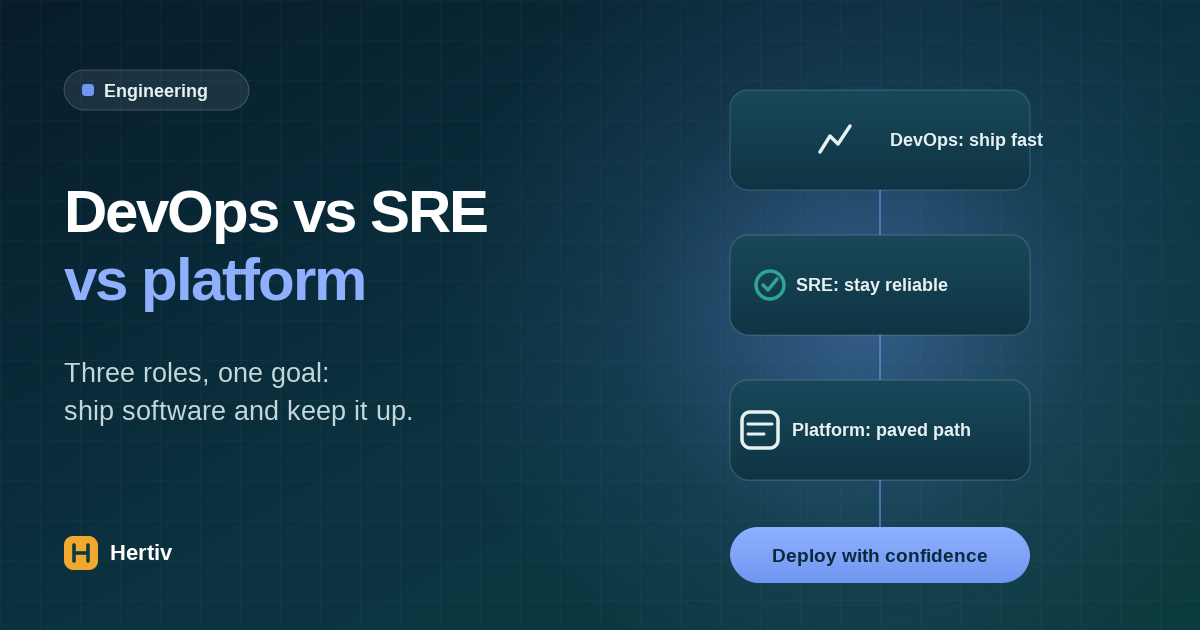
The three roles share one goal, reliable software shipped fast, but they work at different levels. DevOps changes how teams work together, SRE changes how reliability is measured and defended, and platform engineering changes what teams build on.
| Role | Main focus | How success is measured |
|---|---|---|
| DevOps | Fast, safe releases and shared ownership | Release frequency and recovery time |
| SRE | Reliability targets and error budgets | Uptime against agreed targets |
| Platform engineering | Shared tools and self-service paths | Time from idea to first deployment |
None of the three is a job title you hire once and forget. Each one is a practice that grows with the team, and most organisations end up using all three in different proportions. For the wider context, SRE vs DevOps compares the first two in more depth.
What does DevOps change in practice?
DevOps changes practice by making releases small, frequent and automated, so a change reaches users in hours instead of weeks. The team that writes a feature also watches it in production, which makes quality a shared job rather than a handoff.
The visible changes are usually:
- Automated pipelines. Code is built, tested and deployed by a pipeline, not by hand, so releases are repeatable.
- Small batches. Changes ship in small pieces, which makes failures easier to find and roll back.
- Shared on-call. Developers take part in on-call, so the pain of a bad release is felt by the people who can fix it.
- Fast feedback. Tests, monitoring and alerts tell the team quickly when a change breaks something.
DevOps does not set a reliability target on its own. It makes shipping faster, but without a target for uptime, a team can ship quickly and still break the product often. That gap is what SRE is built to close.
What does SRE add on top of DevOps?
SRE adds measurable reliability targets on top of DevOps, so the team knows how much downtime is acceptable and when to stop shipping features and fix stability instead. The core tool is the error budget: the amount of failure a service is allowed over a period.
The practice works like this:
- Service level objectives. The team agrees a target, such as 99.9% of requests succeeding over a month.
- Error budgets. The gap between the target and perfection is the budget for change; spending it means slowing releases.
- Toil reduction. Repetitive manual work, such as restarting services by hand, is automated away.
- Blameless reviews. Incidents are reviewed for what failed in the system, not who to blame.
SRE fits teams whose users feel downtime directly, such as a payments or booking product. It is less useful for an internal tool where a short outage costs little, since the measurement overhead outweighs the gain.
What does platform engineering add?
Platform engineering adds a shared internal platform that product teams use to ship without rebuilding the same plumbing each time. The platform team builds paved paths: templates, pipelines, observability and environments that a product team can use on its own.
A typical platform offers:
- Golden paths. A standard way to start a service, with testing, deployment and monitoring already wired in.
- Self-service. Teams create environments and deploy without waiting on a ticket queue.
- Shared services. Authentication, logging, secrets and feature flags provided once, used by all teams.
- Guardrails. Defaults that keep teams safe, such as required tests and secret scanning, without blocking them.
Platform engineering pays off once several teams repeat the same setup work. A single team gains little from building a platform for itself, since the platform becomes another product to maintain. For the building blocks, what platform engineering is explains the idea in detail.
Which model fits your team?
You choose between DevOps, SRE and platform engineering by looking at your team's size, the cost of downtime and how much setup work is repeated. Most teams need DevOps first, add SRE when reliability becomes a promise, and add a platform when repeated setup slows everyone down.
- Count the teams. One team needs DevOps practices; several teams repeating the same setup need a platform.
- Price the downtime. If an outage costs customers or money, SRE targets and error budgets are worth the effort.
- Find the repeated work. If every team builds its own pipeline and monitoring, a platform will save more than it costs.
- Check who is on call. If developers never see production pain, start with shared ownership before adding new roles.
- Start small and measure. Pick one change, such as an error budget or a golden path, and measure whether it helps.
Do not hire for all three at once. A small team that tries to run SRE and a platform team at the same time will spend more time coordinating than shipping. See DevOps use cases for where the practice delivers first.
Example (hypothetical): a team drowning in alerts
Example (hypothetical): a team of 12 engineers runs a booking service and receives 30 alerts a week. Each alert takes about 15 minutes to check, so the team spends 450 minutes, or 7.5 hours, a week on alerts, most of which turn out to be noise.
The team applies SRE thinking first. It agrees a target of 99.9% successful requests, sets an error budget, and deletes alerts that do not map to user pain. It then automates the three most common manual fixes, such as restarting a stuck worker, so those alerts never reach a person.
After the change, alerts fall to 10 a week, each still taking 15 minutes, so the team spends 150 minutes, or 2.5 hours, a week. The saving is 5 hours a week, and the team uses it to build a golden path for new services, which is the first step toward platform engineering. The order matters: measure reliability first, automate the toil second, and build the platform third.
What are the common mistakes?
The most common mistakes with DevOps, SRE and platform engineering are treating them as job titles, copying another company's model, and building a platform nobody asked for. Each one wastes effort that could have gone into shipping.
- Hiring a title, not a practice. A DevOps engineer without pipeline access or shared ownership changes nothing.
- Copying a big company's model. What works for fifty teams will slow down a team of five.
- Building a platform too early. A platform built before teams feel the repeated pain will not be used.
- Targets without teeth. An error budget that never slows a release is decoration, not SRE.
- Automating the wrong work. Automating a broken process just produces failures faster.
Key takeaways
- DevOps changes how teams ship, SRE measures reliability, platform engineering builds shared tools
- Error budgets decide when to slow releases and fix stability instead
- A platform pays off only when several teams repeat the same setup work
- Start with DevOps, add SRE when downtime has a real cost, add a platform last
- Copying another company's model usually slows a small team down
Frequently asked questions
Can one person do DevOps, SRE and platform engineering?
In a small team, yes, the same engineers often cover all three, since the practices overlap. The distinction matters as the team grows: DevOps is how the team works, SRE is how reliability is measured, and platform engineering is what the team builds on. Keep the practices, even if one person does them.
What is an error budget in simple terms?
An error budget is the amount of failure a service is allowed over a period, based on its reliability target. If the target is 99.9% success over a month, the budget is the 0.1% of requests that may fail. While the budget lasts, the team ships features; when it runs out, the team fixes stability first.
Do I need a platform team for a small company?
Usually not. A platform team pays off when several product teams repeat the same setup work, such as pipelines, environments and monitoring. A single team can get the same benefit from a shared template or a well-kept starter project. Build the platform once the repeated work is clearly slowing teams down.
Is SRE only for large companies?
No. SRE is a set of practices, not a headcount. A small team can set a reliability target, track an error budget and run blameless incident reviews without hiring anyone new. The practices scale down well; what does not scale down is copying a large company's SRE organisation chart.
How do DevOps and platform engineering work together?
DevOps is the way teams work, and platform engineering supplies the tools they work with. A platform team builds the paved paths, and DevOps practices decide how teams use them: small releases, automated pipelines and shared ownership. Without DevOps habits, even a good platform is used badly.
What should we fix first: speed or reliability?
Fix whichever one your users feel most. If releases are slow and painful, start with DevOps automation. If outages are frequent, start with SRE targets and an error budget. Measure both before deciding, since the loudest complaint is not always the most costly problem.


