What Is Platform Engineering, and Why Do Teams Adopt It?
Platform engineering builds an internal, self-service platform so product teams can ship software faster on shared, standardised infrastructure. Here is how it works and when to adopt it.
On this page
Short answer
Platform engineering is the discipline of building and running a shared internal platform that gives product teams self-service access to infrastructure, deployment and operational tooling. It turns repeated setup work into a paved road, so developers ship faster with fewer handoffs and more consistency.
What is platform engineering?
Platform engineering is the practice of designing, building and operating a shared internal platform that product teams use to run software without assembling their own infrastructure. The platform bundles compute, deployment pipelines, observability, security controls and service templates behind self-service interfaces.
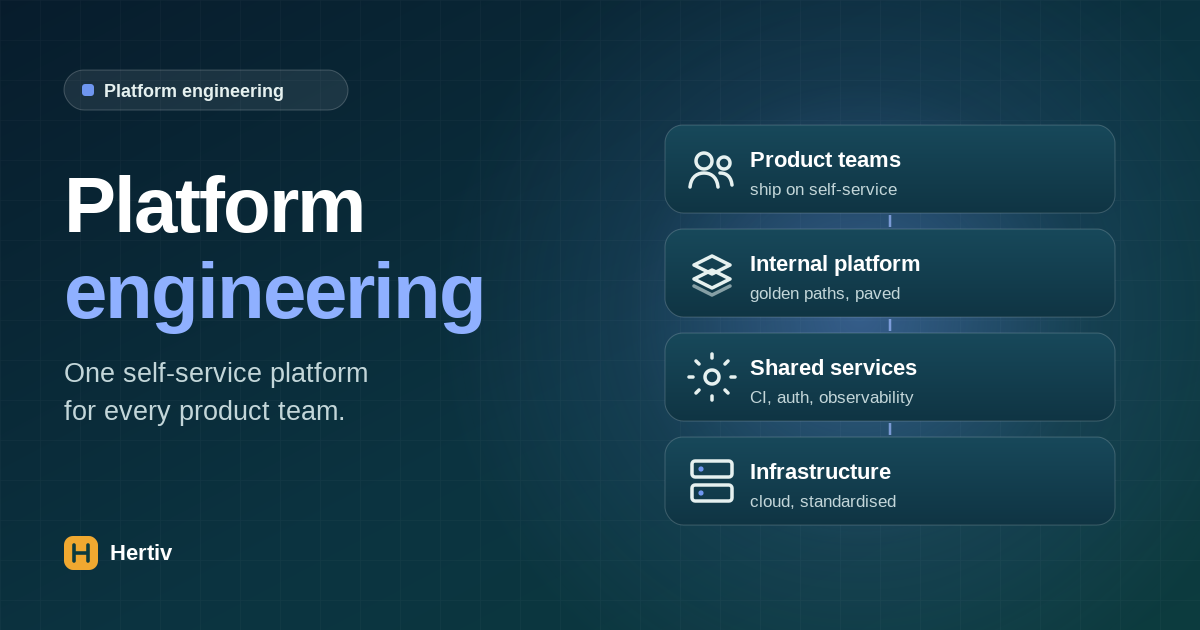
The idea is to treat the platform as a product with internal developers as customers. Instead of each team wiring its own CI/CD, secrets handling and monitoring, they consume a standard offering that the platform team maintains. That offering is often called a paved road or golden path: the well-supported default route from code to production.
Platform engineering is not a single tool or a job title alone. It is an operating model that combines engineering work, product thinking and clear ownership. Teams adopt it when duplicated setup and inconsistent operations start to cost more than a shared platform would.
How is it different from DevOps and SRE?
DevOps is a set of principles about collaboration between development and operations. Site reliability engineering applies software engineering to operations problems and reliability targets. Platform engineering builds the product that makes both easier to practise at scale.
In a classic DevOps model, every team owns its pipeline and infrastructure code. That works until dozens of teams write near-identical Terraform, chase the same permission issues and deploy in subtly different ways. Platform engineering centralises the shared layers and exposes them through automation.
- DevOps: culture and practices for shared ownership of delivery
- SRE: reliability engineering, error budgets and incident response
- Platform engineering: the internal product and team that supply reusable, self-service delivery capability
These roles overlap in practice. A platform team often includes SRE skills and applies DevOps principles internally.
What does an internal developer platform include?
An internal developer platform (IDP) usually covers four layers: infrastructure provisioning, delivery automation, runtime operations and a developer-facing surface. The exact components vary, but most platforms assemble some mix of the following.
- Provisioning: infrastructure as code templates, environment creation, cloud account and network setup
- Delivery: build and deploy pipelines, artefact registries, release automation, preview environments
- Runtime: container orchestration, service mesh or gateway, secrets management, autoscaling
- Operations: logging, metrics, tracing, alerting, incident tooling
- Developer surface: a portal, CLI or API that ties the above together with documentation
- Governance: policy checks, access control, cost visibility and compliance evidence
You do not need every layer on day one. Most teams start with the two or three layers where manual work causes the most delay, then extend the platform as adoption grows.
Why do organisations adopt platform engineering?
Organisations adopt platform engineering to reduce delivery friction and to make good practice the easy path. When setup is standardised, developers spend less time on infrastructure chores and more time on product work, and operations become more predictable.
The typical drivers are concrete:
- Onboarding a new engineer or service involves a template instead of a week of environment setup
- Security and compliance controls are built into the path rather than audited afterwards
- Teams deploy through one pipeline with consistent logging, alerting and rollback
- Platform teams can upgrade shared components once instead of coordinating many bespoke setups
Adoption fails when the platform is imposed without listening to developers. Treat internal teams as customers: interview them, measure satisfaction and retire features nobody uses. For related delivery work, see Hertiv's software engineering services.
How do you build a platform engineering function?
Start with a small team, a narrow scope and measurable pain. A platform function usually begins with one or two engineers who already understand the delivery pipeline, backed by a product owner who can prioritise requests.
- Map the current path. Document how a change goes from commit to production today, including wait times and handoffs.
- Pick one golden path. Choose the most common service type and make its setup, deployment and monitoring self-service.
- Automate the guardrails. Add policy checks, secrets handling and access controls into the path, not around it.
- Publish and support it. Provide templates, documentation and a clear support channel. Track adoption per team.
- Measure and iterate. Follow time to first deploy, change lead time, failed deployments and support ticket volume.
- Extend gradually. Add the next most requested capability only after the first path is stable.
For teams without internal capacity, staff augmentation can supply platform and DevOps engineers while the function matures.
Example: a mid-sized product company adopting a platform
Consider a hypothetical company with about 40 engineers across six product teams and a shared cloud account. Each team maintains its own pipeline, and environment setup takes roughly two days per new service. The figures below are illustrative only.
Example: The platform team builds one service template with a standard pipeline, secrets handling, logging and a policy check. After rollout, new service setup drops from about two days to a few hours for teams that adopt the template. If six teams each create two services a year, the saved engineering time is meaningful, but the larger gain is consistency: every service now has the same alerts, logs and rollback process.
The team tracks adoption weekly. Two teams resist because their workloads need GPU instances, which the template does not cover. The platform team adds a GPU variant in the next quarter rather than forcing a workaround. Support requests about environment setup fall, and the platform team publishes a roadmap based on the request backlog.
This pattern is common: start with the default case, listen to exceptions and expand deliberately.
Common mistakes
Most platform efforts fail on adoption or scope rather than technology. These issues appear often.
- Building in isolation. A platform designed without developer input solves the wrong problems.
- Boiling the ocean. Trying to cover every workload in the first release delays value and burns the team.
- Treating it as a side project. Platform work needs dedicated ownership, or it stalls behind product deadlines.
- Ignoring the migration path. Teams need help moving existing services onto the platform, not just a template for new ones.
- Skipping measurement. Without adoption and delivery metrics, you cannot tell whether the platform helps.
- No escape hatch. A platform that blocks legitimate exceptions pushes teams to work around it entirely.
Data-heavy teams should plan the analytics and pipeline side early; Hertiv's data engineering services cover that layer.
How to choose your first platform investments
Prioritise by the cost of the current friction, not by tool popularity. A short, honest assessment beats a long tool evaluation.
- Quantify the pain. Estimate hours lost per team per month to environment setup, pipeline maintenance and release coordination.
- Check frequency. Fix problems that occur on every release before problems that occur twice a year.
- Assess blast radius. Controls that affect security or compliance belong in the platform early.
- Reuse before building. Managed services and existing cloud tooling may cover the first version.
- Set a success measure. Define adoption and delivery metrics before you start, and review them quarterly.
If your organisation is weighing whether to build, buy or extend an existing toolchain, a short custom software development engagement or an outside review can shorten the decision. For background on adjacent engineering topics, the Hertiv blog covers delivery and AI engineering guides.
Key takeaways
- The platform is a product: internal developer teams are its customers and adoption is the success metric
- Self-service replaces ticket queues with templates, golden paths and automated guardrails
- It differs from DevOps by centralising the tooling layers most teams would otherwise rebuild
- Start with the friction that slows delivery most, not with a tool shopping list
- Measure time to first deploy, change lead time and support request volume
- Small organisations may not need a dedicated team; reuse managed services first
Frequently asked questions
Is platform engineering the same as DevOps?
No. DevOps is a set of cultural and operational practices for shared ownership of delivery. Platform engineering is a team and product that provides self-service tooling so those practices are easier to apply consistently across many teams.
Does a small engineering team need platform engineering?
Usually not as a dedicated function. Small teams can adopt the principles by standardising templates and pipelines on managed services. A dedicated platform team makes sense when duplicated setup and inconsistent operations become a regular drag on delivery.
What tools are used in platform engineering?
Common categories include infrastructure as code, CI/CD pipelines, container orchestration, internal developer portals, secrets management and observability. Specific products matter less than how well they are integrated and supported for internal users.
How do you measure platform engineering success?
Track adoption across teams, time to first deploy, change lead time, failed deployment rate and the volume of manual support requests. Developer satisfaction surveys also help, since low adoption usually signals the platform is not solving real problems.
What is a golden path in platform engineering?
A golden path is the well-supported default route for building and running a service on the platform. It includes templates, pipelines and operational defaults, so teams get a working, compliant setup without assembling each piece themselves.
How long does it take to build an internal developer platform?
An initial golden path for one service type can often be delivered in a few weeks to a few months, depending on existing tooling and constraints. Broader coverage, migration of existing services and governance usually take several quarters and continue as ongoing work.


