DevOps Engineer vs Cloud Engineer: What's the Difference?
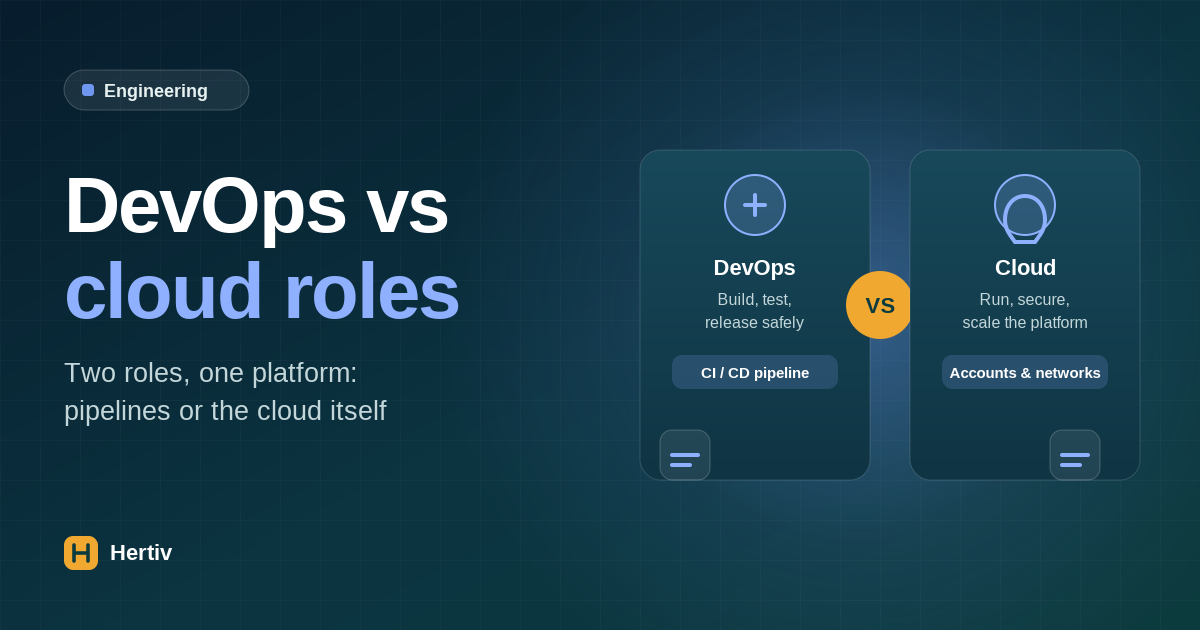
A DevOps engineer focuses on how software is built, tested and released, while a cloud engineer focuses on the platform it runs on. Here is how the two roles differ.
On this page
Short answer
A DevOps engineer focuses on how software is built, tested and released, while a cloud engineer focuses on the cloud platform the software runs on. The two roles overlap and often work on the same systems, but they answer different questions: DevOps asks how a change reaches users safely, and cloud engineering asks where the system runs and how it scales.
What is the difference between a DevOps engineer and a cloud engineer?
A DevOps engineer and a cloud engineer are two different roles that often work on the same systems. A DevOps engineer focuses on how software is built, tested and released, while a cloud engineer focuses on the cloud platform the software runs on.
The overlap is real. Both write automation, both work with infrastructure, and in a small team one person often does both jobs. But the questions they answer are different. DevOps asks how a change reaches users safely and quickly, while cloud engineering asks where the system runs and how it scales.
This article compares what each role does, the skills each needs, and how to decide which one to hire first. For help building either capability, DevOps services cover pipelines, releases and the surrounding operations.
What does a DevOps engineer do?
A DevOps engineer owns the path from code to users. When a developer finishes a change, the DevOps engineer makes sure it is built, tested and released without manual steps, and that a bad release can be rolled back quickly.
The daily work is mostly automation: build pipelines, test runs, deployments, monitoring and alerts. When a release fails, the DevOps engineer is the person who finds out first and fixes the pipeline, not the person who rewrites the feature.
The role also covers the habits around releases: small changes merged often, every change tested before it ships, and releases that are boring instead of dramatic. Those habits matter more than any single tool.
| DevOps duty | What it looks like in practice |
|---|---|
| CI/CD pipelines | Build, test and deploy on every merge |
| Release safety | Staged rollouts, feature flags, rollback |
| Monitoring | Alerts, dashboards, error budgets |
| Incident response | First responder when releases break |
| Developer speed | Faster feedback, less manual work |
What does a cloud engineer do?
A cloud engineer owns the platform the software runs on. They design the cloud accounts, networks, storage and databases, choose the services each part of the system uses, and make sure the whole setup is secure, reliable and affordable.
The daily work is mostly architecture and operations: setting up virtual networks, configuring identity and access, sizing databases, and watching costs. When traffic grows, the cloud engineer is the person who makes sure the system can grow with it.
Cloud engineers also handle the parts of a system that are easy to get wrong: permissions that are too wide, data stored in the wrong region, backups that were never tested, and bills that grow quietly. Their work is often invisible when it goes well, which is the point.
The role changes with the provider. An AWS engineer works with different services than an Azure or Google Cloud engineer, but the underlying questions are the same: where does the data live, who can reach it, what happens when a part fails, and what does it cost. Cloud services teams usually start with those four questions.
DevOps vs cloud engineer: skills compared
The two roles share a base of skills, such as scripting, Linux, networking and version control, but they go deep in different places. A DevOps engineer goes deep on pipelines and release practice, while a cloud engineer goes deep on the provider's services and architecture.
| Area | DevOps engineer | Cloud engineer |
|---|---|---|
| Main goal | Safe, fast releases | Reliable, secure platform |
| Daily tools | CI/CD, containers, monitoring | Cloud console, IaC, networking |
| Core skills | Pipelines, testing, automation | Architecture, security, cost |
| Success measure | Release speed and failure rate | Uptime, security and bill |
| Works closest with | Developers and QA | Architects and security teams |
The table shows why the roles are often confused: both touch infrastructure, both automate, and both care about reliability. The difference is where each one spends most of its time, and which failure each one is hired to prevent.
Certifications also differ. DevOps engineers are often judged by pipeline and Kubernetes experience, while cloud engineers are often judged by provider certifications and architecture work. Neither proves the other role.
Example (hypothetical): who do you hire first?
Example (hypothetical): a startup has 8 developers who spend 2 hours each week on manual releases and fixing broken deploys. That is 8 times 2, which is 16 hours a week, or about 64 hours a month.
A DevOps engineer who automates the pipeline cuts that to 2 hours a week for the whole team. That is 8 hours a month, saving about 56 hours a month, which is more than a full working week of developer time.
Now suppose the same startup runs on a single cloud account with wide-open permissions and no backups. A cloud engineer who fixes the permissions, sets up backups and adds cost alerts prevents a different kind of loss: a breach or a deleted database, which no pipeline can fix.
The numbers are invented to show the reasoning, not a real hiring plan. The point is that the first hire follows the biggest pain: if releases are slow and painful, hire DevOps first; if the platform is fragile or insecure, hire cloud first. A DevOps overview helps a team name which pain is bigger.
Can one person do both roles?
Yes, in a small team one person often does both roles, and that can work well. A team with one product, one cloud account and a handful of developers does not need two specialists, and a generalist who owns the whole platform learns it faster.
The split usually comes as the team grows. When releases happen many times a day, or the cloud setup spans several accounts and regions, one person cannot hold both jobs well. That is when teams hire a second person and draw a line between the pipeline and the platform.
The risk to watch is a generalist who is stretched thin. If one person owns releases, cloud security, costs and on-call, something will be neglected, and it is usually the quiet work, such as backups and permissions, that slips first.
A practical rule is to hire for the pain you feel today and plan the split for the pain you expect next year. Write down who owns what, so the split is a decision rather than an accident.
What are the common mistakes?
The most common mistakes start with hiring one person to do both roles at a scale where that cannot work. A single engineer cannot own a multi-account cloud platform and a release pipeline for dozens of developers at the same time.
- Confusing tools with the role. Knowing Kubernetes or Terraform is not the same as owning releases or owning the platform; the job is the outcome, not the tool.
- Hiring for the wrong pain. A team with slow releases hires a cloud engineer, or a team with a fragile platform hires a DevOps engineer, and neither problem gets fixed.
- No clear ownership. When nobody owns the pipeline or the platform, both decay quietly until an incident forces the issue.
- Judging by certificates alone. A certificate shows study, not judgement under pressure. Ask how the candidate handled a real outage or a bad release.
Avoiding these mistakes is mostly a matter of naming the job before hiring for it. Write down the outcomes you need, then hire the role that owns them. A CI/CD guide shows what the DevOps side of that ownership looks like in practice.
Key takeaways
- DevOps owns the path from code to users; cloud owns the platform it runs on
- Both roles automate, but they prevent different failures
- Hire for the pain you feel today: slow releases or a fragile platform
- One person can do both in a small team, then the roles split as you grow
- Name the outcomes before hiring, and judge by real incidents, not certificates
Frequently asked questions
Which role earns more, DevOps or cloud engineer?
Pay depends on the market, the company and the seniority, not on the title alone. Both roles pay well in most markets, and the gap between them is usually smaller than the gap between junior and senior in either role.
Do DevOps engineers need to know AWS or Azure?
Yes, in practice. A DevOps engineer runs pipelines on a cloud platform, so they need to know how that platform works, even if they do not design the whole architecture. The depth is less than a cloud engineer needs.
Can a cloud engineer become a DevOps engineer?
Yes. The shared base of scripting, Linux, networking and automation carries over, and the move is mostly about learning pipelines, testing and release practice. Many engineers move between the two roles over a career.
Which role should a startup hire first?
Hire for the biggest pain. If releases are slow and manual, hire DevOps first. If the cloud setup is insecure, untested or hard to scale, hire cloud first. Small teams often start with one generalist and split later.
Is Kubernetes a DevOps or a cloud skill?
Both. A DevOps engineer uses Kubernetes to run and release containers, while a cloud engineer designs and operates the cluster itself. The same tool serves two different jobs, which is why the roles are easy to confuse.
Do I need both roles on my team?
Not at first. A small team can run with one person covering both, as long as the ownership is written down. As the product and the platform grow, the two jobs split, and each needs its own owner.


