How to Develop a Poloniex-Like Bitcoin Exchange
A Poloniex-like exchange needs an order book, a matching engine, secure wallets and KYC checks. This guide covers the build, the costs and the compliance steps.
On this page
Short answer
To develop a Poloniex-like bitcoin exchange, build a centralised spot trading platform with an order book, a matching engine, hot and cold wallets, KYC checks and an admin panel. Poloniex itself launched in January 2014 as a centralised exchange, so the model is proven, but the build still needs careful work on security, liquidity and licensing before launch.
What is a Poloniex-like exchange?
A Poloniex-like exchange is a centralised cryptocurrency exchange modelled on Poloniex: users deposit bitcoin and other coins, place buy and sell orders, and trade against each other through an order book. The exchange holds the funds, matches the orders and takes a fee on each trade.
Poloniex launched in January 2014 and became one of the early large exchanges for altcoin trading. It was acquired by Circle in February 2018 and spun out to Polo Digital Assets in 2019. The product itself is the classic centralised model: accounts, deposits, an order book, spot trading and withdrawals.
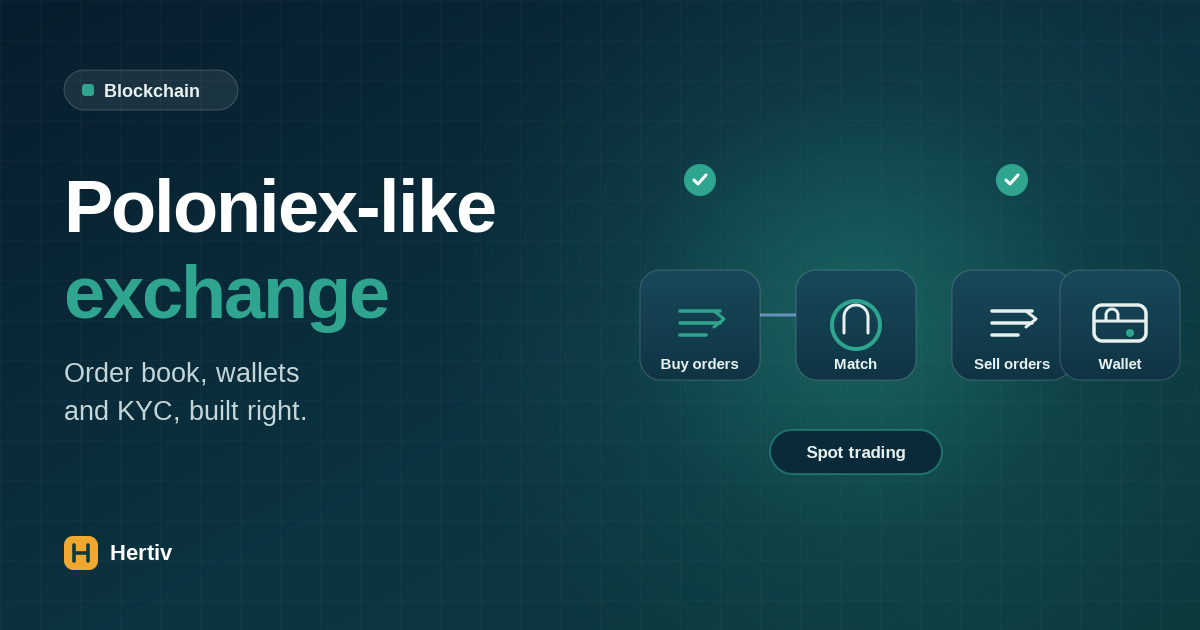
Building a clone means copying that product shape, not the code. Your exchange needs the same moving parts:
| Feature | What it must do | Why it matters |
|---|---|---|
| Order book | Match buy and sell orders by price and time | Fair, fast fills for traders |
| Spot trading | Trade one coin for another at the market price | The core product of the exchange |
| Wallets | Hold user funds in hot and cold storage | Most funds must stay offline |
| KYC and AML | Check identity and watch for abuse | Required by most licences |
| Admin panel | List coins, set fees, freeze accounts | Day-to-day operation |
| Market data | Charts, tickers and trade history | Traders decide on this data |
The hardest parts are not the trading screens. They are the matching engine, the wallet security and the legal position. A team that starts with the interface and leaves those three for later usually has to rebuild. For the service side, see crypto exchange development.
What features does a Poloniex-like exchange need?
A Poloniex-like exchange needs the trading features users expect, the account features regulators expect, and the operational tools the team needs to run it. Leaving any of the three out creates a product that cannot launch or cannot stay running.
On the trading side, users need spot trading with limit and market orders, an order book with live depth, a trade history, price charts and a way to see their open orders and balances. Advanced orders such as stop-limit are useful, but they can wait for a later release.
On the account side, users need registration, email verification, identity checks, two-factor authentication, deposit addresses and withdrawal requests with confirmations.
On the operations side, the team needs an admin panel to list and delist coins, set trading fees, review flagged accounts and pause trading in an emergency. The first version should be small: one or two trading pairs, a handful of coins and a clean order flow. Extra pairs and features are easy to add once the core works and the first users trust it.
How do you build the matching engine and order book?
The matching engine is the heart of the exchange. It takes buy and sell orders, sorts them by price and time, and creates trades when a buy price meets a sell price. It must be fast, fair and correct, because every trade moves real money.
Build the engine as a single-threaded core that processes orders one at a time, in the order they arrive. That design is simple to reason about and avoids the race conditions that appear when two threads touch the same order book. The engine keeps the book in memory for speed and writes every event to a durable log, so the book can be rebuilt after a restart.
Price-time priority is the rule: the best price trades first, and among orders at the same price the earliest one trades first. The engine must also handle partial fills, cancelled orders and self-trade prevention, so a user cannot accidentally trade with their own order.
Test the engine with a replay of real order flows before launch, and measure how many orders per second it handles. A slow engine shows up as stale prices and missed fills, and traders leave quickly when that happens.
How do wallets, deposits and withdrawals work?
Wallets are where the exchange holds user funds, and they are the part attackers want most. The standard design splits funds between hot wallets, which are online and hold only what is needed for daily withdrawals, and cold wallets, which are offline and hold the bulk of the funds.
Deposits work by giving each user a unique address for each coin. A listener watches the blockchain for payments to those addresses and credits the user's exchange balance after enough confirmations. Withdrawals work in reverse: the user requests an amount, the exchange checks the balance and the withdrawal limits, and a signed transaction moves the coins out.
Keep the hot wallet balance small, move the surplus to cold storage on a schedule, and require more than one person to approve large withdrawals. Multi-signature wallets and hardware signing devices are the usual way to do this.
Never store a private key on the same server that serves the website, and never reuse a deposit address across users, because that makes it impossible to tell whose payment arrived. A cryptocurrency guide covers the coin side, but the wallet operations are what keep funds safe.
What about security and compliance?
Security and compliance decide whether a Poloniex-like exchange can operate at all. An exchange that loses funds or breaks the law in its market does not get a second chance, so these steps belong in the plan from the start, not after launch.
A workable sequence:
- Choose the market and licence. Pick one jurisdiction, read its rules for exchanges, and apply for the licence or registration it requires before taking deposits.
- Set up KYC and AML checks. Verify identities at registration, screen against sanctions lists and watch transactions for suspicious patterns.
- Protect accounts. Require two-factor authentication, rate-limit logins and send alerts for new devices and large withdrawals.
- Secure the infrastructure. Separate the trading engine, wallets and website onto different networks, and keep private keys offline.
- Audit the code. Have an independent security review of the matching engine, wallet code and admin panel before launch.
- Plan for incidents. Write down who decides to pause trading, who talks to users and how funds are recovered after a problem.
Fees and pricing need a clear policy too: state the trading fee, the withdrawal fee and any listing fee in one place, and do not change them without notice. For the legal launch steps, see how to legally launch a crypto exchange.
Example (hypothetical): first-year budget for a small exchange
Example (hypothetical): a small team plans a Poloniex-like exchange with three trading pairs, bitcoin and two other coins, serving one market with a licence.
The build costs are straightforward. Development takes three engineers for six months at a blended cost of 10,000 dollars a month each, which is 180,000 dollars. An independent security audit costs 30,000 dollars, and legal work and the licence application cost 40,000 dollars. The first-year build total is 180,000 plus 30,000 plus 40,000, which is 250,000 dollars.
Running costs add 8,000 dollars a month for servers, monitoring and support, or 96,000 dollars a year. Fee income is smaller at first: monthly trading volume of 5,000,000 dollars at a 0.1 percent fee is 5,000 dollars a month, or 60,000 dollars a year. The team should plan to fund the gap from its own capital until volume grows, and should not spend on marketing before the engine and wallets are proven.
What are the common mistakes?
The most common mistakes in building a Poloniex-like exchange are launching without liquidity, keeping too much in hot wallets, and treating compliance as an afterthought.
- Launching with no liquidity. An empty order book means wide spreads and no fills, and traders leave in a day. Seed liquidity with a market maker agreement before launch.
- Too much in hot wallets. A hot wallet should hold only what the day's withdrawals need. The rest belongs in cold storage.
- Skipping the audit. The matching engine and wallet code hold real money. An independent review is cheaper than a breach.
- Listing too many coins. Each listing adds wallet work, monitoring and legal review. Start with a few well-known coins.
- Unclear fees. Hidden or changing fees destroy trust fast. Publish the fee schedule and stick to it.
Key takeaways
- A Poloniex-like exchange is a centralised spot platform with an order book
- The matching engine must be fast, fair and correct, and it should process orders one at a time
- Keep most funds in cold storage and only daily needs in the hot wallet
- Choose the market and licence before taking any deposits
- Launch with a few pairs and seeded liquidity, not an empty order book
Frequently asked questions
How much does it cost to build a Poloniex-like exchange?
A small first version typically costs 150,000 to 300,000 dollars to build, plus a security audit and legal work, with monthly running costs for servers, monitoring and support. The exact figure depends on the number of coins, the licence and the team.
Do I need a licence to run a crypto exchange?
In most markets, yes. The licence or registration depends on the jurisdiction and whether the exchange serves local residents. Get legal advice for the chosen market before taking deposits, because the rules vary widely.
What is the difference between a centralised and a decentralised exchange?
A centralised exchange holds user funds and matches orders on its own servers. A decentralised exchange lets users trade from their own wallets through smart contracts. The centralised model is faster and simpler to operate, but it carries custody risk.
How does an exchange make money?
Mostly from trading fees, a small percentage of each trade, plus withdrawal fees and sometimes listing fees. Volume is what matters: low volume means low fee income even with high fee rates.
Can I use a white-label exchange instead of building one?
Yes. A white-label product gives you a ready trading engine and interface that you brand and operate. It is faster and cheaper than building from scratch, but you depend on the provider for updates and fixes.
How long does it take to build a Poloniex-like exchange?
A small first version with a few pairs usually takes four to seven months, including testing and a security audit. Licensing can take longer than the build, so it should start early.


