How to Develop an NFT Aggregator Like Blur
An NFT aggregator like Blur pulls listings from several marketplaces into one trading screen. Here is how it works, what to build, and what it costs.
On this page
Short answer
An NFT aggregator like Blur is a trading app that pulls NFT listings from several marketplaces into one screen, so a buyer sees every price for a collection without checking each venue. It adds fast trading tools on top: collection-wide bids, floor sweeping, batch listing and live analytics. Building one means combining listing aggregation, a trading interface, wallet connections and reliable indexing.
What is an NFT aggregator like Blur?
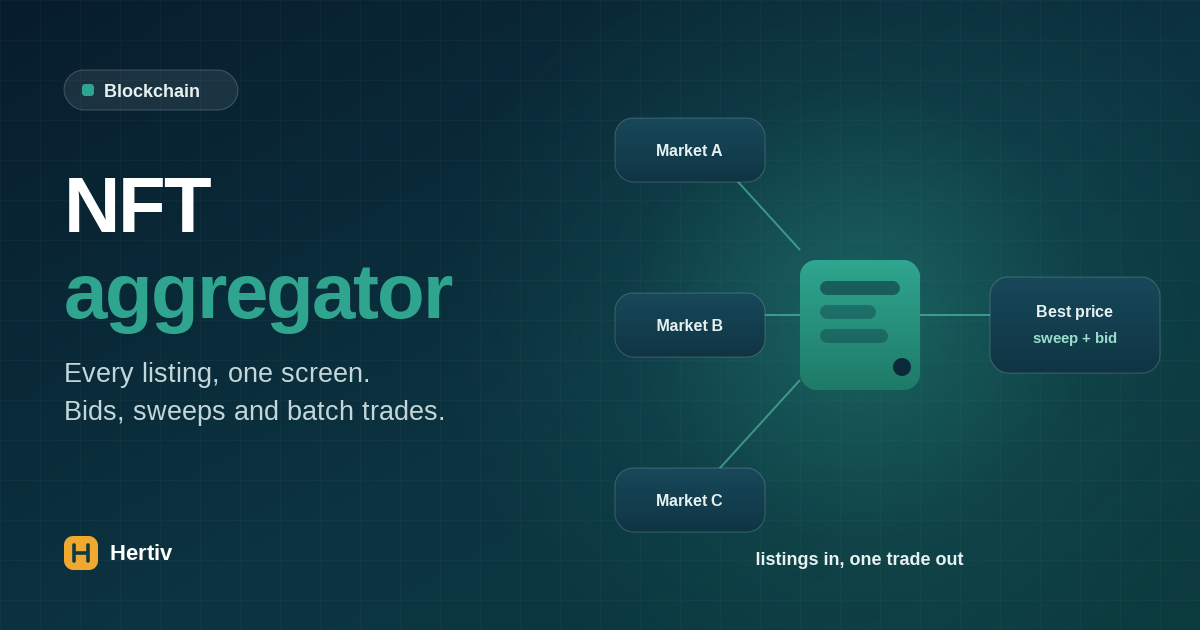
An NFT aggregator like Blur is a marketplace that indexes listings from several NFT venues and shows them together in one place. A buyer looking at a collection sees the cheapest listings from every connected marketplace, ranked by price, instead of visiting each site in turn.
Blur launched in October 2022 on Ethereum as a marketplace built for active traders, and it combines its own order book with listings pulled from other marketplaces. That combination is what makes it an aggregator rather than a single-venue marketplace: the buyer gets a wider set of listings and the seller reaches more buyers.
The trading side is what sets Blur apart from a simple listing search. Traders can place bids across a whole collection, buy several items at the floor price in one transaction, and list or reprice many items at once. The interface is built around market data: floor price, bid depth, sales history and holder counts, rather than artwork and curation.
An aggregator is a different product from a marketplace that only lists its own items. The core technical problem is indexing: keeping a fresh, correct copy of listings, bids and sales from several sources, and turning that into a screen a trader can act on in seconds.
How does Blur's aggregator actually work?
Blur's aggregator works by indexing listings from its own marketplace and from competing venues, then routing a buyer's order to the listing with the best price. When a buyer sweeps a floor, the aggregator can fill the order from several marketplaces in one transaction.
Collection-wide bidding is the feature traders use most. Instead of bidding on one token, a trader deposits ether into a bidding pool and sets bids at price levels across a whole collection. Any owner can sell into the highest standing bid at once, and the bidder can build a position without watching listings all day.
Blur charges no marketplace fee on trades, and it enforces a minimum 0.5% creator royalty on standard listings. The BLUR token is the platform's governance token, distributed to active participants through airdrop seasons that rewarded listing and bidding activity. The first airdrop ran in February 2023.
Blur also runs Blend, a peer-to-peer lending protocol that lets NFT owners borrow ether against their NFTs. It is a separate product from the aggregator, but it shares the same trader audience, which is why it is often mentioned alongside the marketplace. For teams building in this space, DEX development covers the order-book and routing patterns that aggregators borrow from token trading.
What features does an NFT aggregator need?
An NFT aggregator needs four groups of features: listing aggregation, trading tools, portfolio tracking and account handling. Miss one group and traders will keep a second app open, which defeats the point of an aggregator.
Use this table as a feature checklist before you scope the build.
| Feature group | What it does | Why traders need it | Build effort |
|---|---|---|---|
| Listing aggregation | Indexes listings from several marketplaces | One view of every price | High |
| Collection bids | Bids across a whole collection at set prices | Buy without watching listings | High |
| Floor sweeping | Buys several floor items in one transaction | Fast position building | Medium |
| Batch listing | Lists many items with one action | Fast repricing | Medium |
| Live analytics | Floor, volume, bids, holder counts | Decisions need fresh data | Medium |
| Portfolio view | Holdings, cost basis, floor value | Traders track many positions | Medium |
| Wallet connection | Sign in and sign trades with a wallet | No accounts or passwords | Low |
| Gas controls | Fee presets and transaction batching | Failed trades cost money | Low |
Start with aggregation, sweeping and collection bids. Those three are the reason a trader opens an aggregator instead of a marketplace. Analytics and portfolio views can follow once the trading loop works.
How to build an NFT aggregator, step by step
Building an NFT aggregator means solving indexing first, then trading, then the interface. Teams that start with the interface usually rebuild it once the data layer shows its limits.
- Pick the chain and the sources. Start with one chain, usually Ethereum, and two or three marketplaces. Each extra source adds indexing work and edge cases.
- Build the indexer. Listen to marketplace contract events and API feeds, normalise listings, bids and sales into one data model, and keep it fresh within seconds.
- Design the order routing. Decide how a buy is filled across venues, how fees and royalties are handled per venue, and what happens when a listing disappears mid-trade.
- Build the trading contracts. Collection bids need a bidding pool contract, and sweeping needs a router that can fill several listings in one transaction.
- Add wallet connection and signing. Support the wallets your traders use, and make every trade a signed transaction the user can inspect before confirming.
- Build the trading screen. Floor charts, bid depth, trait filters and one-click actions, with data refreshing live.
- Audit before launch. Get an independent smart contract audit of the bidding and routing contracts, then test on a testnet with real trading flows.
The indexer is the long pole. Marketplace APIs change, listings go stale, and a price shown a minute late is a price a trader cannot trust. Budget more time for data quality than for the interface.
Example: scoping a small aggregator build
Example (hypothetical): a team of three developers plans a small aggregator for one chain and three marketplaces, with collection bids and floor sweeping in the first version. They estimate five months of work.
The cost arithmetic is simple. Three developers at $8,000 a month for five months is 3 x 5 x $8,000 = $120,000. Add $15,000 for an independent audit of the bidding and routing contracts and $5,000 for indexing infrastructure and testnet work, and the first version totals $120,000 + $15,000 + $5,000 = $140,000.
The team keeps the scope tight: one chain, three sources, two trading features. Adding a second chain or a lending feature would add months, because each new source needs its own indexing and each new contract needs its own audit.
Running costs after launch include indexing servers, API access and ongoing audit work for contract changes. A realistic planning figure is $3,000 to $6,000 a month for a small aggregator, before any team salaries.
What about royalties, fees and lending?
Royalties, fees and lending are policy choices as much as technical ones, and they shape who uses the aggregator. Get them wrong and creators or traders will stay away.
Blur's approach was no marketplace fee with a minimum 0.5% creator royalty on standard listings, and full royalty enforcement on collections that block trading on OpenSea. Other aggregators take a small fee on each trade or charge for premium features instead. There is no single right model; the choice depends on whether you want to attract traders with low costs or creators with strong royalty protection.
Lending, like Blur's Blend protocol, is a separate build. It needs its own contracts, its own risk rules and its own audit, and it brings lending regulation into scope. Most teams should ship the aggregator first and treat lending as a second product.
Regulation also matters for the aggregator itself. Token rewards and airdrops, royalty handling and the jurisdictions you serve all need legal review before launch. A blockchain consulting review early in the project is cheaper than rework after launch.
What are the common mistakes?
The most common mistakes in NFT aggregator builds are stale data, weak routing and skipping the audit. Each one costs traders money, which is the fastest way to lose them.
- Showing stale listings. A listing that sold an hour ago but still shows as available wastes a trader's time and gas on a failed transaction.
- Routing that ignores royalties. Filling an order without applying the right royalty for the venue creates disputes with creators and marketplaces.
- No audit of the bidding contracts. A bidding pool holds user funds; a bug there is a direct loss, not a display error.
- Too many chains at launch. Each chain doubles the indexing and testing work, and none of it is done well.
- Copying Blur's rewards without a plan. Token rewards attract traders, but they also attract farmers who leave when the rewards stop.
- Treating the interface as the product. The data layer is the product; the interface is just how traders see it.
If you are planning an aggregator and want the indexing and contract design reviewed before you build, dApp development is the place to start.
Key takeaways
- An NFT aggregator wins on fresh data, fast trading tools and honest routing
- Collection bids and floor sweeping are the features that make an aggregator worth opening
- Indexing is the hardest part; budget more time for data quality than for the interface
- Audit bidding and routing contracts before launch, because they hold user funds
- Start with one chain and a few sources, then expand only when the data layer is solid
Frequently asked questions
What is the difference between an NFT aggregator and an NFT marketplace?
An aggregator indexes listings from several marketplaces and shows them together, so a buyer sees every price for a collection in one place. A marketplace lists only its own items. Blur does both: it runs its own order book and pulls in listings from other venues.
Does Blur charge fees on NFT trades?
Blur charges no marketplace fee on trades. It enforces a minimum 0.5% creator royalty on standard listings, with full royalty enforcement on collections that block trading on OpenSea. Gas fees for the underlying blockchain transactions still apply.
What are collection bids on Blur?
Collection bids let a trader deposit ether into a bidding pool and set bids at chosen prices across a whole collection. Any owner can sell into the highest standing bid at once, so the bidder can build a position without watching individual listings.
What is Blend on Blur?
Blend is Blur's peer-to-peer lending protocol, separate from the marketplace. It lets NFT owners borrow ether against their NFTs, with terms set between lender and borrower. It needs its own contracts and audit, and it is usually a second-phase build.
How long does it take to build an NFT aggregator?
A small aggregator for one chain and a few marketplaces typically takes four to six months with a small team, including indexing, trading contracts, the interface and an audit. Adding chains, lending or token rewards extends that by months.
Do I need a token to launch an NFT aggregator?
No. A token can reward early traders, but it adds legal, economic and security work. Many teams launch without one and add rewards later, once the trading loop works and the user base is real.


