Designing and Building AI Products That People Use
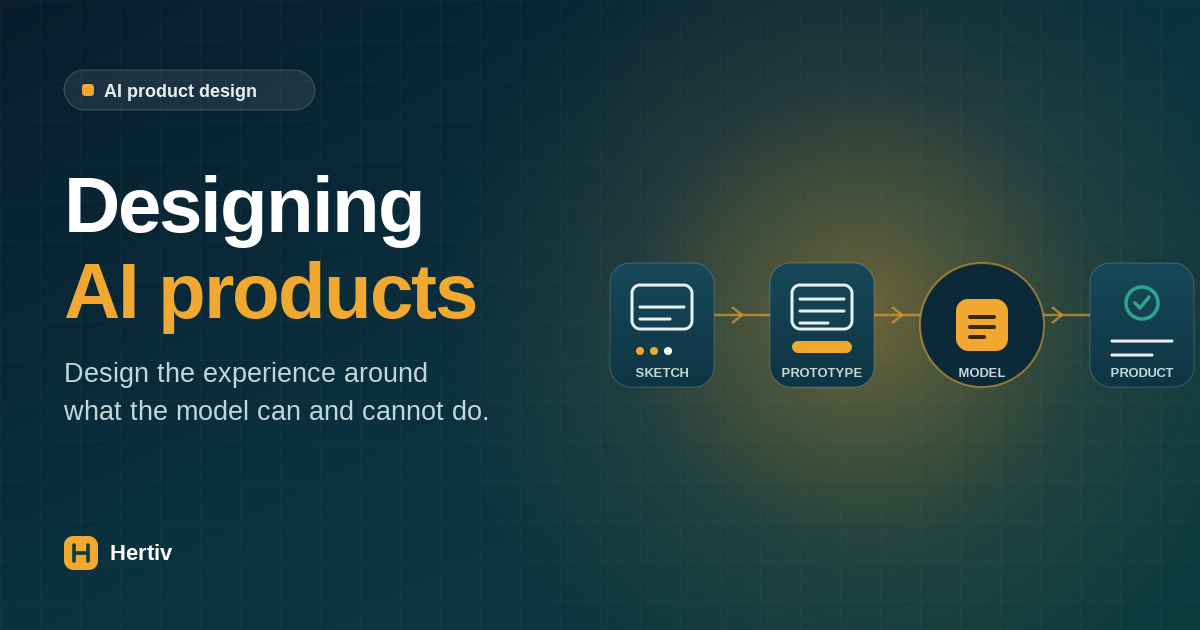
Designing and building an AI product means shaping the experience around what the model can and cannot do, from idea to a product people trust.
On this page
Short answer
Designing and building an AI product means turning a model capability into a product people can use with confidence. The work starts with a real user problem, then a prototype built on real data, then careful design around uncertain outputs, and finally evaluation and iteration after launch. The model is one part; the experience around it decides whether people keep using it.
What does designing an AI product mean?
Designing and building an AI product means turning a model capability into software that solves a real problem for real users. The model is only one part: the product also needs a clear job to do, data it can trust, an interface people understand, and a way to check whether its answers are right.
Design matters more for AI products than for ordinary software because the output is not fixed. A search box returns the same results for the same query, but a model can answer the same question differently twice. The product has to show what the model did, how sure it is, and what the user can do when the answer is wrong.
A useful way to think about it is a table of decisions:
| Decision | What it covers |
|---|---|
| Problem | The job the product does and who it helps |
| Data | Where the model's knowledge comes from |
| Behaviour | What the model may and may not do |
| Experience | What the user sees and controls |
| Evaluation | How you know the product is working |
If you are starting from scratch, how to build AI covers the build steps in order. This article focuses on the design choices that decide whether the finished product gets used.
How do you find a problem worth building for?
You find a problem worth building for by watching how people work today, not by asking what AI could do in theory. Look for tasks that are repetitive, text-heavy or data-heavy, and where a mistake is cheap to catch. Support replies, document summaries and first drafts are common starting points.
Talk to the people who do the work, and ask what a good day looks like. If the answer is fewer repetitive tickets or faster first drafts, you have a measurable goal. If the answer is vague, keep looking: a product built on a vague problem is hard to evaluate and harder to sell internally.
Check three things before you commit: the work happens often enough to matter, the data to do it already exists in digital form, and a wrong answer will be caught by a human or a rule before it causes harm. If any of the three is missing, pick a smaller problem or fix the data first.
How do you design for answers that are sometimes wrong?
You design for wrong answers by treating them as a normal part of the product, not an exception. Every model output should be shown with its source, a way to correct it, and a clear path to a human. When users can see where an answer came from, they trust the product more, even when it makes a mistake.
Four design patterns help:
- Show sources. Link each claim to the document it came from.
- Offer a fix. Let users edit or reject the output in one click.
- Ask for confirmation. Require approval before anything irreversible.
- Keep a log. Record what the model produced and what the user did with it.
Confidence scores look helpful but are easy to misread. A score of 0.8 does not mean the answer is 80% right, and users treat it as a promise. Use plain language instead, such as checked against three documents or needs a human review, which says what actually happened.
How do you prototype with real data?
You prototype with real data by building the smallest version that answers a real question from a real user. Start with a sample of genuine inputs, such as fifty real support tickets or twenty real contracts, and a list of the answers you expect. If the prototype cannot handle those, a bigger build will not fix it.
A useful prototype can be a simple form that sends a question to the model and shows the answer with its sources. You do not need a polished interface yet. What you need is evidence: how often the answer is right, how often it is wrong, and what the wrong answers have in common.
Build the evaluation set before you tune the prompt. Twenty real cases with known good answers will guide your design choices more than any framework. When the prototype passes most of the set, you have something worth turning into a product.
What should the build look like, step by step?
A build that holds up in production follows a sequence, and skipping a step usually shows up later as a bug or a support ticket.
- Define the job and the success measure. One workflow, one metric, one owner.
- Gather and clean the data the model will use. Remove duplicates and outdated documents first.
- Choose the model or API, and write down what it may not do. The limits matter as much as the abilities.
- Build an evaluation harness. Run the same cases on every change so regressions show up.
- Add guardrails. Input checks, output checks and a human approval step for risky actions.
- Launch to a small group, measure the metric, and fix the worst failures first. Expand only when the metric moves.
Launch small on purpose. A pilot with ten users and a fixed evaluation set teaches you more than a company-wide rollout, and it limits the damage when the first version gets something wrong. Expand only when the metric moves in the right direction for two weeks in a row. If the first version is a minimum viable product, how to build an AI MVP covers the scoping.
Example: a support-drafting product
Example (hypothetical): a shop has 60 support agents, and each agent writes 20 replies a day. Each reply takes about 4 minutes to write, so one agent spends 80 minutes a day on replies, and the whole team spends 4,800 minutes, or 80 hours, a day.
The team builds a drafting tool that writes a first draft from the help centre. An agent now spends 2 minutes checking and fixing each draft instead of 4 minutes writing from scratch. That saves 2 minutes on each of 20 replies, or 40 minutes per agent per day. Across 60 agents that is 2,400 minutes, or 40 hours, a day saved.
The saving only holds if the drafts are usually right. The team checks the first 200 drafts against the answers agents would have written, and finds 170 are good enough to send with small edits. The other 30 go back to manual writing. The product ships with a rule: drafts are suggestions, and the agent always sends the reply.
What are the common mistakes?
The most common mistakes in AI products come from treating the model as the product, instead of treating the experience around it as the product.
- Starting with the model instead of the problem. A demo that impresses in a meeting but has no daily user.
- No evaluation set. Quality debates become opinions, and regressions slip through.
- Hiding uncertainty. Users discover errors themselves and stop trusting the tool.
- Shipping to everyone at once. A bad first version reaches the whole company before it is fixed.
- Ignoring the cost of review. If every output needs ten minutes of checking, the product saves nothing.
When the product is live, scaling AI products covers what changes as users grow. Keep the evaluation set running on every release, so a model change cannot silently make the product worse.
Key takeaways
- An AI product is the experience around the model, not the model itself
- Pick a problem that is frequent, digital and safe to get wrong sometimes
- Show sources, offer a fix and require approval for irreversible actions
- Build the evaluation set before tuning the prompt or the interface
- Launch to a small group and expand only when the metric moves
Frequently asked questions
What is the difference between building AI and building an AI product?
Building AI usually means training or wiring up a model. Building an AI product means wrapping that model in software people use every day: an interface, data connections, guardrails, evaluation and support. The model is one component; the product is the whole system around it.
Do I need to train my own model?
Usually not. Most products start with an existing model or API and put the effort into data, prompts, evaluation and the interface. Training your own model makes sense only when no existing model handles your data well and you have the data and team to support it.
How much data do I need to start?
Enough to build an evaluation set and a working prototype. Fifty real examples with known good answers is a reasonable start for many products. You need more data if the task has many variations, and less if the task is narrow and the answers are short.
How do I know if my AI product is working?
Pick one metric tied to the job, such as time saved per task, share of drafts accepted without edits, or error rate against your evaluation set. Track it on the same cases over time, so you can tell whether a change helped or hurt.
Should the AI act on its own or wait for approval?
It depends on the cost of a mistake. Let the model act alone only for reversible, low-cost actions such as drafting text. For anything that moves money, changes data or contacts a customer, require a human approval step before it happens.
What does an AI product cost to run?
Costs come from model calls, data storage, evaluation and support, and they grow with usage. Measure cost per task early, and check whether the time saved is worth the running cost. If a task costs more to automate than to do by hand, narrow the scope.


