How DeFi Works in Supply Chain Financing
Decentralised finance can fund a supplier invoice in hours instead of weeks, by putting the invoice and the payment on a shared ledger. Here is how it works.
On this page
Short answer
Decentralised finance, or DeFi, in supply chain financing means using blockchain-based lending pools and tokenised invoices to pay suppliers early, without a bank in the middle. A supplier turns an unpaid invoice into a digital token, lenders fund it through a smart contract, and the buyer repays the pool when the invoice falls due.
What is DeFi in supply chain financing?
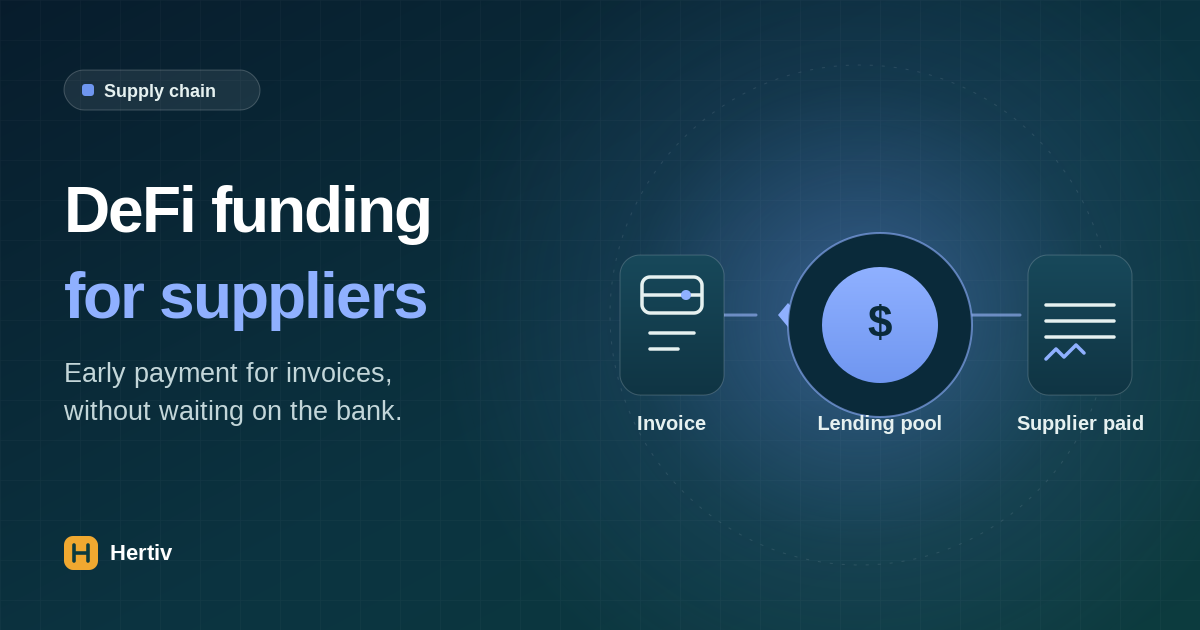
Decentralised finance in supply chain financing is a way for suppliers to get paid early using blockchain-based lending instead of a bank. The supplier has delivered goods and holds an invoice that the buyer will pay in 60 or 90 days. In a DeFi setup, that invoice is recorded on a blockchain as a digital token, and lenders put funds into a pool that pays the supplier most of the invoice value at once.
The buyer still pays the full invoice on the due date, but the payment goes to the lending pool instead of the supplier. The pool keeps a fee for the early payment, and the supplier gets cash weeks earlier than the invoice terms allow. The smart contract holds the rules, so the money moves only when the agreed conditions are met.
The difference from bank invoice finance is the plumbing. A bank checks the supplier, the buyer and the paperwork by hand, which takes days and often excludes small suppliers. A DeFi pool checks the invoice record on the ledger, the buyer's payment history and the token, which can be done in hours and can include suppliers a bank would turn away.
How does a DeFi supply chain deal work?
A DeFi supply chain deal follows the same shape as invoice finance, with the paperwork replaced by tokens and smart contracts. The steps below describe a typical deal for a single invoice.
- The invoice is tokenised. The supplier uploads the invoice and the delivery proof, and a token is created on the blockchain that represents the right to be paid.
- The invoice is checked. The platform or the pool checks the buyer, the invoice amount and the delivery record, so a fake or duplicate invoice cannot be funded twice.
- Lenders fund the pool. People or institutions put stablecoins into a lending pool, and the pool pays the supplier most of the invoice value, minus a fee.
- The supplier gets cash early. The supplier receives the funds within hours and can buy materials or pay staff without waiting for the invoice date.
- The buyer pays on the due date. The buyer settles the full invoice amount to the smart contract, which returns the lenders' funds plus the fee.
- The deal closes. Once the buyer has paid, the token is marked as settled and the pool can fund the next invoice.
The smart contract is the part that makes the deal work without a bank. It holds the funds, checks the conditions, releases the payment and records every step on the ledger, so all sides can see the same record of what happened and when.
How is it different from bank supply chain finance?
Bank supply chain finance and DeFi finance solve the same problem, which is a supplier waiting weeks to be paid, but they do it with different tools. The table below shows where they differ in practice.
| Feature | Bank supply chain finance | DeFi supply chain finance |
|---|---|---|
| Who decides | Bank credit team | Smart contract and pool rules |
| Time to first payment | Days to weeks | Hours in most cases |
| Small suppliers | Often excluded | Can join if the invoice checks out |
| Paperwork | Forms, contracts, manual checks | Tokenised invoice and ledger record |
| Cost | Bank fees and interest | Pool fee plus network fees |
| Cross-border | Slow, with currency steps | Same flow, settled in stablecoins |
The speed and the access for small suppliers are the real gains. A small supplier that a bank would not finance can still get early payment if its invoices are real and its buyer is reliable, because the pool judges the invoice and the buyer, not the supplier's credit file alone. For the wider picture of how these systems compare, see the guide to DeFi versus traditional finance.
Cross-border deals gain the most. A supplier in one country and a buyer in another usually wait for bank transfers, currency conversion and paperwork. A DeFi deal settles in stablecoins on the same ledger, so the money moves as fast as the network allows, and the currency steps disappear.
Where does it fit best?
DeFi supply chain finance fits best where invoices are large, buyers are reliable and payment terms are long. Those three conditions together make early payment worth the fee, because the supplier's cash is tied up for weeks and the buyer is very likely to pay.
It also fits supply chains that cross borders. When the buyer and the supplier are in different countries, bank finance adds currency conversion, correspondent banks and waiting time. A stablecoin deal keeps the same steps whatever the countries involved, which is why early projects in this area often start with international trade.
It fits less well where invoices are small, buyers are unknown or the goods are hard to verify. A small invoice is not worth the cost of tokenising and checking, and an unreliable buyer makes the pool charge a fee that eats the benefit. In those cases a simple payment term, or a bank facility the supplier already has, is usually the better answer.
What are the risks?
DeFi supply chain finance carries four risks that a business should understand before joining a pool or funding an invoice: fraud, the buyer failing to pay, smart contract bugs and regulation.
- Fake or double invoices. The same invoice could be funded twice if the platform does not check for duplicates. A good platform records each invoice once on the ledger and rejects any invoice already tokenised.
- Buyer default. If the buyer does not pay on the due date, the pool loses money. Pools manage this by funding only buyers with a payment record, and by spreading the risk across many invoices.
- Smart contract bugs. The contract holds the funds and the rules, so a bug in it can freeze or lose money. Pools that use audited contracts and hold reserves for failures are safer than ones that do not.
- Regulation. Rules for tokenised invoices and DeFi lending differ by country and are still changing. A business should check the rules in each market where it operates before joining.
The practical answer is to start with one invoice and one reliable buyer, and to use a platform that shows its audit reports and its default history. A platform that hides either of those is a platform to avoid. The payment side of these deals is covered in more detail in the guide to stablecoins for business payments.
Example (hypothetical): a parts supplier gets paid 45 days early
Example (hypothetical): a parts supplier delivers components to a manufacturer and raises an invoice for $100,000, payable in 60 days. The supplier needs the cash now to buy materials for the next order, and the bank would take two weeks to decide.
The supplier tokenises the invoice on a DeFi platform. A lending pool funds it at a fee of 2%, so the supplier receives $98,000 within a day, and the pool holds the right to the $100,000 payment when it falls due.
On day 60 the manufacturer pays $100,000 to the smart contract. The pool keeps $2,000 as its fee and returns the lenders' funds. The supplier paid $2,000 to get $98,000 forty-five days early, which is the cost of the cash, and the buyer paid nothing extra, since the invoice amount never changed.
The numbers only work if the buyer pays on time. If the manufacturer paid 30 days late, the pool would wait, and the lenders would earn nothing extra for the delay, which is why pools check the buyer's payment record before they fund an invoice.
What are the common mistakes?
The most common mistakes are funding invoices without checking the buyer, trusting a platform without reading its audit, and treating a DeFi deal as free money.
- Skipping the buyer check. The whole deal rests on the buyer paying. Funding an invoice from an unknown buyer is a gamble, not finance.
- Ignoring the audit. A smart contract that nobody has audited is a risk the pool carries for you. Ask for the audit report before you fund anything.
- Funding the same invoice twice. An invoice tokenised on two platforms can be funded twice, and the second funder loses. Check that the platform records invoices on a shared ledger.
- Forgetting the fee. A 2% fee on a 60-day invoice is cheap, but the same fee on a 10-day invoice is expensive. Price the fee against the days saved, not against the invoice alone.
- Assuming the law is settled. Tokenised invoices sit under different rules in different countries. Get local advice before running deals across borders. Cross-border settlement is also covered in the guide to tokenisation for cross-border payments.
Key takeaways
- DeFi supply chain finance turns an unpaid invoice into a token that a lending pool can fund early
- The buyer still pays the full invoice on the due date, and the pool keeps a fee for the early payment
- It is fastest and most useful for large invoices, reliable buyers and cross-border trade
- The main risks are fake invoices, buyer default, smart contract bugs and changing regulation
- Start with one invoice, one reliable buyer and a platform that publishes its audits
Frequently asked questions
What is supply chain financing?
Supply chain financing is a way for a supplier to get paid early for an invoice, usually by a bank or a finance provider that pays the supplier now and collects from the buyer later. It exists because buyers often pay in 60 or 90 days, while suppliers need cash for materials and wages much sooner.
How does a tokenised invoice work?
A tokenised invoice is a digital record on a blockchain that represents the right to be paid for a specific invoice. Once the invoice is tokenised, it can be funded, traded or settled by a smart contract, and the ledger prevents the same invoice from being funded twice.
Do suppliers need crypto to use DeFi supply chain finance?
Usually not. Most platforms settle in stablecoins, which are tokens designed to hold a steady value, and many convert the payment to local currency for the supplier. The supplier needs a wallet or an account on the platform, but does not need to hold crypto as an investment.
What happens if the buyer does not pay?
The lending pool loses money, because it already paid the supplier. Pools reduce this risk by funding only buyers with a payment record, by spreading funds across many invoices, and by holding reserves. Some platforms also use insurance or a first-loss fund to cover a default.
Is DeFi supply chain finance legal?
It depends on the country. Tokenised invoices and DeFi lending sit under different rules in different markets, and those rules are still changing. A business should get local legal advice before running deals, especially across borders, and use platforms that follow the rules in the markets where they operate.
How much does early payment cost a supplier?
It depends on the fee, the invoice size and how early the payment is. A fee of 2% on a 60-day invoice is a common shape, but the real cost is the fee against the days saved. A supplier should compare that cost with a bank loan or an overdraft for the same period before choosing.


