10 Questions Every DeFi Entrepreneur Should Answer
Before you build a DeFi product, answer ten questions on regulation, custody, yield, governance and failure plans, and see what a solid answer looks like.
On this page
Short answer
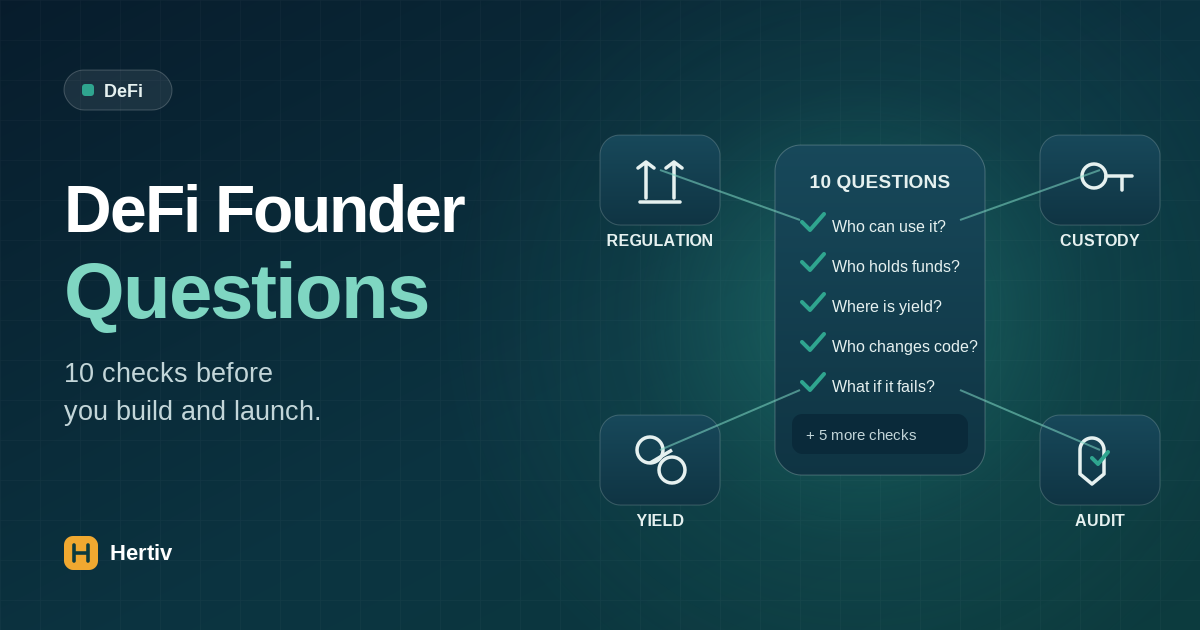
The ten questions cover who can legally use the product, who holds user funds, where yield comes from, how the protocol earns money, who can change the code, how it handles fast markets, whether the code was audited, where liquidity comes from, what breaks at scale, and what happens when something goes wrong.
Which ten questions should a DeFi entrepreneur answer first?
The questions worth answering first are the ones that decide whether your product survives contact with real users, real regulators and real markets. A clever mechanism means little if the team cannot say who holds the funds, where the yield comes from, or what happens when a price moves sharply in an hour.
Work through the list before you write much code. Each question below has a short test: if you cannot give a plain answer in two sentences, that area needs more work. Start with what DeFi is if the basics are still fuzzy, then use the table to plan.
| Question | Why it matters | A solid answer looks like |
|---|---|---|
| Who can legally use it? | Rules differ by place and user | Named regions, blocked where needed |
| Who holds the funds? | Custody decides who bears the loss | Clear custody model, no vague claims |
| Where does yield come from? | Yield must have a real source | Fees, lending or staking, stated plainly |
| How does it earn money? | Fees must cover real costs | Fee model that pays for running it |
| Who can change the code? | Admin power is a risk | Named controls and time locks |
| What happens in a fast market? | Volatility tests every design | Limits, oracles and liquidation rules |
| Has the code been checked? | Bugs in finance code cost money | Independent audit and fixes done |
| Where does liquidity come from? | Thin markets break products | Named sources and incentives |
| What breaks first at scale? | Growth exposes weak points | Known limits and a fix plan |
| What if it all goes wrong? | Failures need a rehearsed plan | Pause, contact and recovery steps |
None of these questions has a single right answer. A lending product answers them differently from a trading product. What matters is that the answers are written down, honest and consistent with each other.
Who can use it, and who holds the funds?
1. Who can legally use it, and where?
Regulation is the first question because it shapes everything else: who you can serve, what you can offer them, and what you must disclose. Rules for financial products differ by country, and some regions restrict who can use a lending or trading product at all. A product that ignores this can be forced to block users after launch, which is far more expensive than planning for it early.
Write down the regions you will serve and the ones you will block, and get that list checked by a lawyer who knows financial regulation in those places. If your product touches securities, derivatives or payments, the rules are stricter still, and the answer may be that you need a licence or a partner who holds one. Compare your model with DeFi versus centralised finance to see which rules usually apply to each side.
2. Who holds the users' funds?
Custody is the question users care about most once they understand it. In a non-custodial design, users keep their own keys and the protocol never holds their assets, so a failure of your company does not take their funds with it. In a custodial design, your company or a partner holds the assets, which means you need strong controls, insurance thinking and a clear answer to the question of what happens if you disappear.
State the model in plain language on your site and in your docs, and make sure the code matches the claim. Many products describe themselves as non-custodial while an admin key can move funds, which is the worst of both worlds: users think they are safe, and the team holds a risk it has not admitted. A good answer names who holds what, who can move it, and under what conditions.
Where does the money come from?
3. Where does the yield come from?
Yield is the number every DeFi pitch leads with, and it is the number most worth questioning. Real yield comes from somewhere specific: borrowers paying interest, traders paying fees, or rewards paid by a protocol for providing a service. If you cannot name the source in one sentence, the yield is probably being paid from new deposits or from a token whose value depends on new buyers, and that does not last.
Write the yield down as a flow: who pays, how much, and what changes if that payer leaves. A lending market earns from borrowers, a trading pool earns from swap fees, and a staking product earns from network rewards. Each source has its own risks, and a product that mixes several should explain each one separately rather than blending them into a single attractive rate.
4. How does the protocol earn money?
A protocol that cannot pay its own costs is a hobby, not a business. Fees must cover the team, the infrastructure, the audits and the support, and they must do so at the volumes you can realistically reach, not at the volumes in a hopeful forecast. Work out the monthly cost of running the product, then work out how much volume is needed at your fee rate to cover it.
Be honest about the gap between launch and sustainability. Many teams fund the early months from a treasury or from token sales, which is fine as long as the plan says so and the treasury has a stated runway. A good answer names the fee, who pays it, what it covers, and how long the team can operate if volume is half of the forecast.
Who can change the code, and what happens in a fast market?
5. Who can change the code?
Every DeFi product has someone who can change it, even if that someone is a multisig wallet or a governance vote. The question is who, how many of them there are, and how long a change takes to go live. An admin key held by one person is a single point of failure; a multisig with a time lock is slower to act but much harder to abuse.
Publish the answer. Name the signers or the governance process, state the time lock, and explain what the admin can and cannot do. Users who trust a protocol are trusting these controls, whether they read them or not, and the teams that last are the ones whose controls survive public scrutiny. If a change can drain funds instantly, say so and explain why that power is needed.
6. What happens when the market moves fast?
Fast markets are when DeFi products fail. Prices drop, borrowers get liquidated, oracles lag, and gas fees spike so that nobody can act in time. Your design should have an answer for each of these: how liquidations work, which price feed you trust, what happens if that feed stops, and how the product behaves when the network is congested.
Test the bad day before launch, not after it. Run through a sharp price fall on a test deployment and watch what liquidators, borrowers and lenders each experience. A good answer names the limits: the largest price move the system handles cleanly, the oracle setup and its fallback, and the point at which the team pauses the product rather than letting it run into a worse state.
Has the code been checked, and where does liquidity come from?
7. Has the code been checked by anyone outside the team?
Finance code that has only been read by its authors is a risk, however careful the authors are. An independent audit does not make code safe, but it finds the classes of mistake that teams miss in their own work: re-entrancy, rounding errors, access control gaps and economic assumptions that do not hold under stress. Budget for an audit early, because a good auditor needs weeks and the fixes take more time after that.
Treat the audit as a public document, not a marketing badge. Publish the report, list what was fixed and what was accepted as a known risk, and say what the audit did not cover. A smart contract audit is one part of the answer; the other part is ongoing testing, bug bounties and a process for patching when something new is found.
8. Where does liquidity come from, and will it stay?
Liquidity is the product's oxygen. A trading pool with thin liquidity gives users bad prices, a lending market with thin liquidity cannot fund withdrawals, and both problems get worse exactly when users need the product most. Name your liquidity sources: your own treasury, professional market makers, or users incentivised with rewards, and say what each source costs.
Rewards that attract liquidity can also destroy it when they end, so plan the transition from incentivised to organic liquidity before launch. A good answer states the target depth for the main pairs, the cost of keeping it there, and what happens to users if liquidity halves overnight. If the product only works at large scale, say so plainly.
What breaks first at scale, and what is the plan when things go wrong?
9. What breaks first at scale?
Every product has a first breaking point, and founders who know theirs in advance can plan around it. It might be gas costs that make small trades uneconomic, an oracle that updates too slowly for the volume, a support queue that grows faster than the team, or a user interface that confuses people who have never used a wallet. Find the breaking point by load testing with realistic numbers, not by hoping growth is gradual.
Write the limits down and watch them. Decide in advance which chain or layer the product runs on and what would trigger a move, how the team handles a surge in users, and which features get cut first when the system is under strain. Teams that build DeFi apps on a clear scaling plan recover faster from growth spikes than teams that improvise.
10. What is the plan if it all goes wrong?
Something will go wrong eventually: a bug, a bad oracle reading, a key compromise or a market event nobody predicted. The difference between a bad day and a dead product is whether the team has a rehearsed plan. That plan needs a pause mechanism, a named decision maker, a way to contact users, and a recovery sequence that has been practised, not just written.
Decide the hard questions now, while nobody is panicking. Who can pause the contracts, and how quickly? How do you tell users what happened without guessing? What funds can be recovered, and what cannot? A good answer is a short document the whole team has read, with phone numbers, contract addresses and the order of steps, reviewed after every incident and every major release.
How do you work through the ten questions?
Work through the ten questions in order, but treat them as a loop rather than a checklist you finish once. Answers change as the product changes, so revisit the list at each major decision: a new market, a new feature, a new chain or a new funding round.
- Write the answers down. One page per question, in plain language, with the names of the people responsible for each answer.
- Test the weak ones first. The questions you cannot answer are the risks; put time and money into those before polishing the ones you already know.
- Get outside eyes on the list. A lawyer for question one, an auditor for question seven, and an experienced operator for the rest will each find gaps you missed.
- Turn answers into controls. Each answer should map to something concrete: a time lock, a limit, a test, a document or a monitoring alert.
- Revisit after every release. A new feature can change the answers to several questions at once, so review the list before launch, not after.
If you need help turning the answers into a build plan, a partner for DeFi development can work through the list with your team and flag the answers that need more work before code is written.
What are the common mistakes?
The most common DeFi entrepreneur mistakes are treating the ten questions as paperwork, hiding the hard answers, and building the product before the business model is clear.
- Answering for investors, not for users. A pitch deck answer and a real answer are different things; users and auditors read the real one.
- Hiding the admin key. If one person can move funds, say so. Hidden power is found eventually, and it is found at the worst time.
- Quoting yield without a source. A rate with no named payer is a promise the team cannot keep.
- Skipping the audit to save time. The weeks saved are small compared with the cost of a bug in live finance code.
- No pause plan. A product that cannot be stopped safely cannot be fixed safely either.
- Planning for the good day only. Markets fall, oracles fail and keys get lost; the plan should cover those days first.
Key takeaways
- Answer regulation and custody first, because they shape every other decision
- Yield needs a named source: fees, lending or staking, stated in one sentence
- Admin power should be public, limited and slow enough to stop abuse
- Audits, liquidity plans and a rehearsed incident plan are part of the product, not extras
- Revisit the ten questions at every major release, not just at launch
Frequently asked questions
Do I need a lawyer before building a DeFi product?
Yes, for the regulation question at least. A lawyer who knows financial rules in your target regions can tell you which licences, disclosures or restrictions apply before you commit to a design. That advice is far cheaper before launch than after a regulator or a partner asks questions.
What is the difference between custodial and non-custodial DeFi?
In a non-custodial product, users keep their own keys and the protocol never holds their assets. In a custodial product, your company or a partner holds the assets for them. The choice changes who bears the loss if something fails, and it should be stated plainly.
How much does a smart contract audit cost?
It varies with the size and complexity of the code, and the only reliable figure is a quote from an auditor who has read it. See the vendor site for current pricing, and budget for the fixes that follow the audit, which take real engineering time.
Can a small team launch a DeFi product safely?
Yes, if the scope is small and the ten questions have honest answers. A single well-tested lending market with a pause mechanism and an audit is safer than a large product with many features and no incident plan. Start narrow and grow the scope as the controls prove themselves.
What is a time lock, and why does it matter?
A time lock delays a change to a smart contract for a set period after it is proposed, so users can see it coming and leave if they disagree. It turns instant admin power into slow, visible power, which is much harder to abuse.
Should a DeFi product launch on one chain or several?
Start on one chain where your users and liquidity already are. Each extra chain adds audit work, monitoring and incident handling, so add chains only when the first one is stable and the team can support the extra load.


