DeepSeek vs ChatGPT: Which One Fits Your Work?
DeepSeek and ChatGPT differ in how you run them, what they cost and where they fit best. Compare the differences before you pick one.
On this page
Short answer
DeepSeek is a family of open-weight models you can run yourself, while ChatGPT is OpenAI's managed chat product and API. DeepSeek gives you more control over deployment and data; ChatGPT gives you a ready product with no infrastructure to run. The better choice depends on your data rules, volume and team capacity.
What is the difference between DeepSeek and ChatGPT?
DeepSeek is a family of open-weight large language models, while ChatGPT is OpenAI's chat product built on its GPT models. The difference matters because it decides how you run the model, what you can change, and who holds your data.
With DeepSeek, you can download the model weights and run them on your own servers or through a hosted API, which gives you more control over deployment and data. With ChatGPT, you use OpenAI's product and API, which gives you a polished interface, managed infrastructure and regular updates without running anything yourself.
Both can draft text, answer questions, summarise documents and help with code. The practical differences sit in deployment, cost structure, customisation and support, not in whether they can do the job at all.
How do DeepSeek and ChatGPT compare?
The two options differ most in how they are delivered and controlled. Use this table to see the trade-offs side by side before you test either one.
| Aspect | DeepSeek | ChatGPT |
|---|---|---|
| Access | Open-weight models you can self-host or call through an API | Chat product and API run by OpenAI |
| Model weights | Available to download and run yourself | Closed; you use the model through OpenAI |
| Deployment | Your servers, a cloud host or a third-party API | OpenAI infrastructure only |
| Customisation | Fine-tune the weights or adapt the serving stack | Prompting, retrieval and fine-tuning through the API |
| Data control | You decide where prompts and data are stored | Data is processed under OpenAI's terms |
| Support | Community and vendors, depending on how you run it | Vendor support from OpenAI |
Neither row is better in every case. Self-hosting gives control but adds work; a managed product gives convenience but less control. The right choice depends on your data rules and your team's capacity.
When is DeepSeek the better fit?
DeepSeek is the better fit when you need to run a model inside your own environment or when per-token API pricing does not suit your workload. Teams with strict data rules often prefer a model they can host themselves.
It also fits teams that want to fine-tune deeply or build a custom serving setup around the model. If you already run infrastructure and have engineers who can maintain it, the control is worth the effort.
- Data must stay in your network. Self-hosting keeps prompts and documents inside systems you control.
- Usage is heavy and steady. Running your own instance can be cheaper than paying per request at high volume.
- You need deep customisation. Open weights let you fine-tune and change the serving stack.
- You want no vendor lock-in. The same weights can move between hosts.
The trade-off is operational work: you own updates, scaling, monitoring and security. That cost is real, so count it before you commit.
When is ChatGPT the better fit?
ChatGPT is the better fit when you want a working product quickly, with no infrastructure to run. Most teams start here because the product is ready on day one and the API is simple to call.
It fits support drafting, internal search, content help and copilots where the model is one part of a larger workflow. The managed service handles scaling, updates and safety tooling, so your team focuses on the workflow, not the model.
- Speed matters more than control. You can ship a pilot in days, not weeks.
- You have no ML operations team. OpenAI runs the model, so you do not need to.
- Usage is variable. Pay-per-use pricing fits workloads that spike and fall.
- You need the newest capabilities fast. New features arrive in the product without a migration.
The trade-off is dependence on one vendor's terms, pricing and availability. If your data rules forbid sending content to a third party, that alone rules it out.
How to compare them on your own work
A short test on your own tasks beats any general comparison. Run both on the same inputs and score them the same way, so the result reflects your work, not someone else's demo.
- Pick three real tasks. Choose tasks your team does every week, such as drafting replies, summarising documents or triaging tickets.
- Build a small test set. Gather 20 to 30 real examples with a known good outcome for each one.
- Run both models the same way. Use the same prompt and the same scoring, and keep a human in the loop.
- Score accuracy and usefulness. Count how many outputs were usable without heavy editing, not just how fluent they read.
- Add up the full cost. Include hosting, engineering time and review time, not just the API bill.
If you need help designing that test, how to test AI models covers evaluation sets and scoring in more detail.
Example: a support team compares both
Example (hypothetical): a support team handles 200 tickets a day and wants a drafting assistant. It builds a test set of 40 past tickets with the replies that resolved them, then runs both models on the same 40 tickets.
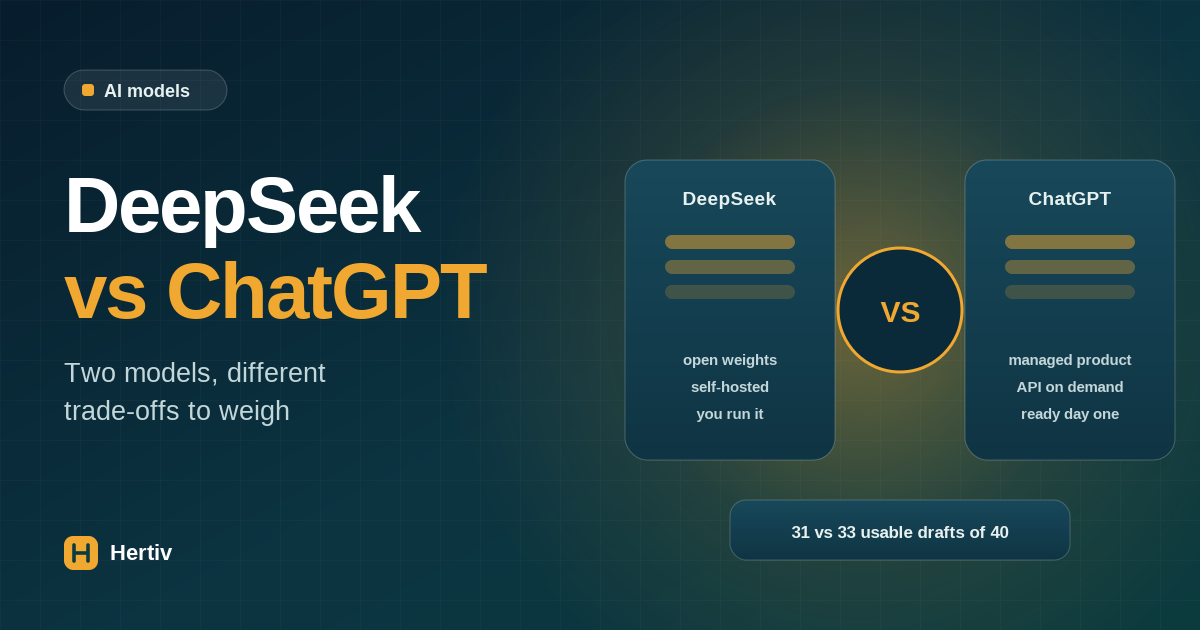
DeepSeek, self-hosted, produces usable drafts for 31 of the 40 tickets, and ChatGPT produces usable drafts for 33 of the 40. The difference is small, so the team looks at cost instead: self-hosting needs about 10 engineering hours a month to maintain, while the API bill is modest at this volume.
The team picks ChatGPT for the pilot because the accuracy gap is small and the managed service needs no maintenance. It keeps DeepSeek as a fallback for a later phase, when ticket volume is expected to triple and the hosting cost may pay off. The decision is recorded with the test results, so it can be revisited when volume changes.
What are the common mistakes?
The most common mistakes are choosing on reputation, skipping a test on your own data, and ignoring the cost of running a model yourself.
- Choosing from benchmarks alone. Published scores rarely predict performance on your documents and your tasks.
- Ignoring data rules. A model that cannot legally receive your data is not an option, however good it looks.
- Forgetting maintenance. Self-hosting means updates, monitoring and incident response, which need staff.
- Testing with one prompt. A single example proves nothing; use a fixed test set and score every output.
- Skipping the fallback. Every model fails sometimes, so plan what happens when the draft is wrong.
If you plan to move from a test to a real deployment, how to build an AI proof of concept covers the steps that follow, including evaluation and rollout.
Key takeaways
- DeepSeek is open-weight and self-hostable; ChatGPT is a managed product and API
- Control over data and deployment is DeepSeek's main advantage; convenience is ChatGPT's
- Test both on your own tasks with a fixed test set before deciding
- Count hosting, engineering and review time, not just the API bill
- Keep a human review step and a fallback, whichever model you choose
Frequently asked questions
Is DeepSeek free to use?
The model weights are available to download, but running them is not free: you pay for servers, storage and engineering time, or you pay a hosting provider. Check the licence and the hosting costs before you plan a budget.
Can ChatGPT be used without sending data to OpenAI?
No. ChatGPT runs on OpenAI infrastructure, so prompts and files are processed by OpenAI under its terms. If your data rules forbid that, a self-hosted model is the safer path.
Which is better for coding help?
Both can help with code, but the answer depends on your codebase and your workflow. Run the same coding tasks through both on your own repository and score how many suggestions were usable without heavy editing.
Do I need to fine-tune either model?
Usually not at first. Prompting and retrieval over your own documents handle most support, search and drafting work. Fine-tuning helps when you need a consistent format or tone at scale.
Can I switch from one to the other later?
Yes, if you keep the model behind a thin interface in your own code. Avoid hard-coding one vendor's API into every part of the product, so a switch stays a small change.
Which one is safer for customer data?
Neither is safe by default. Safety comes from your controls: what data you send, who can see outputs, logging and review. A self-hosted model keeps data inside your network, which helps when the rules are strict.


