Decentralized AI: What It Is and How It Works
Decentralized AI spreads training and inference across many machines no single company controls. Here is how it works, where it fits, and what to watch for.
On this page
Short answer
Decentralized AI is AI that is trained, run or governed across a network of independent machines instead of one company's data centre. Models, data and compute are shared through open protocols, and no single party controls the whole system. It suits teams that want to avoid vendor lock-in, use idle hardware, or keep data close to where it is created.
What is decentralized AI?
Decentralized AI is artificial intelligence that is trained, run or governed across a network of independent machines instead of inside one company's data centre. The model, the data and the compute can each live in different places, and the parts are tied together by open protocols rather than by a single vendor's platform.
The idea is simple: no one party should hold all the keys. A team that trains a model on a shared network rents compute from many owners, stores its data where it chooses, and publishes the model so others can check it. If one provider leaves the network, the work moves to another node.
This is different from using a single cloud AI service. With a hosted service, the vendor sets the price, the rules and the limits. With a decentralized setup, those choices are spread across the network, which gives a team more control but also more work to do. To learn how AI agents fit into this picture, see what an AI agent is.
How does decentralized AI work?
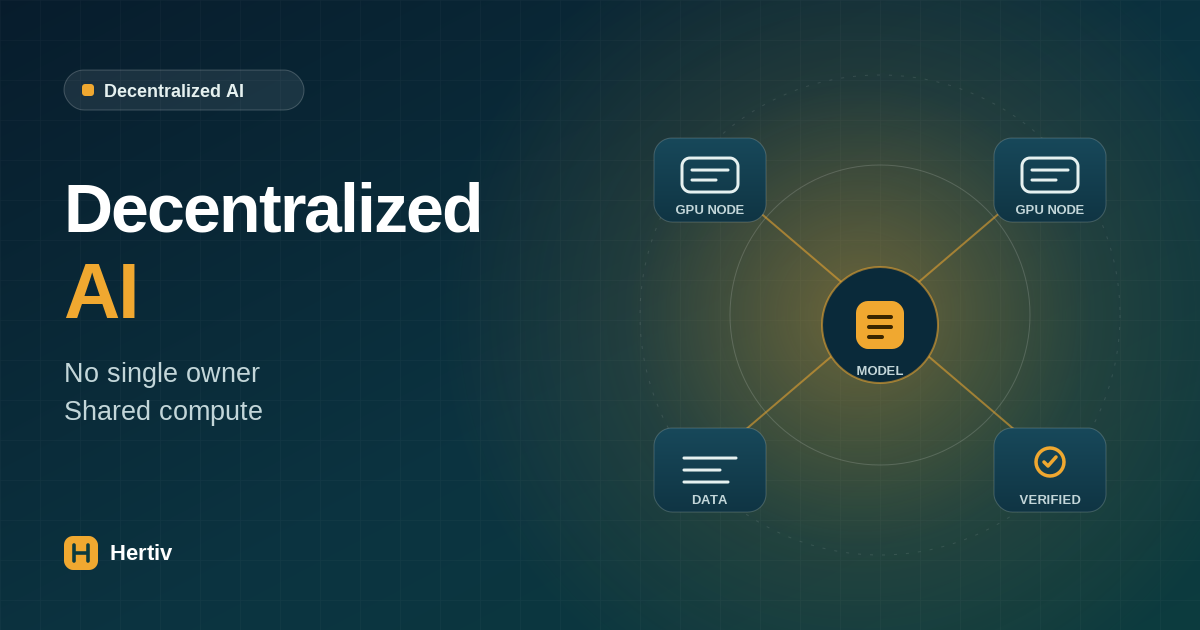
A decentralized AI system has four parts that work together. The compute network supplies the machines, the data layer decides where training data lives, the model registry tracks which model version is running, and the governance rules decide who can change what. Each part can come from a different provider.
| Part | What it does | Who runs it |
|---|---|---|
| Compute network | Supplies GPUs and CPUs for training and inference | Independent node owners |
| Data layer | Stores and shares training data with access rules | Data owners and hosts |
| Model registry | Records model versions and their test results | Open protocol or community |
| Governance | Sets voting and change rules for the network | Token holders or members |
Work is usually paid for with the network's own token or with a standard payment. A job is split into tasks, each task is sent to a node, and the result is checked before payment is made. Slow or faulty nodes lose work over time, which keeps the network honest without a central manager.
Where is decentralized AI used today?
Decentralized AI is used most where a single provider is a poor fit. Small research teams use shared compute to train models they could not afford on one cloud. Hospitals and banks use it to keep sensitive data on their own machines while still sharing a model with partners. Open-source groups use it to train models in public, so anyone can check the data and the method.
It also shows up in consumer apps. A phone app can run a small model on the device itself and send only the hard questions to the network, which keeps private data off other people's servers. Voice and image tools use this pattern when users want answers without uploading their files to a central service.
The pattern is still young. Most production AI still runs on a few large clouds, because that is simpler to run and easier to support. Decentralized networks win when control, cost or data rules matter more than convenience. For background on shared compute, see blockchain-based decentralized cloud computing.
What are the trade-offs?
The main gain is control. A team is not locked into one vendor's price, rules or shutdown risk, and it can move work between providers. Data can stay where the law or the customer wants it, and the model can be checked by anyone, which helps when trust matters.
The main cost is complexity. Someone has to join the network, pay nodes, check results and fix failed jobs. A single cloud gives you one support desk and one bill; a network gives you many small providers and no one to call when a job stalls. Speed can also vary, because nodes differ in hardware and in how busy they are.
Security is a mixed picture. Spreading work across many machines removes a single point of failure, but it also means trusting code that runs on machines you do not own. Good networks check results from several nodes and pay only for work that matches, which limits how much a bad node can do.
How do you start with decentralized AI?
Start with a small, well-defined job rather than a full migration. Pick one task that is easy to measure, such as running an existing model on a shared network, and compare the cost, speed and result quality against your current setup.
- Write down what the job needs: model size, data size, speed target and budget.
- Choose one network and read its rules for payments, node checks and dispute handling.
- Run a test job with data you can afford to lose, and check the result against a known answer.
- Compare the real cost per job, including failed runs and re-checks, with your current cost.
- Move a second job only if the first one meets your speed and quality bar.
Keep your data rules in writing from the start. Decide which data may leave your machines, which must stay, and who may see the model outputs. A network that cannot meet those rules is the wrong network, however cheap it looks.
Example (hypothetical): a small team runs a model on shared compute
Example (hypothetical): a four-person team needs 1,000 GPU-hours to fine-tune a support chatbot. Their usual cloud charges $2 per GPU-hour, so the job costs $2,000. A decentralized network offers the same class of GPU at $1.20 per hour, which puts the job at $1,200.
The team expects about 10% of the jobs to need a re-run because some nodes are slow. That is 100 extra GPU-hours at $1.20, or $120. The total comes to $1,320, which is $680 less than the cloud price. The saving is real, but only because the team checked the results and re-ran the failed jobs.
The lesson is to count the full cost, not the headline price. Failed runs, result checks and the time spent managing nodes are all part of the bill. If the team had skipped the checks, a wrong result could have cost far more than the $680 saved.
Common mistakes
The most common mistake is moving everything at once. A team that shifts its whole pipeline to a new network in one week has no fallback when a node fails or a payment stalls. Move one job, measure it, and keep the old setup running until the new one proves itself.
Another mistake is ignoring data rules. Sending customer data to nodes in regions where it may not legally go is a compliance problem, not a technical one. Check where the nodes are and what the network promises about data handling before the first job runs.
Finally, teams often trust the network too much. A result should be checked against a known answer or a second node before it is used in production. Networks that pay for checked work make this easy, but the check still has to happen. Skipping it turns a small saving into a large risk.
Key takeaways
- Decentralized AI spreads training, inference and control across independent machines.
- No single vendor sets the price, the rules or the limits for the whole system.
- It fits teams that need control, lower cost or strict data rules.
- The cost is complexity: more providers to manage and no single support desk.
- Start with one small, measurable job and count the full cost before moving more.
Frequently asked questions
What is decentralized AI, in one sentence?
Decentralized AI is AI that is trained, run or governed across a network of independent machines instead of inside one company's data centre. The parts are tied together by open protocols, and no single party controls the whole system.
Is decentralized AI cheaper than cloud AI?
It can be, because many small providers compete on price and idle hardware is cheaper than reserved capacity. The real cost includes failed runs, result checks and management time, so a team should measure the full cost per job before deciding.
What data can you use on a decentralized network?
Only data that may legally and safely leave your machines. Sensitive data should stay on hardware you control, or be split so no single node sees the full set. Check where the nodes are before the first job runs.
How do you know a node did the work correctly?
Good networks check results from several nodes and pay only for work that matches a known answer or agrees with other nodes. A team should still run its own checks on results that feed production systems.
Who governs a decentralized AI network?
It depends on the network. Some use token-holder votes for rule changes, some use a member council, and some use a foundation. Read the governance rules before joining, because they decide how prices and rules change.
When should you not use decentralized AI?
When you need one support desk, a fixed price and a guaranteed speed, a single cloud is usually simpler. Decentralized setups suit teams that value control and cost over convenience, and that can manage several providers.


