7 dApp Use Cases in Legal Work Worth Knowing
dApps in legal work record evidence, hold escrow, track IP rights and keep dispute records on chain. Here are seven uses where a shared record wins.
On this page
Short answer
The strongest dApp use cases in legal work are on-chain evidence records, smart contract escrow, tokenised property closings, IP licensing and royalties, verified credentials, DAO governance records and dispute audit trails. Each one works because a shared, tamper-resistant record solves a problem a private database cannot, such as proving a date or settling who owns a right.
Which dApp use cases matter in legal work?
The dApp use cases that matter in legal work are the ones where a shared, tamper-resistant record solves a real problem: proving a document existed, holding funds in escrow, tracking rights, or keeping a dispute record. The table below compares the seven strongest uses.
| Use case | What the dApp does | Main benefit | Main limit |
|---|---|---|---|
| Evidence records | Hashes documents on chain | Proves a date | Proves existence, not truth |
| Escrow | Holds funds in a contract | No escrow agent | Code errors are hard to fix |
| Property closings | Tracks closing steps | Faster settlement | Needs registry support |
| IP licensing | Records rights and royalties | Clear ownership | Needs legal review |
| Credentials | Issues signed records | Instant verification | Issuers must adopt it |
| DAO governance | Runs and records votes | Auditable decisions | Legal status unsettled |
| Dispute records | Keeps an audit trail | Shared, fixed record | Sensitive data stays off chain |
Start with one use case where the record itself is the value, such as evidence or escrow. A dApp that only copies an existing database adds cost without adding trust.
Evidence records and smart contract escrow
1. On-chain evidence records: best for proving a document existed
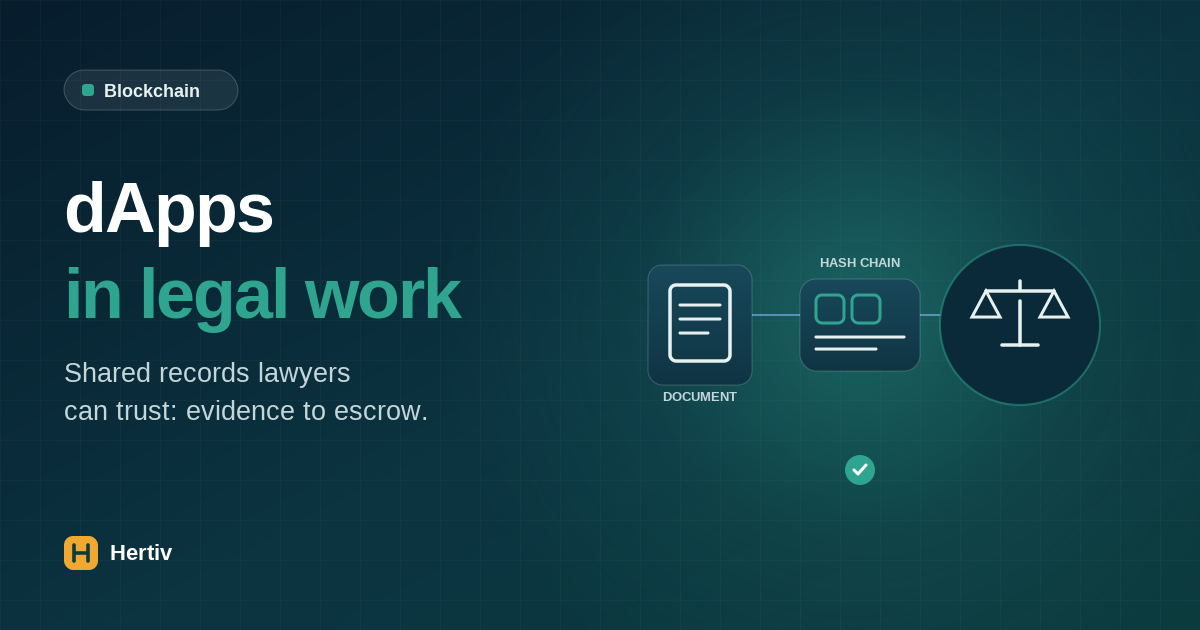
A dApp can record a hash of a document on chain, which proves the document existed at a given time without revealing its contents. Lawyers use this for contracts, evidence and filings where the date matters as much as the text.
The pattern is simple: the document stays off chain, only its hash is stored. Anyone can later check that a document matches the hash, which settles disputes about whether a file was changed or backdated.
Pros:
- Proof is independent of any single company
- Cheap to run once built
- Works across borders
Cons:
- A hash proves existence, not truth
- Courts vary in how they treat it
- Needs a clear process to be useful
2. Smart contract escrow: best for holding funds until conditions are met
An escrow dApp holds funds in a smart contract and releases them only when agreed conditions are met, such as a signed delivery note or an arbitrator's decision. This cuts the need for a third-party escrow agent in smaller deals.
For legal teams, the value is that the rules are written into the contract and visible to all parties. The risk is that a badly written contract cannot be fixed easily, so legal review of the code matters as much as review of the paper agreement.
Pros:
- Rules are visible to all parties
- No escrow agent fees
- Releases happen automatically
Cons:
- Code errors are hard to fix
- Disputes need a human arbitrator
- Regulation is still unclear in places
Property closings and IP licensing
3. Tokenised property closings: best for faster settlement
A dApp can handle the steps of a property closing, from title checks to payment and registration, with each step recorded on chain. The aim is to cut the weeks of waiting between agreement and settlement.
This works best where the land registry already accepts digital records. Where it does not, the dApp can still prepare the paperwork and track the process, even if the final registration stays on paper.
Pros:
- Each step is recorded and visible
- Fewer manual handoffs
- Settlement can be faster
Cons:
- Needs registry support to finish the job
- Title disputes still need courts
- Upfront integration cost
4. IP licensing and royalties: best for tracking who owns what
A dApp can record who owns a piece of intellectual property and who has licensed it, with royalty payments triggered by use. Creators and publishers use this to track rights across many licensees without a central database.
The record is useful because it is shared: a licensee can check the chain of rights before using a work, and a creator can see where their work is licensed. The dApp does not create the rights, but it makes them easier to prove and enforce.
Pros:
- Rights are visible to all parties
- Royalties can be paid automatically
- Reduces disputes over ownership
Cons:
- Does not replace registration
- Licensing terms still need lawyers
- Royalty rules vary by market
Verified credentials and DAO governance
5. Verified credentials: best for checking a lawyer or expert
A dApp can issue and check professional credentials, such as a bar admission or an expert witness qualification, as signed records on chain. A firm hiring an expert can verify the credential without calling the issuing body.
The value is speed and trust: the credential is signed by the issuer and cannot be altered, so a fake certificate is easy to spot. The issuer still controls who gets a credential, so the dApp adds verification, not new authority.
Pros:
- Verification is instant
- Fakes are easy to spot
- No central database to maintain
Cons:
- Issuers must adopt it first
- Revocation needs a clear process
- Privacy rules limit what is shared
6. DAO governance records: best for member decisions
A dApp can run votes and record decisions for a DAO or a member organisation, with each vote tied to a member's token or identity. The record shows who voted, what they voted for, and when, which matters for disputes and audits.
For legal teams advising DAOs, the dApp provides the paper trail that regulators and courts ask for. Without it, decisions made in chat rooms and social channels are hard to prove later.
Pros:
- Decisions are recorded and auditable
- Members can vote from anywhere
- Results are transparent
Cons:
- Legal status of DAOs is unsettled
- Voter turnout is often low
- Smart contract votes are hard to reverse
Dispute records
7. Dispute records: best for keeping an audit trail
A dApp can keep a tamper-resistant record of a dispute: filings, evidence, communications and decisions, each timestamped on chain. This gives both sides and any arbitrator a shared record that neither side can alter after the fact.
The record does not decide the dispute, but it removes arguments about what was filed and when. That alone can shorten proceedings, because the parties spend less time arguing about the record and more time on the substance. Similar record-keeping ideas appear in NFT use cases in legal work.
Pros:
- Records cannot be altered after the fact
- Both sides see the same record
- Shortens arguments about filings
Cons:
- Sensitive material must stay off chain
- Courts may still want paper copies
- Storage costs add up over time
How to choose a dApp use case for your firm
Choose a dApp use case by starting from a record problem, not from the technology. If the problem is that nobody trusts the record, a dApp can help. If the problem is slow paperwork, a better form may be enough. When the contract itself needs building, smart contract development covers the code review side.
- Find a record both sides must trust. Evidence, escrow and dispute records are the strongest candidates.
- Check what the law accepts. Some courts accept on-chain records readily, others need paper as well. Confirm before building.
- Keep sensitive data off chain. Store hashes on chain and documents elsewhere, so privacy rules are not broken.
- Plan for disputes. Decide who arbitrates when the contract or the record is challenged, and write it into the agreement.
- Start with one use case. A single evidence or escrow dApp teaches the firm more than a platform covering five uses at once.
For a broader view of how these uses fit together, see web3 use cases in legal.
If you need the dApp itself built, dApp development covers the design and the smart contract work.
What are the common mistakes?
The most common dApp mistakes in legal work are putting sensitive data on chain, trusting code without legal review, and building a dApp where a database would do. Each one adds cost or risk without adding trust.
- Storing documents on chain. Only hashes belong on chain. Documents stay off chain, or privacy rules and storage costs will break the project.
- Skipping legal review of the code. A smart contract is a legal agreement in code form. A lawyer must review it, not just a developer.
- Building where a database would do. If only one party needs the record, a database is cheaper and faster. A dApp earns its place when several parties must trust the same record.
- Ignoring court acceptance. A record that a court will not accept is useless in a dispute. Check the rules in each market first.
- No plan for upgrades. Smart contracts are hard to change once deployed. Plan upgrades and dispute handling before launch.
Key takeaways
- dApps earn their place in legal work when several parties must trust the same record
- Evidence hashing and escrow are the strongest starting points
- Store only hashes on chain and keep documents and sensitive data off chain
- Smart contracts need legal review, not just developer review
- Check court acceptance in each market before building
Frequently asked questions
What is a dApp in legal work?
A dApp is an application that runs on a blockchain, using smart contracts for its rules and a shared ledger for its records. In legal work it is used for evidence, escrow, licensing, credentials and dispute records.
Are on-chain records accepted in court?
It depends on the market and the judge. Some courts accept on-chain hashes as proof that a document existed at a given time, while others still require paper records. Check the rules where the dispute would be heard.
What is the difference between a dApp and a web app for legal work?
A dApp stores its rules in smart contracts and its records on a shared ledger, so no single party controls them. A web app stores records in a private database controlled by its owner. The dApp is useful when several parties must trust the same record.
Do dApps replace lawyers?
No. A dApp records and enforces agreed rules, but it does not draft agreements, give advice or decide disputes. Lawyers still write the terms, review the code and handle cases that the contract cannot settle.
How much does a legal dApp cost to build?
It depends on scope. A single-purpose evidence or escrow dApp is a small project, while a platform covering several uses costs far more. The legal review of the smart contracts is a significant part of the budget.
Can a dApp store confidential legal documents?
No, not on chain. Documents stay off chain in secure storage, and only their hash is recorded. This keeps the contents private while still proving the document existed at a given time.


