Dapp Startup Ideas Worth Building First
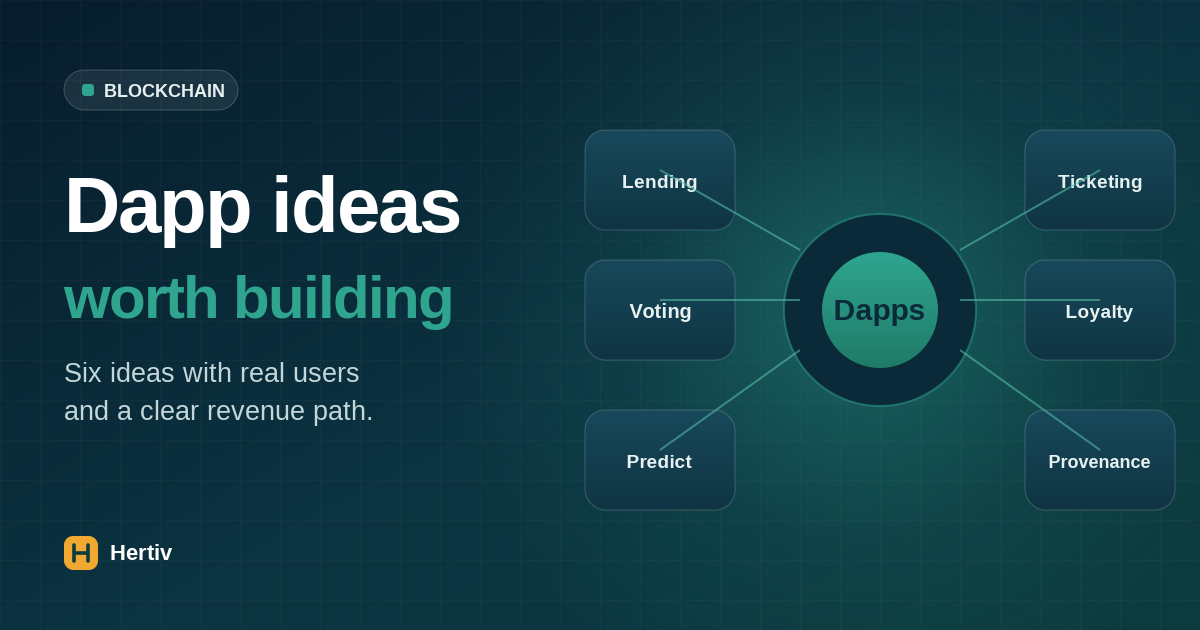
Good dapp startups solve one real problem on-chain: lending, ticketing, voting, loyalty, prediction or provenance. Six ideas worth a first build.
On this page
Short answer
Good dapp startups solve one real problem on-chain, such as lending money, selling tickets, running a vote, rewarding loyal customers, settling a prediction or proving where a product came from. The six ideas below are worth a first build because each one has real users, a clear revenue path and a working example to learn from.
Which dapp startup ideas are worth building first?
The dapp startup ideas worth building first are the ones where the blockchain does work that a normal database cannot: moving value without a middleman, proving ownership, or recording a result that nobody can change later. Ideas that only add a token to an ordinary app rarely survive, because the token adds cost without adding value.
Use the table to shortlist. Each idea below names the users, the on-chain job and the main risk, so a team can compare them before writing code.
| Idea | Who uses it | On-chain job | Main risk |
|---|---|---|---|
| Micro-lending dapp | Small businesses | Loans and repayments | Defaults and rules |
| NFT ticketing dapp | Event organisers | Tickets as NFTs | Low event demand |
| DAO voting dapp | Communities and clubs | Proposals and votes | Low turnout |
| Tokenised loyalty dapp | Shops and cafes | Points as tokens | Points nobody wants |
| Prediction market dapp | Traders and fans | Bets and settlement | Rules and liquidity |
| Provenance dapp | Brands and buyers | Origin records | Getting brands on board |
Start with the idea whose users already pay for a weaker version today. If people pay for the manual version, they will usually pay for a faster on-chain one.
Micro-lending dapp: best for small-business credit
1. Micro-lending dapp: best for small-business credit
A micro-lending dapp lets small businesses borrow small amounts from a pool of lenders, with the loan terms written into a smart contract. Repayments flow back to the pool automatically, and lenders can see every loan and repayment on-chain. The idea fits markets where banks are slow or where small firms cannot get credit at all.
The hard part is not the contract but the credit decision. The team needs a way to judge who is likely to repay, such as sales history, invoices or a local partner that knows the borrowers. A dapp that lends to anyone will lose its pool fast.
- Pros: real demand, clear fees, on-chain transparency builds trust.
- Cons: defaults hurt lenders, rules differ by country.
2. NFT ticketing dapp: best for events that fight scalping
An NFT ticketing dapp sells event tickets as NFTs. Each ticket is unique, the organiser can set a maximum resale price in the contract, and the ticket can carry perks such as backstage access or a discount on the next event. Fans can prove the ticket is real by checking the chain, which cuts fraud.
The idea works best for organisers who already sell out events and lose money to resellers. It works worst for small events where the audience does not use wallets. The team should start with one organiser and one venue rather than building a marketplace first. For how dapps differ from ordinary apps, see what a dapp is.
- Pros: stops fake tickets, resale rules built in, tickets can carry perks.
- Cons: needs wallet-friendly fans, small events may not need it.
DAO voting dapp: best for communities that decide together
3. DAO voting dapp: best for communities that decide together
A DAO voting dapp lets a community propose ideas, discuss them and vote on-chain, with the result recorded where nobody can change it. Clubs, creator groups, open-source projects and local funds all make decisions that are easy to argue about later, and an on-chain record settles those arguments.
The main risk is turnout. Many DAOs find that only a small group votes, so the result reflects the active few rather than the whole community. A good voting dapp makes voting easy, shows the proposal in plain language, and lets members delegate their vote to someone they trust.
- Pros: transparent results, easy to audit, works for many group types.
- Cons: low turnout is common, delegation needs careful design.
4. Tokenised loyalty dapp: best for shops that want repeat customers
A tokenised loyalty dapp gives customers tokens instead of points. The tokens live in the customer's wallet, can be used at any shop in the programme, and can carry perks such as early access or a discount. Shops join because the tokens bring customers back, and customers keep them because the tokens have real value.
The idea fails when the tokens are worth too little to matter. A loyalty token that buys nothing will not change behaviour, no matter how clever the contract is. The team should agree with a few shops first on what a token buys, then build the dapp around that promise.
- Pros: tokens work across shops, customers own their rewards, easy to track.
- Cons: tokens need real value, needs several shops to join early.
Prediction market dapp: best for settling open questions
5. Prediction market dapp: best for settling open questions
A prediction market dapp lets people bet on the outcome of an event, such as an election, a sports match or a product launch, with the contract paying out to the winners when the result is known. The market price becomes a live forecast that is often more accurate than a poll, because people put money behind their view.
The rules are the hard part. Prediction markets are treated as gambling in many countries, so the team must check the law before building, and the market needs enough traders to set a fair price. A market with five traders tells the team nothing. For dapps that already work in production, see the top blockchain dapps.
- Pros: prices act as forecasts, settlement is automatic, clear fees.
- Cons: gambling rules apply in many places, needs liquidity to work.
6. Provenance dapp: best for brands that prove origin
A provenance dapp records each step of a product's journey on-chain, from raw material to shop shelf. A buyer scans a code and sees where the product came from, who handled it and whether the claims on the label are backed by a record. Luxury goods, food and medicine are the strongest cases, because buyers already pay more for proof.
The hard part is getting the first brands on board. A provenance record is only useful if the producer, the shipper and the seller all add their data, and each one needs a reason to do so. The team should start with one product line and one brand that already markets its origin.
- Pros: strong case for luxury and food, buyers pay for proof, hard to fake.
- Cons: needs every party to add data, slow to start.
How to choose a dapp startup idea
Choosing a dapp startup idea comes down to three checks: do users already pay for a weaker version, does the chain do work a database cannot, and can the team reach the first ten users? An idea that passes all three is worth building. An idea that fails one is worth dropping.
- Find users who already pay. Talk to ten people who pay for the manual version today and ask what it costs them.
- Check the on-chain job. Name the exact thing the chain does: moves value, proves ownership, or records a result. If the list is empty, the idea does not need a chain.
- Price the first version. Sketch the smallest build that serves ten users and price it in developer weeks, not months.
- Check the rules early. Ask a lawyer whether the idea touches lending, gambling or securities law before writing code.
- Test with one partner. Sign one organiser, shop or brand before building the full product, and build what they need first.
A team that follows these steps spends its first month talking to users and lawyers, not writing contracts. That month saves the team from building a dapp nobody can legally use. For how to build the dapp itself, see how to create web3 dapps.
What are the common mistakes?
The most common mistake is building the token before the product. Teams mint a token, write a whitepaper and build a community, then discover that nobody wants the app the token was for. A dapp should work without a token first; the token should only be added when it makes the product better.
Another mistake is copying a famous dapp instead of serving a real user. A team that clones a lending protocol for a market with no borrowers has a working product and no business. The chain is a tool, not a market.
Teams also underestimate the rules. Lending, prediction and token sales are regulated in most countries, and a dapp that ignores the rules can be shut down after launch. A short legal check before building costs far less than a rebuild after a regulator's letter.
Key takeaways
- Pick an idea where users already pay for a weaker version.
- The chain must do work a database cannot: move value, prove ownership, record results.
- Start with one partner, not a marketplace.
- Check lending, gambling and securities rules before building.
- Build the product first; add a token only if it makes the product better.
Frequently asked questions
What is a dapp startup?
A dapp startup is a company that builds a decentralised application: an app whose core logic runs on a blockchain through smart contracts, rather than on a single company's servers. Users interact with it through a wallet instead of an account.
How much does it cost to build a dapp?
The cost depends on the contracts, the front end and the audit. A simple dapp can take a few months of work by a small team, while a lending or exchange dapp needs more time and a security audit. Prices vary, so check the vendor site for audit and development rates.
Do dapp startups need a token?
No. Many working dapps run without a token and charge fees in a stablecoin or the chain's native token. A token only helps when it gives users a real benefit, such as voting rights or shared revenue, and it adds legal work.
How do dapp startups make money?
Most charge a fee on each transaction, such as a share of a swap, a loan or a ticket sale. Some charge a subscription or take a cut of marketplace sales. The fee must be small enough that users stay, and large enough to cover the team's costs.
What is the biggest risk for a dapp startup?
The biggest risk is building something nobody uses, followed closely by the rules. Lending, prediction and token sales are regulated in most countries, so a team should check the law and talk to real users before writing code.
Should a dapp startup launch on one chain or many?
One chain first. Each extra chain adds testing, monitoring and support work. A team should prove the idea on one chain, then expand to others once users ask for it and the economics work.


