dApp Development Companies for Startups: 6 to Shortlist
Shortlisting a dApp development company for your startup? Compare six firms on what they build, how they work and what to ask before you sign.
On this page
Short answer
The best dApp development companies for startups combine smart contract work, wallet and front-end skills, and experience shipping small products on a tight budget. The six firms below are established names that work with early-stage teams. Compare them on the chains they support, the size of project they take on, and how they handle audits, then shortlist two or three for a call.
Which dApp development companies should startups shortlist?
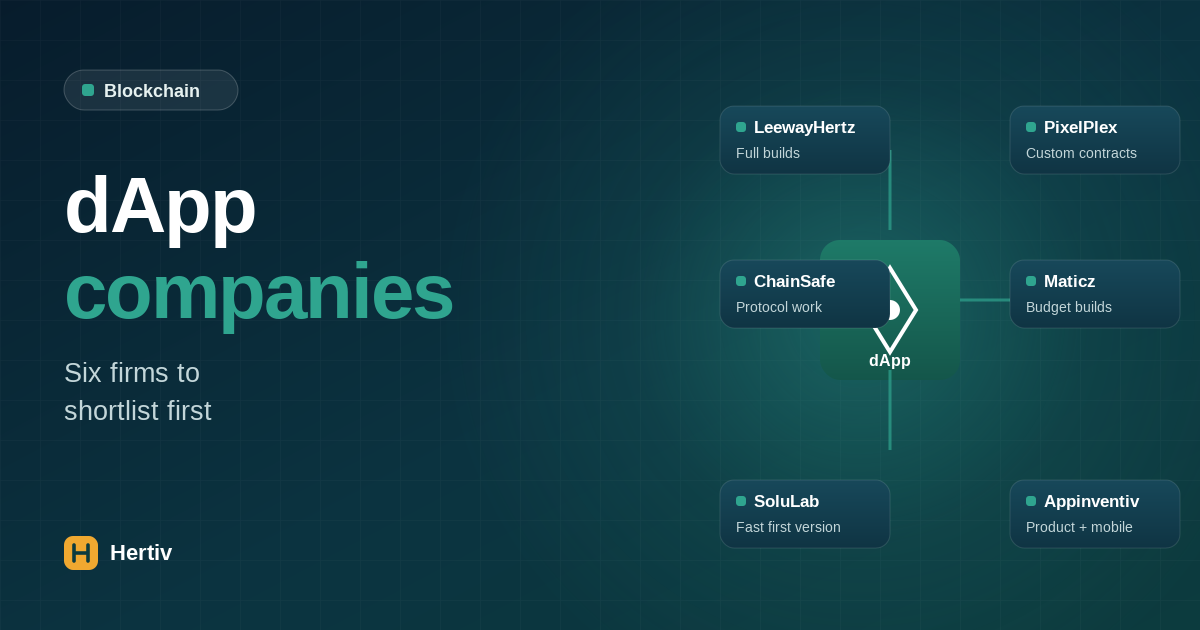
Startups need a dApp partner that can ship a small working product, not a year-long enterprise programme. The six firms below are established development companies that take on early-stage work, from the first smart contract to a live app with users.
| Company | Best for | Chains | Team size |
|---|---|---|---|
| LeewayHertz | Full product builds | Ethereum, Polygon, Solana | Mid-size |
| SoluLab | Fast first versions | Ethereum, BNB Chain, Polygon | Mid-size |
| PixelPlex | Custom contracts and apps | Ethereum, Hyperledger, Solana | Mid-size |
| Appinventiv | Product plus mobile apps | Ethereum, Polygon, Solana | Large |
| ChainSafe | Protocol-level work | Ethereum, Polkadot, Filecoin | Mid-size |
| Maticz | Budget-friendly builds | Ethereum, Polygon, BNB Chain | Small to mid-size |
Team size matters for a startup. A mid-size firm usually gives you a named team and a direct line to the developers, while a large firm may move slower and cost more. Ask every firm for a recent startup project, the team that will work on yours, and what happens after launch.
1. LeewayHertz: best for full product builds
1. LeewayHertz: best for full product builds
LeewayHertz is a development company that builds dApps end to end, from the smart contract to the front end and the wallet connection. It suits a startup that wants one team to own the whole product, rather than splitting the work across several vendors.
Its work covers token platforms, DeFi products and enterprise blockchain apps, and it supports the main chains a startup is likely to choose. Ask for a recent startup build, the chain it used, and how the audit was handled before you sign.
Pros:
- One team for contracts, front end and wallets
- Experience across several chains
- Clear project process for early-stage teams
Cons:
- Full builds cost more than a contract-only job
- Smaller projects may wait for a team slot
2. SoluLab: best for fast first versions
2. SoluLab: best for fast first versions
SoluLab is a development company that focuses on getting a first version live quickly. It suits a startup that needs to test an idea with real users before spending on a full build.
Its dApp work covers DeFi, NFT platforms and token projects, and it works with the chains most startups pick first. Ask how the first version is scoped, what is left out, and what the second phase would cost.
Pros:
- Fast first versions for testing ideas
- Clear scoping for small budgets
- Experience with DeFi and NFT products
Cons:
- Less suited to protocol-level research work
- Post-launch support needs a separate agreement
3. PixelPlex: best for custom contracts and apps
3. PixelPlex: best for custom contracts and apps
PixelPlex is a development company that builds custom smart contracts and the apps around them. It suits a startup whose product needs contract logic that an off-the-shelf template cannot cover.
Its work includes DeFi, tokenisation and enterprise blockchain, and it has built on Ethereum, Hyperledger and Solana. Ask to see a contract it wrote for a product like yours, and who reviews the code before it ships.
Pros:
- Strong custom contract work
- Experience across chains and enterprise projects
- Design and front-end work in house
Cons:
- Custom work takes longer than a template build
- Pricing is higher than a small-shop build
4. Appinventiv: best for product plus mobile apps
4. Appinventiv: best for product plus mobile apps
Appinventiv is a large development company that builds dApps alongside mobile and web apps. It suits a startup whose dApp is part of a bigger product, such as a wallet app or a marketplace with a phone app.
Its blockchain work covers DeFi, wallets and token platforms, and it has large product teams for the mobile side. Ask which team will work on your project, and whether the blockchain developers are in house.
Pros:
- Large teams for product and mobile work
- Experience shipping consumer apps
- Structured process for bigger builds
Cons:
- Higher cost than a specialist small firm
- Small projects may get less senior attention
5. ChainSafe: best for protocol-level work
5. ChainSafe: best for protocol-level work
ChainSafe is a development company known for protocol and infrastructure work, including clients and bridges for major networks. It suits a startup building close to the chain itself, rather than a simple app on top of it.
Its work covers Ethereum, Polkadot and Filecoin, and it contributes to open-source protocol projects. Ask whether your product needs protocol-level work at all; if it does not, a product-focused firm may be a better fit.
Pros:
- Deep protocol and infrastructure skill
- Open-source contributions you can check
- Strong security culture
Cons:
- Less focused on consumer product design
- May be more than a simple dApp needs
6. Maticz: best for budget-friendly builds
6. Maticz: best for budget-friendly builds
Maticz is a development company that builds dApps, DeFi products and NFT platforms at lower price points than the larger firms. It suits a startup with a tight budget that still needs a working product, not just a demo.
Its work covers the main chains and common dApp types, including exchanges, marketplaces and games. Ask for a fixed scope and a recent live product, and check who handles the audit before you agree a price.
Pros:
- Lower prices than larger firms
- Wide range of dApp types built
- Fast turnaround on standard builds
Cons:
- Less depth on unusual contract logic
- Check audit and support terms carefully
How to choose a dApp development company
Choose a dApp development company in five steps, and keep the comparison on paper so the decision is based on evidence, not on the smoothest sales call.
- List your must-haves. Write down the chain, the contract features, the wallet support and the launch date before you talk to anyone.
- Check live work. Ask each firm for two live dApps it built, and use them yourself. A firm with no live product to show is a warning sign.
- Ask about the audit. Every contract that holds user funds needs an independent audit. Ask who does it, when, and who pays.
- Meet the team. Ask who will actually write your contracts, how senior they are, and whether they stay on the project to launch.
- Compare the full cost. Add the build, the audit, the launch and three months of support, then compare the totals, not the headline build price.
Price is only one part of the choice. A cheap build that fails its audit or ships late costs more than a fair-priced build that launches on time. If you are unsure what your product needs, read what a dApp is before you shortlist.
For the selection itself, how to choose a dApp development company walks through the same checks in more detail, including the questions to ask on the first call.
What are the common mistakes?
The most common mistakes are picking on price alone, skipping the audit, and signing before the scope is fixed.
- Choosing the cheapest quote. A low price often means a template build, junior developers or no audit included.
- Skipping the audit. A contract that holds user funds without an independent audit is a risk no startup should take.
- Vague scope. If the scope is not written down, the price will grow. Fix the features, the chain and the launch date in the contract.
- No post-launch plan. Contracts need monitoring and fixes after launch. Agree who watches them and for how long.
- Ignoring the front end. Users judge the app, not the contract. Budget for design, wallets and testing on real devices.
Start with your must-haves, check live work, and ask about the audit before you talk price. A short dApp development review can help you write the brief your shortlist will be judged against.
Key takeaways
- Shortlist firms on the chains they support, live work and audit handling
- LeewayHertz and PixelPlex suit full custom builds; SoluLab and Maticz suit fast, budget-friendly first versions
- ChainSafe suits protocol-level work; Appinventiv suits dApps that need a mobile app too
- Compare the full cost, including the audit, launch and three months of support
- Use each firm's live products yourself before you sign
Frequently asked questions
What does a dApp development company do?
A dApp development company builds decentralised applications, which run on a blockchain instead of a single company's server. Its work usually covers the smart contracts, the front end, the wallet connection and the launch, and it should also arrange an independent audit of any contract that holds user funds.
How much does it cost to build a dApp?
Costs vary widely by scope, chain and team, so there is no single price. A simple first version costs far less than a full DeFi product with audits and mobile apps. Ask each firm for a fixed scope and a total that includes the build, the audit, the launch and three months of support.
Do startups need a smart contract audit?
Yes, if the contract holds user funds or controls access to value. An audit is an independent review that looks for bugs and security flaws before launch. A firm that suggests skipping the audit to save money is a warning sign.
Which blockchain should a startup build its dApp on?
It depends on your users, your costs and the tools your team knows. Ethereum has the largest developer community, while Polygon, Solana and BNB Chain are common choices for lower fees and faster transactions. Choose the chain that fits your product, not the one that is most talked about.
How long does it take to build a dApp?
A simple first version can take a few weeks, while a full product with audits, wallets and mobile apps usually takes several months. The timeline depends on the contract logic, the design work and how long the audit takes, so ask each firm for a dated plan before you sign.
What should I ask a dApp development company first?
Ask for two live dApps it built, the team that will work on your project, how the audit is handled, and the full cost including launch and support. Then use its live products yourself and compare the answers across your shortlist.


