dApp Best Practices: Build and Run Without Costly Mistakes
Good dApps fail less often because their teams plan the contract, the keys and the upgrade path before launch. These practices cover the decisions that matter most.
On this page
Short answer
dApp best practices are the working habits that keep a decentralised app safe and usable: small audited contracts, clear key rules, tested upgrades, honest gas costs and a plan for when something goes wrong. They matter because a deployed contract is hard to change, and a mistake can lock user funds. The list below covers design, security, testing, launch and upkeep.
What are dApp best practices?
dApp best practices are the working habits that keep a decentralised app safe, usable and easy to fix. They cover how the contract is written, how keys and access are handled, how the app is tested, and what happens when something breaks after launch.
They matter more for dApps than for normal web apps because a deployed contract is hard to change. A bug in a normal app can be fixed with a quick deploy; a bug in a contract may need a migration, a vote or a new contract, and user funds can be stuck in between.
| Area | Practice | Why it matters |
|---|---|---|
| Design | Keep contracts small and simple | Less code means fewer bugs to hide |
| Security | Limit who can call admin functions | Stops one stolen key from draining funds |
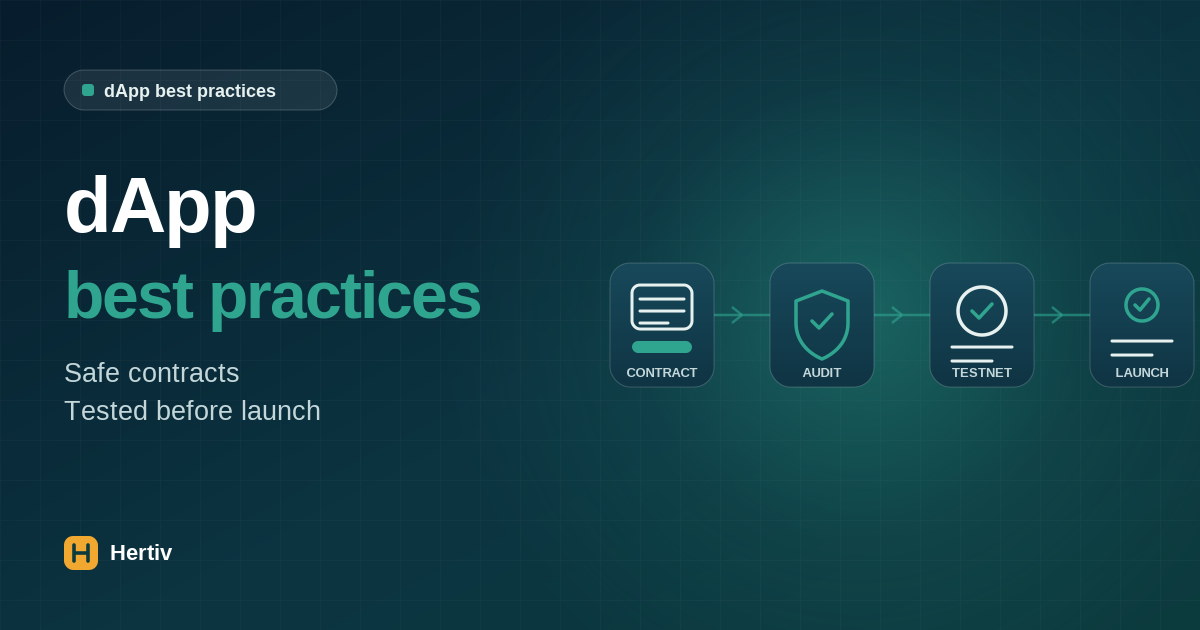
| Testing | Test on a testnet, then audit | Catches bugs before real money is at risk |
| Launch | Set honest gas limits and fees | Users leave when a simple action costs too much |
| Upkeep | Plan upgrades and pauses in advance | A known plan beats a panic fix |
If you are new to the topic, start with what a dApp is before reading the practices below.
Keep contracts small and simple
A contract should do one job well. Split a large app into small contracts that each handle one thing, such as holding tokens, recording votes or paying out rewards. Small contracts are easier to read, easier to test and easier to audit, and a bug in one part does less damage to the rest.
Resist the urge to add features to the contract that belong in the front end. Price displays, sorting and search are interface work; the contract should only store what must be on-chain and enforce the rules that must be trusted. Every line in the contract is a line that can hold a bug, so each one should earn its place.
Use well-known, audited code for standard parts instead of writing your own. Token standards, access control and safe transfer patterns have been tested by thousands of projects. Writing a custom version of a solved problem is the most common way a new dApp introduces a serious bug.
Protect keys and access from day one
Decide who holds the admin keys before the contract is deployed. A single key held by one person is a single point of failure: if it is lost, the app cannot be fixed, and if it is stolen, the thief controls the app. Use a multi-signature wallet so that two or more people must agree before an admin action runs.
Limit what admin functions can do. An admin key should be able to pause the contract or fix a parameter, but it should not be able to move user funds to a new address. Write those limits into the contract itself, not just into a team policy, so they hold even if a key is misused.
Keep deployment keys off shared machines and out of chat logs. Use a hardware wallet for admin actions, rotate keys when a team member leaves, and test the recovery process before launch. A team that has never tried to recover its keys will discover the gaps at the worst possible moment.
Test on a testnet and audit before launch
Run the full app on a testnet with real users before any real money is involved. A testnet run finds problems that unit tests miss: gas costs that are higher than expected, buttons that fail on slow networks, and steps that confuse users. Invite a small group of outside users and watch where they get stuck.
Get an independent audit for any contract that holds user funds. An audit does not prove the code is perfect, but a second pair of expert eyes finds the bugs the team has read past a dozen times. Fix every high-severity finding before launch, and publish the audit so users can judge the risk for themselves.
Test the failure paths, not just the happy path. Try a failed payment, a rejected transaction and a network outage, and check that the app shows a clear message instead of freezing. For the build steps that lead up to testing, see how dApp development works.
Plan upgrades and emergencies in advance
Decide how the contract can be changed before it is deployed. Some teams use a proxy contract that points to new code, some use a time-locked vote, and some accept that the contract cannot change at all. Each choice has a cost, and the wrong one is found out only when a fix is urgent.
Write a pause plan. The contract should have a way to stop new deposits or trades if a bug is found, and the team should know who can trigger it and how fast. A pause that takes a day to arrange is barely better than no pause at all.
Keep a simple runbook for the first month after launch. It should list the contract addresses, the key holders, the monitoring alerts and the steps for a pause, an upgrade and a user refund. A new team member should be able to follow it without asking anyone. Trends change fast, so check dApp development trends when you plan the next version.
Example (hypothetical): a token-swap dApp catches a bug before launch
Example (hypothetical): a team builds a small token-swap dApp and runs it on a testnet with 50 outside users. An auditor finds a rounding bug that lets a trader drain a small amount on every tenth swap. Fixing it before launch takes the team 3 days of work.
If the bug had gone live, the fix would have needed a contract migration. Moving 2,000 users to a new contract, with 10 minutes of support time per user, would take 20,000 minutes, or about 333 hours of support work. That is more than two months of one person's full-time work, plus the lost funds and the lost trust.
The testnet run and the audit cost the team two weeks. The migration would have cost far more, and the bug would have been public. The lesson is that testing time is cheap compared with fixing a live contract that holds user funds.
Common mistakes
The most common mistake is copying a contract from another project without reading it. Code that worked for one app may hold assumptions that do not fit yours, such as a fee rate, a time limit or an admin address. Read every line you deploy, and test it against your own use cases.
Another mistake is hiding the gas cost from users. If a simple action costs more than the user expects, they will leave and not come back. Show the fee before the user confirms, and design the app so the common actions stay cheap.
Finally, teams often launch without a support plan. Users will lose keys, send funds to the wrong address and hit failed transactions. A short help page and a way to contact the team will not fix those problems, but it will stop a small problem from becoming a public complaint.
Key takeaways
- Keep contracts small: one job per contract, standard code for standard parts.
- Admin keys need multi-signature control and limits written into the contract.
- Test on a testnet with real users, then audit any contract that holds funds.
- Plan upgrades, pauses and refunds before launch, not during a crisis.
- Testing time is cheap compared with migrating a live contract.
Frequently asked questions
What is the first best practice for a new dApp?
Start with a small contract that does one job well. Split a large app into small contracts, use audited code for standard parts, and keep interface work out of the contract. Small contracts are easier to read, test and audit than one large contract.
Do all dApps need an audit?
Any contract that holds user funds should be audited by an independent reviewer before launch. A contract that holds no funds and cannot move money still benefits from a review, but the risk is lower and a careful testnet run may be enough.
How many keys should control a dApp?
At least two people should approve admin actions, using a multi-signature wallet. A single key is a single point of failure: if it is lost the app cannot be fixed, and if it is stolen the thief controls the app.
What is a proxy contract?
A proxy contract is a fixed address that points to the current version of the code, so the team can deploy a fix without changing the address users call. It adds trust questions, because someone must control the pointer, so the rules for changing it should be public.
How do you keep gas costs low for users?
Keep the common actions simple, store as little as possible on-chain, and batch work where it makes sense. Show the fee before the user confirms, and test the cost on a testnet so there are no surprises at launch.
What should a dApp runbook contain?
The contract addresses, the key holders, the monitoring alerts and the steps for a pause, an upgrade and a user refund. A new team member should be able to follow it without asking anyone, even during an incident.


