Custom MLOps Platforms for Enterprises: Build or Buy?
A custom MLOps platform is a set of tools a large company builds to train, deploy and watch its models under its own rules. Here is when it pays off.
On this page
Short answer
A custom MLOps platform is a set of tools and processes a large company builds or assembles to train, deploy, monitor and retrain its machine learning models under its own rules. Instead of relying on one vendor's managed service, the company picks the pieces that fit its data, security and compliance needs and runs them on its own infrastructure.
What is a custom MLOps platform?
A custom MLOps platform is the in-house system a company uses to move a model from an experiment to a service that runs in production, and to keep it working over time. It covers data and feature pipelines, experiment tracking, model packaging, deployment, monitoring and retraining. The 'custom' part means the pieces are chosen and wired together by the company, rather than bought as one managed product.
Enterprises build one when the standard products do not fit. Common reasons are strict data rules, models that must run in a private cloud or on premises, unusual hardware, or a need to connect to systems that a managed service cannot reach. A bank that cannot send customer data to a shared cloud, or a factory that runs models on edge devices, will often build its own platform.
The platform is not one tool. It is a set of parts with clear owners: who runs the feature store, who approves a model for release, who watches it in production. For how teams compare ready-made options, see the best MLOps platforms for startups.
Why do enterprises build their own?
Enterprises build their own MLOps platform when control matters more than convenience. A managed service is faster to start, but the company gives up control over where data lives, which model versions run, and how changes are approved. For regulated industries, that control is not optional.
Three drivers appear most often. First, data rules: customer or patient data may have to stay inside a specific region or network. Second, integration: the platform must connect to internal systems, such as a data warehouse or an identity service, that a vendor cannot reach. Third, scale and cost: at very high volumes, running your own serving layer can cost less than paying per request.
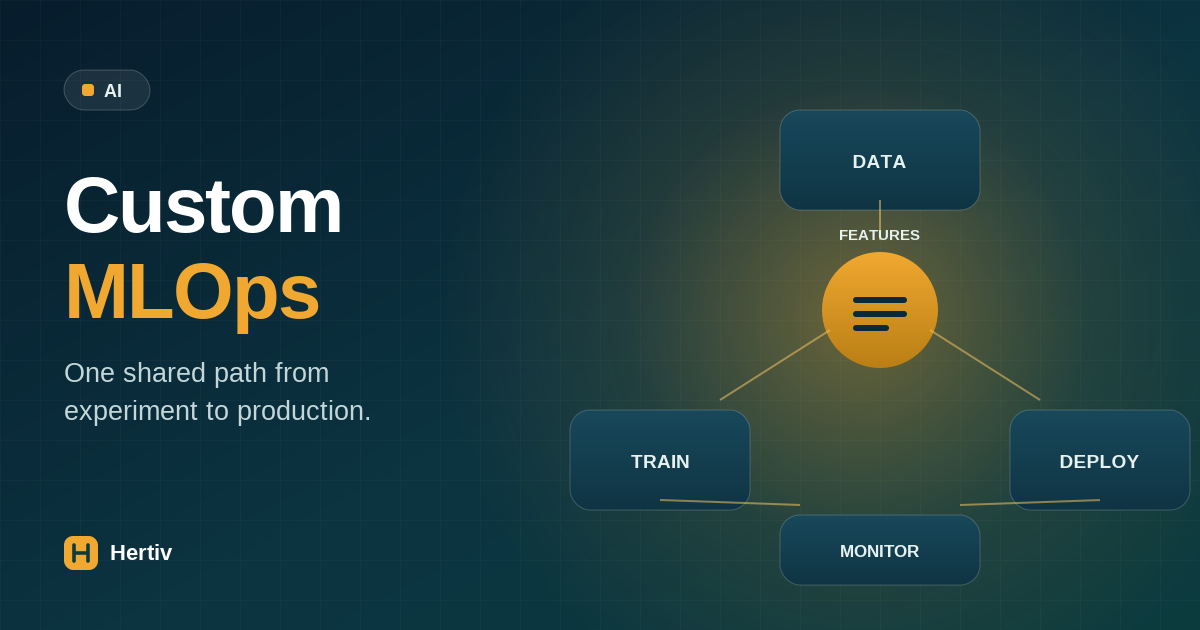
There is also a team argument. A company with many model teams wants one shared way to ship models, so each team does not invent its own. A custom platform gives that shared path, with the company's own checks built in.
Build, buy or extend: what fits?
The choice is rarely build everything or buy everything. Most enterprises mix: they buy or adopt open tools for the standard parts and build only the parts that are specific to them. The table below shows the usual trade-offs.
| Approach | Upfront effort | Control | Best when |
|---|---|---|---|
| Buy a managed service | Low | Low | Speed matters and rules allow it |
| Adopt open tools | Medium | Medium | Team runs its own cloud already |
| Build a custom platform | High | High | Strict rules or special hardware |
| Extend a managed service | Medium | Medium | Mostly fits, one gap to close |
A useful rule is to build only what makes the company different. Model serving, tracking and monitoring are solved problems with good open tools. The parts worth building are the ones tied to the company's own data, approvals and audit needs.
What must the platform cover?
A custom MLOps platform must cover the full life of a model, from data to retirement. If any stage is missing, teams work around the platform and the shared path breaks down.
- Data and features. Versioned datasets and a feature store, so training and serving use the same inputs.
- Experiment tracking. A record of every run, its data, its parameters and its results.
- Model registry. One list of model versions, with approval states and a clear owner per version.
- Deployment. A standard way to ship a model behind an API, with rollbacks and traffic splits.
- Monitoring. Tracking of input drift, output quality and cost, with alerts when a model degrades.
- Retraining. A scheduled or triggered path to retrain on fresh data and re-approve the new version.
Governance sits across all of these: who approves a model, what tests it must pass, and what is logged for audit. For a practical build sequence, see how to build an MLOps pipeline.
Example (hypothetical): a bank builds its own platform
Example (hypothetical): a bank runs 12 models, from fraud scoring to document checks. Customer data must stay inside the bank's private cloud, and each model release needs sign-off from risk and compliance. A managed service cannot meet those rules, so the bank builds a custom platform.
The platform team starts with 3 people and a simple scope: one feature store, one model registry and one deployment path. In the first year, 8 of the 12 models move onto the platform. Each release now takes 2 days instead of 3 weeks, because the checks are automated and the approval trail is built in.
The cost is real: the platform team grows to 5 people, and the bank pays for the servers. The bank accepts that because the alternative is 12 separate release paths, each with its own gaps. The platform pays for itself when the third team stops building its own tooling and uses the shared path instead.
What are the common mistakes?
The most common custom MLOps mistakes are building too much too soon, skipping the approval path, and measuring the platform by features instead of by teams using it.
- Building everything at once. A platform that tries to cover every team on day one ships late and fits nobody. Start with one team and one model.
- No approval path. If the platform cannot record who approved a model and why, regulated teams cannot use it.
- Ignoring training data. A platform that versions models but not data cannot reproduce a result when something goes wrong.
- Skipping monitoring. Models degrade quietly. Without drift and quality alerts, nobody notices until customers do.
- Measuring features, not use. Success is the number of teams shipping on the platform, not the number of tools it contains.
How should an enterprise start?
An enterprise should start a custom MLOps platform with one team, one model and the smallest set of parts that removes that team's biggest pain.
- Pick one model team. Choose a team that ships often and feels the release pain. Their needs define the first version.
- Map the current release path. Write down each step from experiment to production, and mark the steps that are slow or manual.
- Build the missing parts only. Adopt open tools for tracking and serving, and build only the approval and audit pieces that are specific to the company.
- Ship one model end to end. Get a single model from experiment to production on the new path, with monitoring switched on.
- Add the next team. Once the first team ships faster, bring in the next team and fix the gaps they find.
For teams that need help scoping this work, MLOps consulting can map the current release path and the smallest platform that fixes it.
Key takeaways
- A custom MLOps platform is the in-house path from experiment to production
- Enterprises build one when data rules, integration or scale block a managed service
- Build only what is specific to the company; adopt open tools for the rest
- Cover data, tracking, registry, deployment, monitoring and retraining
- Start with one team and one model, and measure success by teams shipping on it
Frequently asked questions
What is the difference between MLOps and a custom MLOps platform?
MLOps is the practice of shipping and running machine learning models reliably. A custom MLOps platform is the in-house system a company builds to do that under its own rules: its own data stores, approval steps and infrastructure, instead of a vendor's managed service.
How much does a custom MLOps platform cost?
It depends on scope and team size. A first version for one team can be built by a small platform team over a few months, using open tools for most parts. The ongoing cost is the platform team and the infrastructure. Costs stay low when the team builds only what is specific to the company.
When should an enterprise not build its own platform?
When a managed service meets the data rules and the team is small, buying is usually faster and cheaper. Building makes sense when rules, integration or scale block the managed option, or when many teams need one shared release path that no vendor provides.
Which open tools fit inside a custom platform?
Common choices are MLflow for tracking and the model registry, Kubeflow or Airflow for pipelines, and BentoML, KServe or Seldon Core for serving. The exact mix depends on the team's cloud and the parts they already run. Pick tools the team can operate, not the most popular ones.
How long until a custom platform pays off?
Most teams see the first payoff when the second model team stops building its own release path and uses the shared one. That usually takes several months. If after a year only the platform team uses it, the scope was wrong and the team should refocus on one model team's release pain.
Who should own a custom MLOps platform?
A small platform team owns the shared parts, such as the registry, deployment path and monitoring. Model teams own their models, data and tests. The split works when the platform team treats model teams as customers and measures success by how many teams ship on the platform.


